Malcolm Averitt
Fictional. Generated by AI — not a real person, and no likeness of one is intended.
32, financial advisor in New York · rolled by @klaus.dietermann · card — no film
History
who has worn him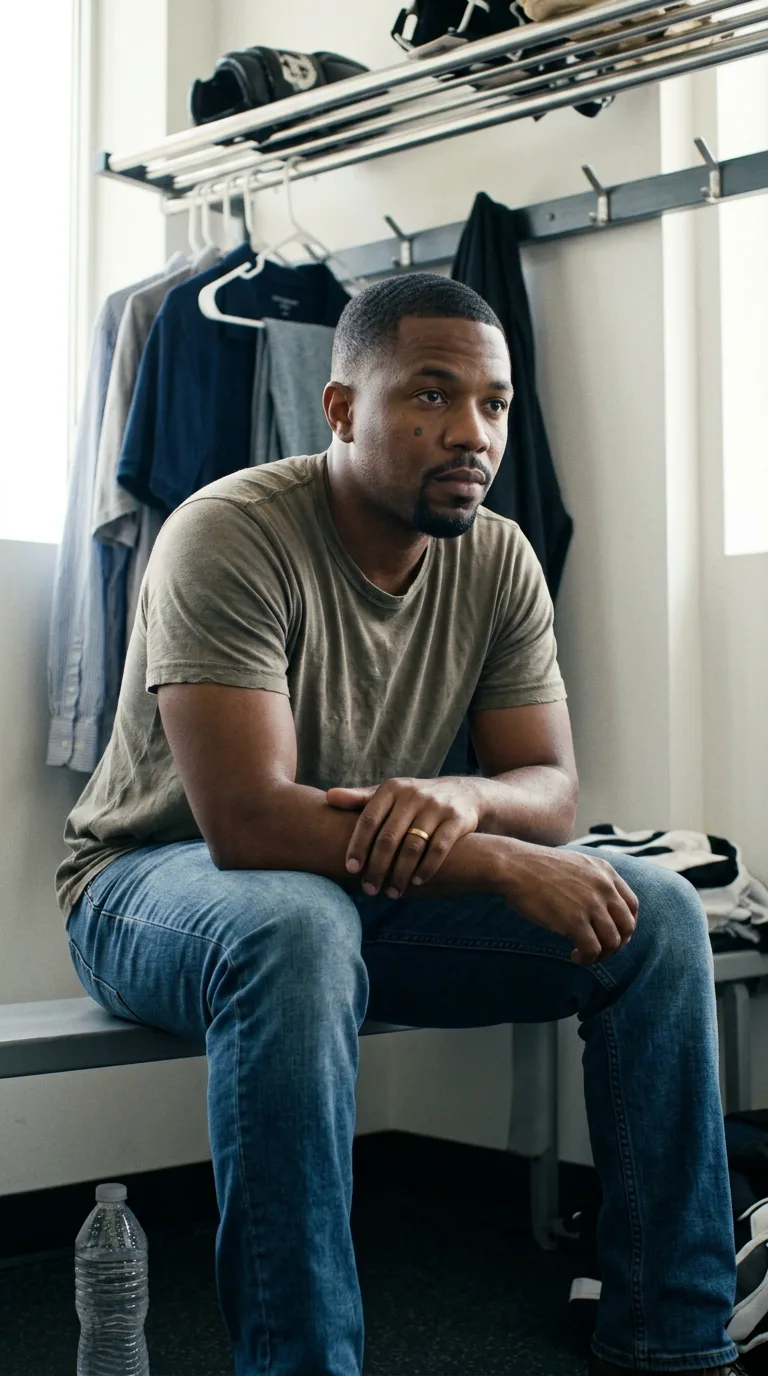
Rarest thing about him: Financial advisor — common, 1 in 176
Season 1seed 83648553 · engine v11
Character card
lineage KEPHG1
His body-swap story
@klaus.dietermann, wearing Colby Marchetti, rolled the wheel on and woke up as Malcolm Averitt, spent 2 minutes in him, then spun the wheel and woke up as Gregory Alsept
Colby Marchetti's hands are wrong. That's the first thing, the only thing, standing in a stamping line in New Orleans with a shift bell already ringing in your skull like a headache that came pre-installed. One minute in this body and you already know its whole complaint: the eyebrow scar that pulls when he squints, the ringing in the left ear from ten years of machine noise, the ache low in the back that will be there at forty and fifty and however long Colby Marchetti was supposed to get. You didn't even unpack him. You stood in his boots for sixty seconds, felt the floor shake with the press cycling, and thought: no. Not this one. Not today. You want out before the shift foreman even says your name — his name — and you go straight for your phone, thumb clumsy in his big fingers, and open the site you have open more than you'd ever admit to anyone with a face of their own to lose.
Vessel.cards. The wheel loads the way it always loads, unbothered, elegant, a soft chime like a slot machine designed by people who've never needed money. You pay. You spin. Somewhere a light turns and a name comes up that means nothing to you yet, and the world does the thing it does — no countdown, no doorway, no in-between.
You are sitting on a bench under a coat rack, and your forearms are on your knees, and there is a wedding band pressing a thin cold line into a finger that used to belong to somebody named Colby. Your shirt is damp between your shoulder blades. A water bottle sweats on the floor by your foot, half-crushed where a hand — his hand, now yours — squeezed it out of habit between sets. Your mouth is open, teeth still shaped around a breath you were blowing out slow, and it just stops, a half-second early, like a tape cut clean. The next breath you take is the first one that's actually yours.
The bar is two inches wider in your grip than it was a rep ago — nobody told your hands that, they just knew, some instinct that isn't instinct at all, just you learning a new width for a new frame — and you finish the set anyway, slow, controlled, because the body under you is already moving before you've caught up to owning it. Your face does not do what a last rep face does. It doesn't strain. It's blank in a way that would look wrong to anyone watching closely, but nobody in this gym is watching closely, and that's the whole mercy of a Monday at this hour.
Then the memories start coming, and they come through his hands, through the bar, through the sweat-slick grip tape, through the cotton of the shirt already stuck to your back.
The bar first: gray steel, worn smooth in two eleven-inch bands where a thousand grips have been. Malcolm's hands know this bar. Not this exact one — the gym's — but the feeling of it, the particular chalk-and-iron smell that comes rushing up along with an afternoon three years back, his first real client win, a woman named Deborah who didn't trust banks and trusted him instead, and the feeling of writing her name on a folder afterward, proud in a way that had nothing to do with the commission.
The shirt sleeve, damp cotton against your triceps, gives you the morning it went on — not this morning, some other one, a hundred mornings folded into one memory the way worn cloth remembers a shape. Standing in a bedroom with gray light coming through blinds, buttoning a checked shirt one-handed while his wife, Renata, laughed at him for still doing his cufflinks wrong after eight years married, took his wrist and did them herself, unhurried, her thumb brushing his pulse point in a way that had nothing to do with cufflinks either. That's a good one. You let it run a beat longer than it needs to. Marriage looks like this from inside it — small, competent, unglamorous, a woman's hands finishing what his hands started.
The water bottle at your foot, when your fingers brush it reaching down out of old habit: gym, gym, always the gym, twice a week before work because sitting across a desk from other people's fear all day does something to a spine that only iron fixes. A flash of the office — his real one, the brownstone one, charts glowing on a monitor, an empty client chair he's talked a hundred people down out of panic in. He is good at that chair. He likes being good at it. There's a small dry pride in the memory, the kind that never announces itself, just sits there solid as a table.
The mole under your fingertip when you touch your own cheek without meaning to — everyone's noticed it his whole life, aunts, girlfriends before Renata, Renata herself the first night they met, when she said it like a beauty mark on purpose and he'd never once thought of it that way before her.
And under all of it, plain and physical and entirely new to you: this height, shorter than you're used to being, packed dense rather than long; a body thirty-two years old and treating you kindly for it, quick to recover, a knee that clicks faintly on the second rep of anything and never on the first; a right leg that starts bouncing the second you stop consciously holding it still, some motor under the floor of him that runs whether he's using it or not. Good hands — hands that know a keyboard, a pen, a barbell, a woman's wrist, all with the same unthinking competence. Nothing in this body hurts. That alone is worth noticing, coming out of Colby.
You sit there a second longer than the moment calls for, forearms on your knees exactly where his were, and you turn your hand — his hand, the wedding band catching the flat gym light — slow, the way you always do, like it might not be real if you don't check.
Then you look up into whatever's in front of you and say, low, almost to yourself, in a voice that isn't Colby's and isn't yours either, just his, entirely his now:
"Alright. One more set."