Larry Feinglass
Fictional. Generated by AI — not a real person, and no likeness of one is intended.
59, drywaller in Seattle · rolled by @bryce.kellerman · card — no film
History
who has worn him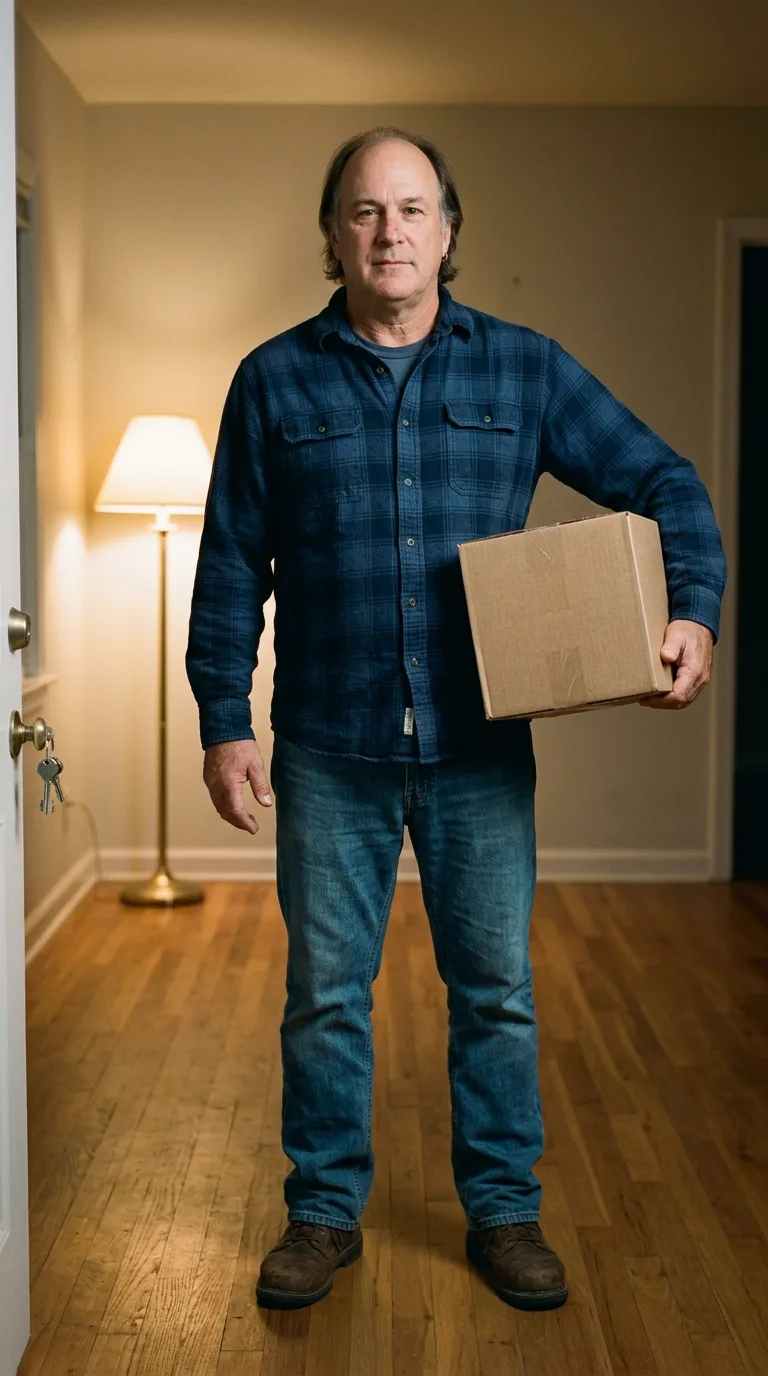
Rarest thing about him: Drywaller — common, 1 in 562
Season 1seed 1365347338 · engine v11
Character card
lineage 9IC4OB
His body-swap story
@bryce.kellerman, wearing Marcos Fuentes, rolled the wheel on and woke up as Larry Feinglass, spent under a minute in him, then spun the wheel and woke up as Marcus Deshawn Fielder
You are Marcos Fuentes for less than a minute, and already you know it was a mistake.
It's the hands. Fifty-three years old and a farmhand's hands, knuckles swollen from forty years of fence wire and hay hooks, and it's the middle of the night in Atlanta, and everyone in the house is asleep, and you are standing in the dark kitchen holding a phone that is not yours, the light of it too bright, the wheel spinning lazy circles on the screen like it's got nowhere to be. Marcos's back aches in a way that isn't dramatic, just constant, a low hum that never resolves. You spun this body forty-seven spins ago into a life you don't want and can't leave fast enough — a body that wakes at four, that smells like animals no matter how many times it showers, that has a bad hip and a good heart and neither of those is yours to keep feeling. You didn't come here for him. You never do. You came here to leave.
Your thumb — his thumb, thick and cracked at the nail — taps the wheel.
It turns.
The floor changes first — hardwood instead of linoleum, cool through different boots — and then the weight of you resettles, redistributes, becomes heavier through the shoulders and gut, and there is a box against your hip, cardboard biting a crease into your forearm, and keys still swinging faintly from a lock somewhere behind you. Evening light, lamp-gold, through an open door. Rain somewhere outside, a smell of wet asphalt and cut wood. Your hip doesn't ache. Your knees do, a duller thing, worn-in. You are enormous compared to what you were a breath ago. You set the box down on the floor because it is heavy and because something underneath the wanting-to-set-it-down is already, quietly, home.
The keys are the first thing. You don't touch them yet — they're just hanging there, glinting — but looking at them is enough, and it comes anyway: a locksmith's counter that afternoon, the new fob heavier in his palm than the old one, the particular satisfaction of a key that's his and nobody else's, no landlord attached, no ex-wife's name on the lease. Larry Feinglass, fifty-nine years old, and this is the first place since the divorce that isn't a stopover.
You walk the room's edge, the way he would, knuckles trailing the drywall — good drywall, somebody did this room right, mudded and sanded clean, and your hand knows that instantly, professionally, the way it would know a bad seam from three feet off in the dark. Twenty-six years of it. The trowel in the other portrait of him, the one where he's covered in mud and looks like he hasn't slept — that's not this room, that's a job in Ballard from six months back, but touching this wall calls it up anyway: the ache across the shoulders that comes from holding a hawk overhead for eight hours, the particular quiet of an unfinished room before the tape goes up, stud bays like ribs. He liked that quiet. Never told anyone.
The shirt gives you more. Flannel, soft from washing, and going through the motions of having put it on this morning — his hands, guided by nothing you're doing, remember buttoning it wrong the first time, distracted, redoing it. Under it: bad shoulder from a fall off a ladder in '09, the crook in his nose he got from a coworker's elbow in his twenties, decades before anyone called it a hazard. Brown eyes that have looked at himself less and less over the years, jaw he still shaves clean out of habit more than vanity, hair he colors himself in the bathroom sink because gray made him look like his father and he wasn't ready for that, not yet, maybe not ever. A silver hoop in his left ear he put in at twenty-two, on a dare, and never took out because by the time it stopped being a dare it had just become his ear.
Deborah is in the walls too, distant now, an ex-wife's voice from a kitchen he doesn't live in anymore — arguments about money, about the kids they didn't have, about nothing, really, in the end, just two people who ran out of things to fight for. No children. He'd wanted them. Doesn't say that to people. There's a synagogue three neighborhoods from here he hasn't been to in a year and keeps telling himself he'll go back to, Rosh Hashanah maybe, once he's settled. Once. This box was the last one. This place was supposed to be once.
He drinks maybe twice a month, big and loud with the crew, and otherwise nothing; quit cigarettes eleven years ago and still, in low moments, his hand drifts up toward his mouth like it's looking for one and finds his own jaw instead, rubs along it, an old tell. It's doing that now. Fingers finding his face without being asked, checking the smoothness of it, some old comfort worn into a groove.
You feel all fifty-nine years of him settle into you — heavy, real, a body that has carried drywall and carried a marriage and set both of them down more than once. It is a good weight. Better than the one you left mid-motion in a dark kitchen in Atlanta, arguing with itself over a phone screen.
You look down at his hands. Not Marcos's. His. Thick fingers, a broken-and-reset knuckle on the right one, calluses at the base of every finger that no lotion has touched in a decade. You turn the right one over slowly, like you're checking it's real, and in a way you are.
"Okay," you say, out loud, to the empty room, to no one, to the keys still hanging in the door. "Okay. Home."
You don't know yet how long that word gets to be true.