Kevin Cho
Fictional. Generated by AI — not a real person, and no likeness of one is intended.
38, teacher in New York · rolled by @colin.hasbrook · card — no film
History
who has worn him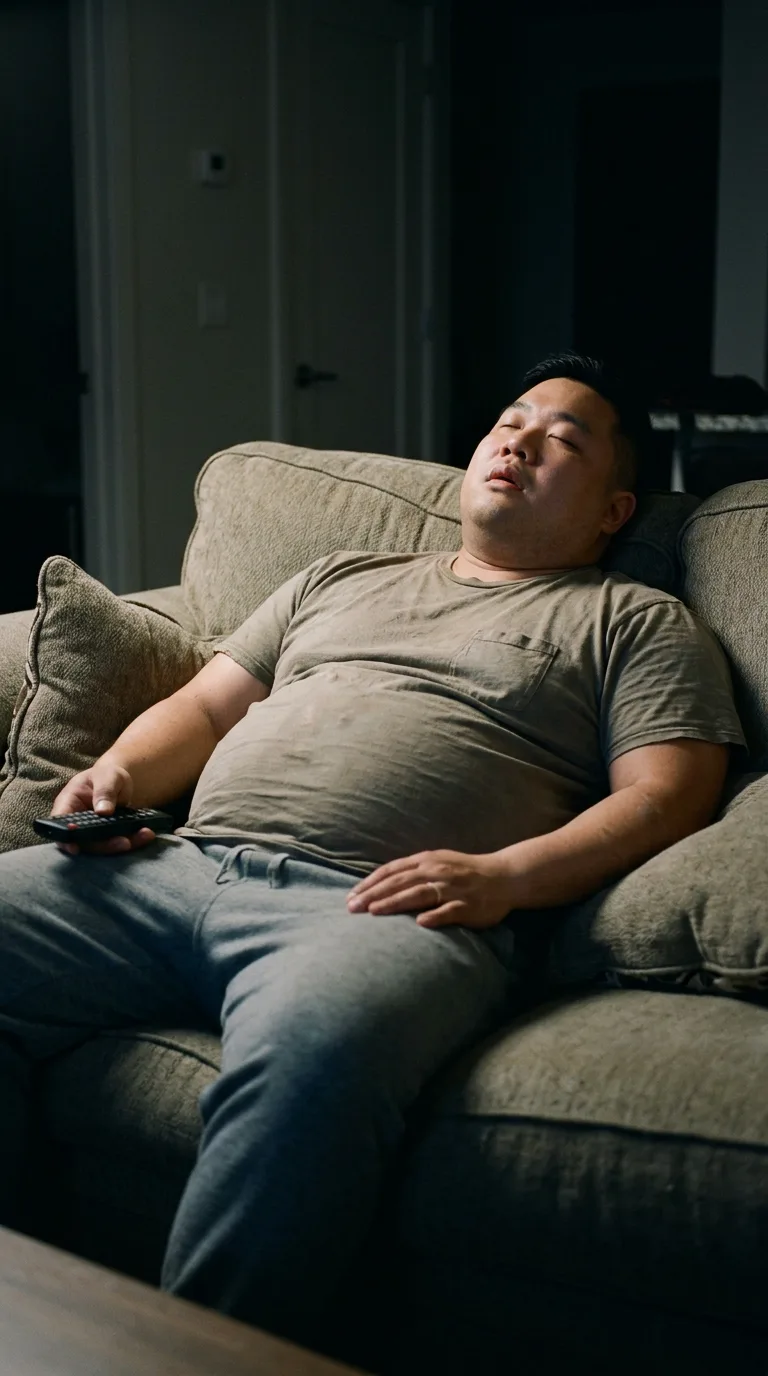
Rarest thing about him: 5'4" — uncommon, 1 in 18
Season 0seed 161445403 · engine v10
Character card
lineage 2NZHHJ
His body-swap story
@colin.hasbrook, wearing Osvaldo Reyna, rolled the wheel on and woke up as Kevin Cho, spent under a minute in him, then spun the wheel and woke up as Charles Renfroe
Osvaldo Reyna's hands are wrong before you even think the word wrong. Sixty-three years of somebody else's knuckles, the skin loose over them like a glove one size too big, and you have had this body less than a minute and already you are bored of it the way you are bored of a hotel room you never asked to book. You stood him up from whatever chair he'd been folded into, and his knees complained, a high complaint, arthritic, and you thought: no. Not tonight. Not this one. Four hundred and one men behind you and somewhere in there you stopped waiting to see who a body was before deciding you didn't want it. Retired means nothing happens to him. Skinny means the cold gets into him faster than it should. You are still holding the memory of him fumbling with a reading lamp switch, his fingers slow on it, and that small failure is the whole reason, if there has to be one — you did not want to spend one more minute being a man whose hands don't work fast. You went to the site with him still standing in some hallway, and you spun.
The television cuts to a bright frame — a laugh track swelling somewhere behind it — and you are sitting up straight before you've decided to, spine snapping into a posture that isn't yours to command yet, and the remote is already out of your hand, set down on the couch arm with a care you didn't perform. Weight everywhere. A gut you didn't have a second ago pressing warm against a t-shirt. Short arms. Thick fingers, unfamiliar and immediate, the ring-shaped paleness on the right one catching lamplight from the kitchen doorway before you even understand you're looking at your own hand. You do not laugh at the joke. He would have laughed at the joke. Somewhere in the wiring of him a laugh is queued up and you let it die there, unfired, and the room goes on without it, the television not knowing anything has changed.
His shirt sleeve brushes your forearm — no, his t-shirt, soft, gray, thinned at the collar from washing — and it gives you a morning: him pulling a chambray shirt over his head in a bedroom with gray light coming through blinds, rolling the sleeves twice because rolling them once always came undone by second period, the lanyard already around his neck before the shirt was even buttoned all the way, a habit from some September years back when he almost forgot it and had to buzz himself into his own building. Kevin Cho. The name arrives with the shirt-memory, stitched to it the way names get stitched to the first thing you feel in a life. Thirty-eight years old. A classroom that empties out every day at the same hour and somehow never gets less lonely for emptying. He teaches seventh grade math to kids who call him Mr. Cho like it's a joke they haven't finished making yet, and he loves maybe four of them a year in a way he'd never say out loud, and the rest he tolerates with a patience that costs him more than anyone in that building has ever noticed.
The couch under you gives you evenings — dozens of them, stacked like plates, all the same shape. Coming home to an apartment two bedrooms too big now that it's just him, because the divorce took the third bedroom's reason for existing and left the room itself, empty, door mostly shut. His ex-wife's name arrives soft and sanded-down, no sharp edges left on it, just tiredness — Mina — and behind her, two kids' faces at different ages layered over each other like a flip-book, a Saturday every other week, drop-off in a parking lot that still makes his chest tight for reasons he's stopped examining. The remote in your hand a second ago — his hand, and now yours — remembers itself clicking through channels after the kids are asleep at his place, or after they've gone back to hers, the silence afterward its own kind of weather.
Your fingers find a pen that isn't there and click nothing, a phantom motion, muscle asking for its favorite thing and finding only air — that's him, grading papers at a kitchen table with a chewed-up pen, click click click while he decides how generous to be with a decimal point. The ring-tan on your finger throbs faintly with feeling that isn't pain exactly, more like a photograph left too long in the sun, the shape of something bleached into skin that used to hold a promise. He does not drink much. Never smoked. His blood pressure is a number a doctor says at him twice a year like a mild scolding, and he nods and means to do something about it and doesn't, the same way he means to date again and doesn't, the same way the apartment stays two bedrooms too big.
Nothing about him is remarkable and that itself sits in you strange — no scar, no story stitched into his face, no single thing anyone would point to across a room. Just a heavy, tired, decent man built out of ordinary Mondays, sitting alone in the dark with a television for company because the company he used to have doesn't come home anymore.
You look at your hands — his hands, thick-fingered, faintly pale around one finger where gold used to sit — and you turn one over slowly, the way you always do, checking the weight of a life against your palm before you decide how long to keep it.
"Huh," you say, out loud, to the empty room, in a voice that isn't laughing at the show anymore. "Okay."