Kenji Ashida
Fictional. Generated by AI — not a real person, and no likeness of one is intended.
43, train conductor in Tokyo · rolled by @colin.hasbrook · card — no film
History
who has worn him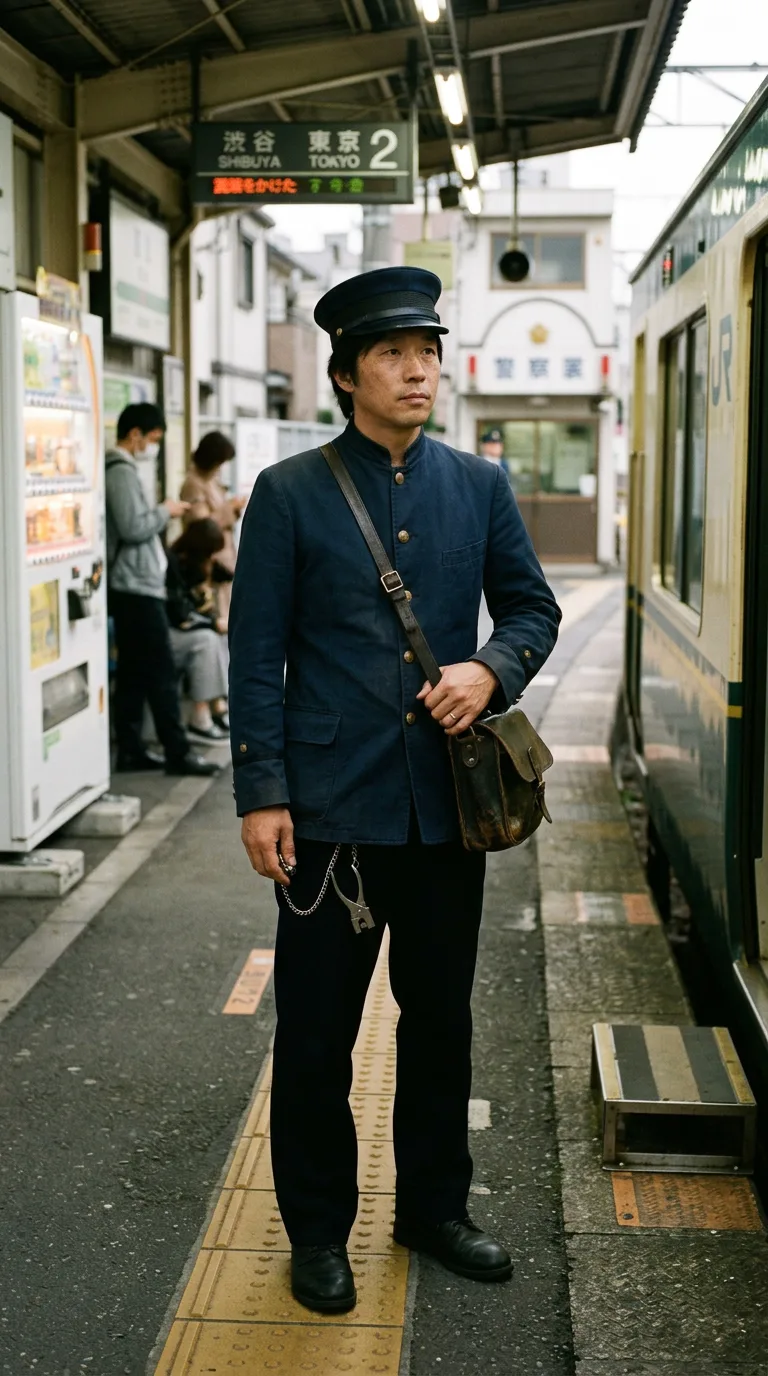
Rarest thing about him: Tokyo — epic, 1 in 804
Season 0seed 1535815970 · engine v10
Character card
lineage 2NZHHJ
His body-swap story
@colin.hasbrook, wearing Gerald Vantassel, rolled the wheel on and woke up as Kenji Ashida, spent under a minute in him, then spun the wheel and woke up as Danny Rusnak
You've been Gerald Vantassel for less than a minute, and already the bathroom mirror is telling you everything wrong with him. The bald head catching the fluorescent light like a bowling ball. The blue eyes that water too easily. Sixty-one years old, retired, athletic in the way retired men mean it — meaning he still does the treadmill, still counts his steps, still has a body that mostly obeys him but reminds him constantly that it's negotiating. Somewhere behind those blue eyes there's a whole Miami life, a condo, a dead wife or a living one you haven't bothered to learn yet, golf clothes maybe, and none of it is yours and none of it interests you. You spun this one four days ago out of some appetite you don't examine too closely, and it filled up fast — the newness went out of him like air out of a tire. Retired men don't do anything. That's the whole problem with retired men. You stand in his kitchen at what his clock says is late morning, a Monday, sun coming in hard and flat over the water, and you think: not this one, not one more hour of this one. You go to the laptop on his kitchen island, already open, because Gerald — or you, wearing Gerald — looked at it last night before bed, at the site with the wheel on it, and didn't spin, and regretted it into sleep. Six hundred and twenty-seven times before this. You know the shape of the wanting. It comes back like hunger, and it is hunger, and you don't fight it anymore, you just feed it. You pay. You spin.
Halfway around the world it is the dead middle of the night, and a small man in a navy uniform is bent at the waist beside a stopped train, checking a coupling he has checked ten thousand times before, and his hand is on the cold metal clamp at the end of its little chain when the wheel decides for both of you at once.
The motion breaks. Your hand — his hand — goes to fasten something that is already fastened, fingers fumbling against brass and steel that don't need fumbling, and you feel the whole body flinch with a wrongness it can't name, like a skipped stair. You go still a half-second too long. Then, carefully, deliberately, you do it again — slowly, correctly — and the clamp closes with the small definite click it is supposed to make. You do the next one the same way. And the next. Ten checks that should take no thought at all come out of you measured, watched, a job with no slack in it suddenly full of slack, because you are new in here and the hands remember more than you do.
It is night. Cold enough that your breath — his breath, forty-three years of it, out through a nose that has never once cost him a second thought — fogs faintly under the platform lights. The uniform jacket is heavier than Gerald's golf shirts, stiff at the collar, and it is that stiffness, that particular chafe of the mandarin collar against the back of the neck, that opens the first flash: a hand — his wife's hand — smoothing this same collar down over his shoulders in a dim front hallway, six-something in the morning, her hair still sleep-flat, saying nothing because there is nothing that needs saying after nineteen years, just the collar straightened and a cup of barley tea pushed into his hand before he goes. You didn't ask for that. It came up out of the wool.
The bag crossing your chest, worn soft at the strap, gives you the weight of it on a hundred mornings — timetables, a spare pair of gloves, a photograph of two kids tucked in an inside pocket that you haven't found yet but already somehow know is there, the way you know a room is occupied before the light goes on. The little brass clippers on their chain, cool and worn smooth where his thumb sits, give you the sound they make — that particular percussive snap — echoing down forty platforms in forty stations over twenty years, a sound so familiar it stopped being a sound and became a kind of breathing. There is a callus at the base of his right thumb built exactly to that shape. You feel it now as your own, except it isn't, it's older than you, it's twenty years of the same motion in the same weather.
The shoes on the yellow tactile paving are worn asymmetrically, heavier on the outside edge, and that wear tells you about a limp he doesn't have yet but is building toward — a knee that complains on the cold mornings, the diabetes making itself known lately in small treacheries, a tingling in the same foot, a thing he has not told his wife because telling her would mean admitting the mornings are getting longer. He is careful about rice at dinner now. He carries hard candy in his coat for the lows, and you can feel, distantly, a slight thinness under the last meal, hunger managed rather than answered.
The wedding band is thin and plain, worn soft-edged from two decades, and it opens wide, not sharp — not one memory but a whole rolling year of them: a wedding in a hall with too much fluorescent light and his mother crying more than the bride; two births, in order, both at the same hospital, both at strange hours because that seems to be his life's arrangement with the world, day shift and night shift and children arriving in between; a daughter now taller than her mother; a son who still, at twelve, comes to stand next to him on the platform on his days off just to watch the trains come in, the way Kenji himself once stood next to his own father's tools without any of them saying why. None of it is dramatic. All of it is his, entire and unclaimed by any camera, and it comes up through the ring finger like water finding a crack.
The freckles are just there under your fingers when you touch your own face, an unfamiliar scatter across a nose that isn't yours yet, and somehow that touch gives you nothing at all — just skin, ordinary, the one true thing about him that nobody who loves him has ever needed explained.
Forty-three years old. Average build going soft at exactly the places you'd expect, average height, black hair he cuts himself with the guard on the clippers set to a number his wife picked years ago and he never changed. Ex-smoker — eleven years off it now, and the old want for one surfaces sometimes on nights exactly like this, cold platform, empty hands, but he doesn't reach for it, hasn't in a decade, and you feel that discipline sitting in him like a held breath he stopped noticing he was holding.
You straighten up off the coupling. The platform is empty this hour, just the vending machine humming its cold blue light down the lane behind the station, everyone in the houses along it long asleep. Your hand — his hand, small-boned, familiar to nobody in this body but him — comes up in front of your face without your quite deciding to lift it, turning once, palm up, palm down, freckled and ringed and callused in a place a hand like Gerald's never was.
You look up into the dark toward the last car of the stopped train, where the light doesn't quite reach, and you say, in a voice you didn't choose and don't yet fully trust, "還いる." *Still here.*
Nobody answers. There is no way to know, standing on this platform with this body's tiredness settling into you like weather, how long that will stay true.