Kenji Arakawa
Fictional. Generated by AI — not a real person, and no likeness of one is intended.
42, contractor in Los Angeles · rolled by @yusuf.brannick · card — no film
History
who has worn him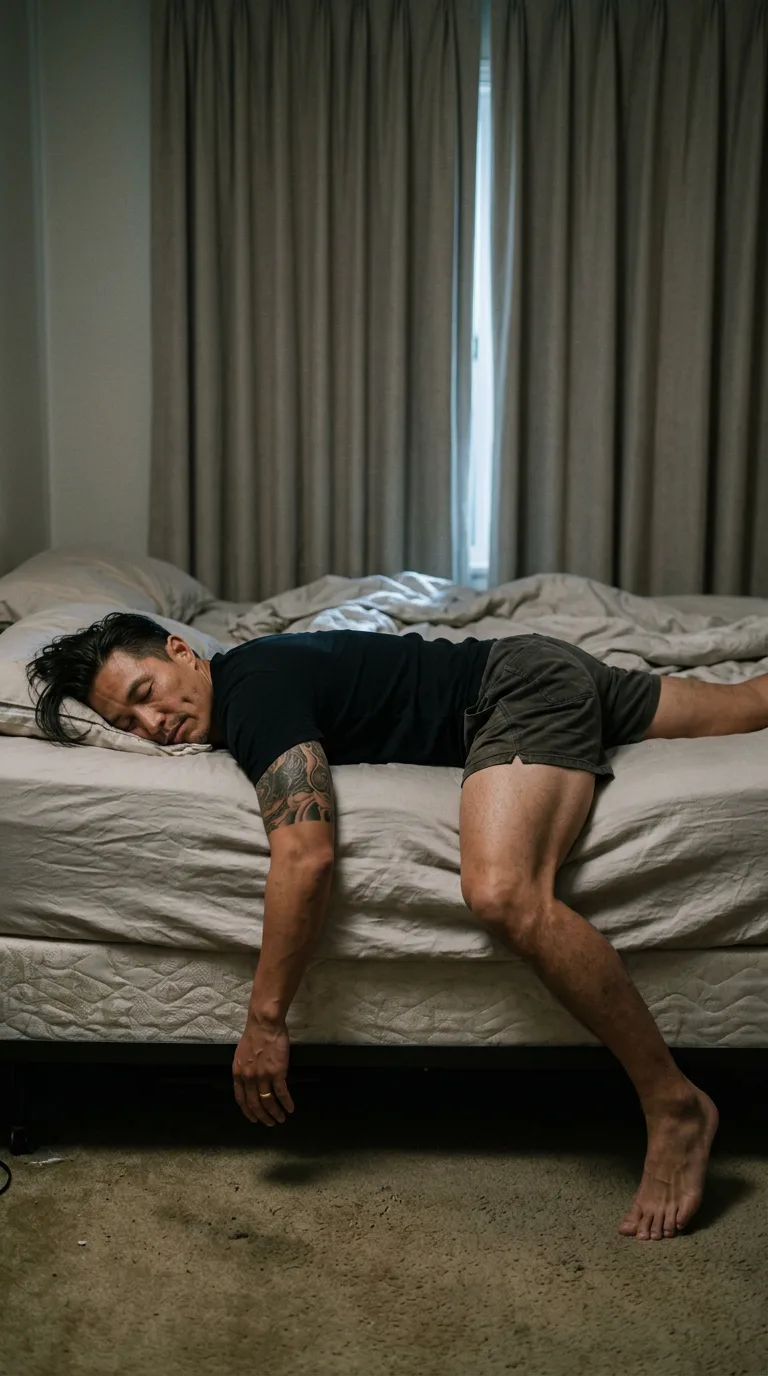
Rarest thing about him: Flips a lighter — rare, 1 in 51
Season 0seed 83377423 · engine v10
Character card
lineage ANU73D
His body-swap story
@yusuf.brannick, wearing Denny Fasano, rolled the wheel on and woke up as Kenji Arakawa, spent 4 minutes in him, then spun the wheel and woke up as Gary Vandermeer
Denny Fasano's hands don't feel like yours yet, and that's the problem. You're standing in his kitchen — his kitchen, one day and one hour now, freckled forearms, that red hair catching the desert light through a window that needs cleaning — and there's a lighter on the counter that isn't yours to flip, a set of tattoo machines in the next room that aren't yours to hold, and none of it fits the way you thought it would. You spun for this. A tattoo artist, inked to the collar, a name that sounds like it belongs on a motorcycle. You wanted to feel dangerous in him. Instead you feel like a man wearing another man's jacket, arms too short in the sleeves, waiting for a phone call that customer service is never going to make. The freckles are somebody's freckles. The red hair is somebody's red hair. You are bored of him already, bored in the specific, itching way that has nothing to do with him and everything to do with you, and you go to the site on his phone with his thumb, because it is the only part of this that still feels like a decision.
The wheel spins. It always spins the same, indifferent, and it lands on a man face-down on a bed eleven hundred miles away, in the middle of an ordinary night that is, for him, the middle of an ordinary morning for you — you don't know that yet, you only know the light behind your eyes changes, and your breathing, which was ragged a half-second ago for reasons that were his and not yours, evens out into something slow and deliberate. The arm that was hanging off the mattress lifts itself, unbidden by anyone Kenji Arakawa would recognize as himself, and folds onto his chest along with the other. You are on your back now. You did not do that. You did it.
The room smells like fabric softener and, faintly, someone else's cigarette smoke drifting up through a gap in the window — not his, a neighbor's, three units over, and even that detail arrives like it's been waiting for you. Streetlight slats the ceiling through the curtain gap. You are forty-two years old in this skin, athletic in a way that Denny Fasano's body never was, low-slung and used, and there's a wedding band on your left hand that goes cold and then warm again as you become aware of it.
You don't move yet. There's no reason to. But your hand — his hand — finds the sheet, and that's the first key: cotton, worn soft at a thousand washes, and it opens the door to a woman's laugh in this same room, a fight about tile grout that ended in this same bed, her hand flat on your sternum at two in the morning telling you the kids are fine, go back to sleep, you worry more than the pediatrician. Michelle. The name comes with the sheet, not from anywhere else. There was another woman before her — Grace, sharper-voiced, a decree finalized four years ago, a custody schedule taped once to a fridge that isn't this fridge anymore — and the ex-wife's name comes in colder, through nothing you're touching, just orbiting the marriage like a moon that never fully sets.
Your palm finds the mattress edge and gets the rest: a framing job in Silver Lake, sawdust hanging gold in a shaft of afternoon light, the particular ache in the left knee from kneeling on subfloor for six hours, the satisfaction — real, uncomplicated, the only uncomplicated thing in this whole reeling inventory — of a wall going up straight and true because you checked it three times with a level you trust more than most people. Your hands know a hammer's balance without being told. They know how to hold a cigarette that was never lit, because you never smoke, never have, some old promise to your mother that outlasted her. Nicotine never took. Drink never took either — there's a memory here of a wedding, someone's toast, your glass of sparkling water sweating rings onto a white tablecloth while your brother-in-law got loud and you sat there dimpled and amused and sober and untouchable.
The asthma arrives last, and it arrives as a held breath — a memory of a chest tightening on a jobsite in July, dust everywhere, an inhaler fished out of a truck's glovebox with hands that were shaking a little, Michelle's voice on the phone afterward saying you scared me, and you saying I'm fine, I'm fine, in the voice of a man who says that too often and means it less each time.
You think of the boys. Two of them — a flash of a birthday cake, candles, a name shouted across a backyard, a smaller hand fitting into this same palm at a crosswalk — and it comes with something that isn't quite yours, a tenderness so total it feels like trespassing to even carry it a second longer. You let it go before it can ask anything of you.
This morning — his morning, the one he was dressing for eleven hours ago in his own timeline, though you feel it as if it just happened, sleeve by sleeve — comes through the grey henley still folded somewhere in a hamper nearby, not on him now, but close enough that the memory leaks anyway: pulling it over his head in bad light, the vest zipped after, the tool belt's familiar drag on his hips, dimples showing in the bathroom mirror at nothing in particular, just the shape his face makes even when he isn't smiling, even now, slack on a pillow with someone else behind it.
You bring your hand up in front of your face. Turn it. The wedding band catches the streetlight.
"Not bad," you say, quiet, into a bedroom that doesn't answer, wondering — the way you always wonder now, one day into a life and already loosening your grip on it — how long you'll want to stay in a man who has this much to lose.