Kaito Sorensen-Baird
Fictional. Generated by AI — not a real person, and no likeness of one is intended.
20, receptionist in Tokyo · rolled by @connor.waskiewicz · card — no film
History
who has worn him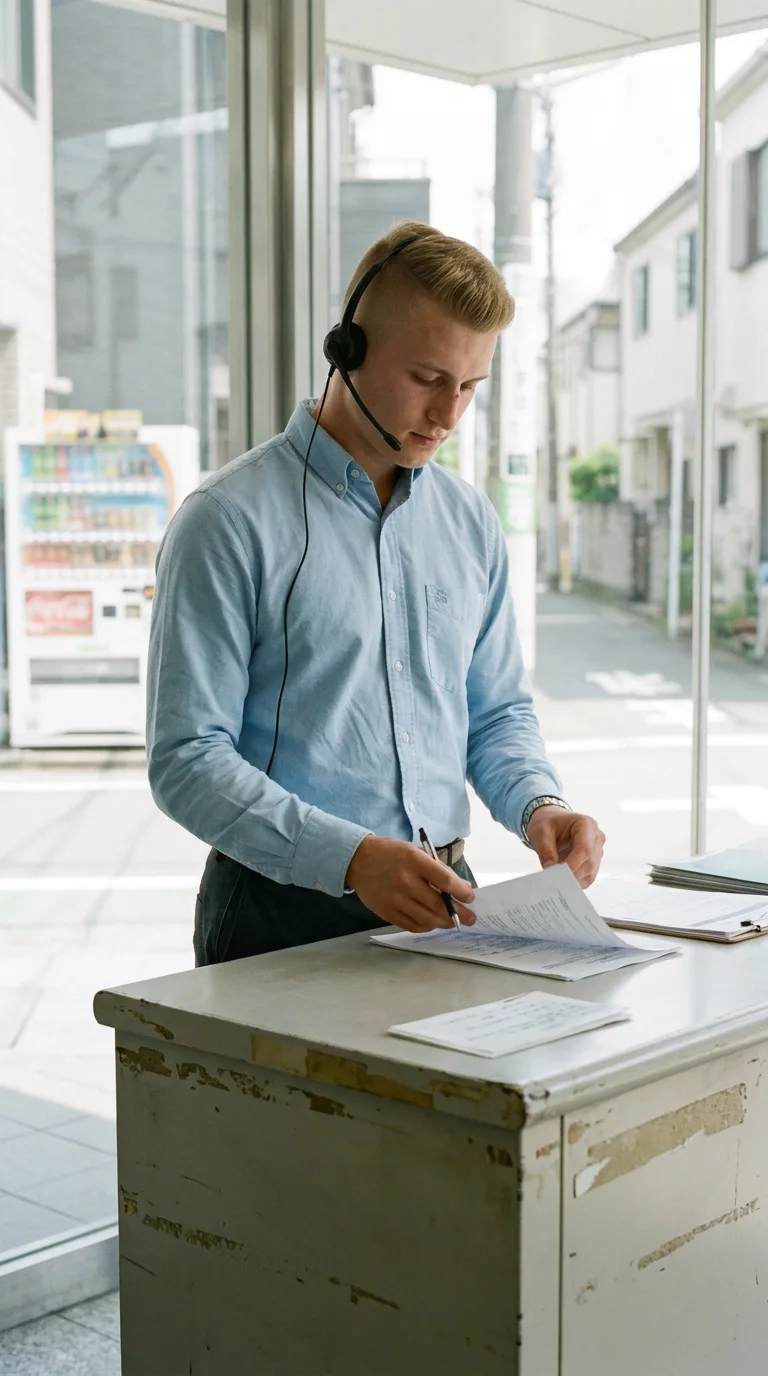
Rarest thing about him: Tokyo — rare, 1 in 653
Season 1seed 1491868745 · engine v11
Character card
lineage 2NZHHJ
His body-swap story
@connor.waskiewicz, wearing Hector Villagómez, rolled the wheel on and woke up as Kaito Sorensen-Baird, spent 8 minutes in him, then spun the wheel and woke up as Wyatt Youngblood
Hector Villagómez's recliner smells like the last thirty years of him — menthol rub, coffee gone cold in the cupholder, a body that has sat in call center chairs for so long it curved to fit one. It is the middle of the night in Houston and the house is dark and nobody is awake to see a sixty-four-year-old man sitting up straight in front of a laptop glow, spinning a wheel with hands that were only his for less than a minute. You have not even learned this one's ex-wife's name yet. You don't need to. You already know Hector's knees ache going down stairs and that is enough to know you are done with him — comfort was never the thing you spin for, it's the arriving, and Hector already arrived. You click. You do not feel yourself leave the recliner. You never do.
You feel yourself land mid-stroke, a pen crossing a line on a clipboard, and the line comes out crooked because whoever was aiming it a half-second ago is not aiming it anymore. You stop. You look at the crooked line like it insulted you personally, then draw the next one slow and careful, the way you'd walk on ice. Ten more careful ones. A glass lobby around you, hot outside the glass, a vending machine humming red and blue through the door glass, a narrow lane with power lines. Afternoon light lying flat and white across a check-in sheet that means nothing to you yet. A headset cord tugs faintly at your collar when you turn your head too far.
Then the clothes start talking.
The shirt first — pale blue, oxford cloth, warm from his own body heat, and it gives you a morning: him buttoning it in a room with tatami smell and a window unit rattling, one button skipped and redone because his fingers were thinking about a text he hadn't answered yet. Sayaka. Not girlfriend anymore, hasn't been for eight months, but her name still surfaces first, before his own landlord's, before anything. She used to fix his collar for him when it sat wrong, laughing at him, *you'll never learn*, and he let her because he liked the ten seconds of her hands near his throat more than he liked a straight collar. He thinks of her more than he'd admit to anyone who asked, which nobody does, because nobody at this job asks him anything real.
The belt, cracked brown leather, worn to the shape of this exact waist — a hand-me-down, his father's, before his father moved back to Fukuoka and left it in a drawer along with a watch that ticks against your wrist right now, a little loud, a little slow. His father is Danish-American, his mother is Japanese, and growing up in Kanagawa with a name that made teachers pause on the register gave him a permanent quiet patience with being looked at twice — which is maybe why this job suits him, a glass box where everyone looks at him once, says a floor number, and moves on. He does not mind being furniture. He minds it a little. He has never said so.
The pen in your hand is his, chewed once at the cap years ago in some exam he doesn't like remembering, and gripping it brings back ten thousand identical afternoons — sign here, headset crackle, a delivery guy's motorbike idling outside, the specific ache that lives in the exact middle of his lower back from standing this many hours on a floor with no give in it. Twenty years old and his body already knows this ache the way old men know weather. His nose — broken at fourteen, a bicycle, a curb, nothing dramatic — throbs faintly in cold weather and not at all today, and you feel how his fingers, resting a moment against the bridge of it without thinking, have done that same unconscious check ten thousand times, the small self-soothing habit of a boy checking a thing is still crooked the way he expects it to be.
The desk under your palms is scarred steel-gray paint chipped at the corners, older than the building around it, and touching it gives you nothing — it's not his, it's the job's, it will outlast him and everyone after him, and some tired part of him respects that about it.
You feel how sober this body has always been — never drank much, quit what little he did without a story attached, no cigarettes ever, nothing to dull with, just this: work, the ache, Sayaka's name surfacing at odd hours, a father's watch ticking a little slow.
You look down at your hands. Not yours — his, blond-haired forearms, faint ballpoint callus on the middle finger, that watch loose enough to spin on the wrist when you shake it once, testing it. Ten seconds ago these hands belonged entirely and only to him, doing a thing he's done so many times his mind was somewhere on a woman who isn't his anymore. Now they're doing it slow, deliberate, foreign in their own certainty.
You lift your eyes into the glass door's reflection, into the lane, into whatever's watching, and you say, quiet, almost to yourself more than to anyone:
"Nine hundred and fifty-eight."