Julián Reyes-Whitfield
Fictional. Generated by AI — not a real person, and no likeness of one is intended.
37, paramedic in Seattle · rolled by @tyler.iverson · card — no film
History
who has worn him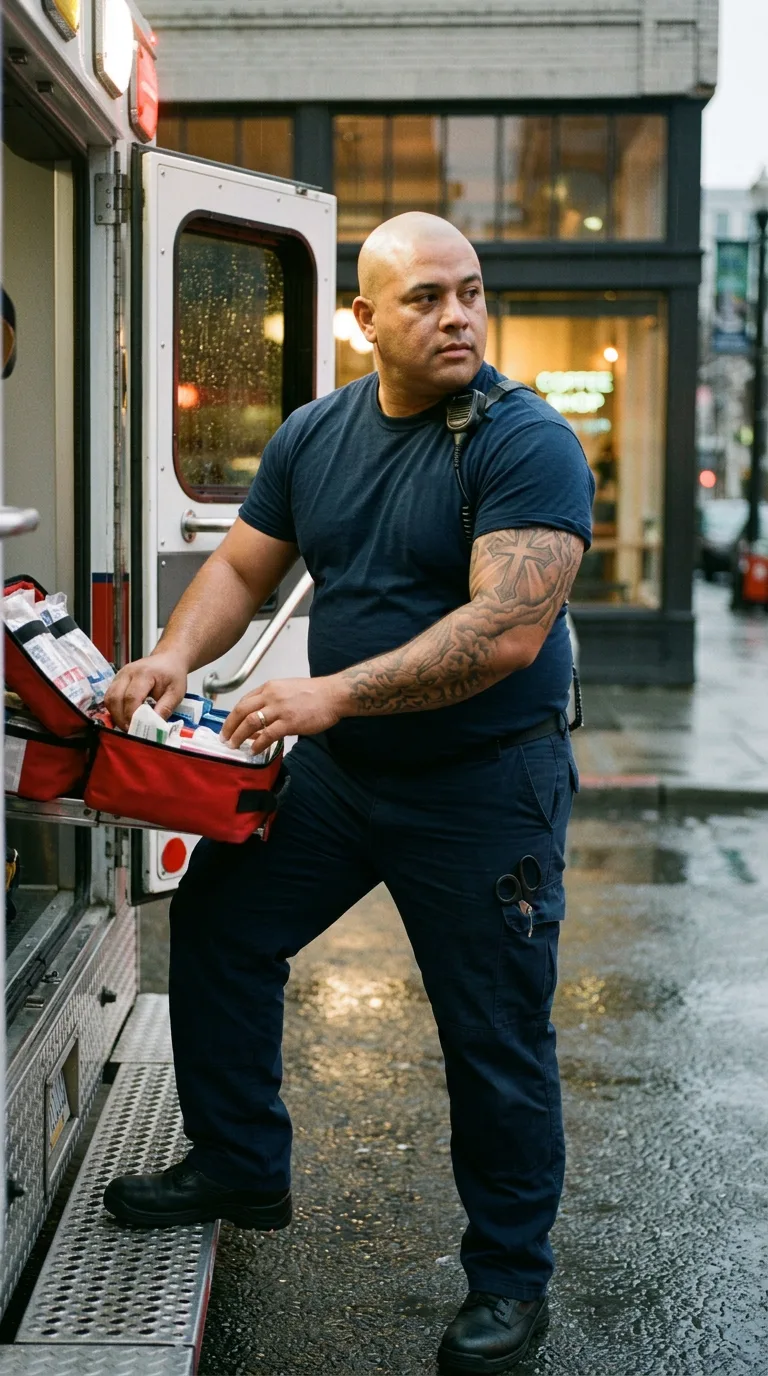
Rarest thing about him: Full sleeve — rare, 1 in 37
Season 0seed 1728171603 · engine v10
Character card
lineage 9IC4OB
His body-swap story
@tyler.iverson, wearing Gary Ostrand, rolled the wheel on and woke up as Julián Reyes-Whitfield, spent 6 minutes in him, then spun the wheel and woke up as an unnamed body
You are Gary Ostrand for exactly three minutes, and in those three minutes you learn that gray hair and a whistle around your neck and a gym full of Nigerian teenagers doing sprawls is not enough, was never going to be enough, because Gary Ostrand's knees ache when he crouches and his wedding is a divorce he keeps meaning to finalize and you spun for athletic and got tired. You feel it settle into you like a bad meal. Boredom, this fast. Sixteen bodies in and you have started to understand that the wheel does not owe you satisfaction, only difference, and difference wore off around body nine. You find a folding chair. You take out your phone, or his phone, and you go to the site with hands that are not going to be yours much longer, and the wheel is already loading before Gary has finished his second thought about it.
The rain finds you first — not falling on you, just present, the smell of a wet Seattle street coming up through a nose that has smelled ten thousand shifts of exhaust and antiseptic and second-hand smoke. Your hand is in a bag. Red nylon, gauze packs, the give of gel and cellophane under your fingers, and the motion you were making — sliding a trauma dressing into its slot — arrests itself half a second in. You do it wrong. You do it again, slow, correct, and the next ten items go into the bag checked, one at a time, like a man doing a job he has done ten thousand times and suddenly cannot trust his own hands to do it, though he could not tell you why, and would forget the doubt by the time the bag closed.
He does not close it yet. You are standing in his weight — heavier than any of the fifteen before him, a low dense strength you feel in your calves just holding still, feet planted wide on wet asphalt in boots that know exactly how much traction they have on this exact street. The shirt against your back gives you the first of it: this morning, this same navy cotton pulled over his head in a dark bedroom, Marisol still asleep, the littlest one's night-light throwing a plastic star pattern on the ceiling, and him standing there a second longer than he needed to, just breathing it in, the house, before the day took him. He puts on his uniform the way some men put on armor and some men put on a costume; Julián puts it on like a favor he's doing somebody, quietly, without saying who.
The radio mic clipped at his shoulder gives you the crackle of a hundred calls, none of them this one — a diabetic on Denny, a fall on Boren, a man who wouldn't stop apologizing while Julián set his wrist. The scissors in the pocket by your hip, worn smooth-edged from four years of the same pocket, give you nothing but the fact of their own shape, familiar as a tooth.
The sleeve does the real work. Your right forearm is inked shoulder to wrist — a cross, hands pressed together in prayer, the linework gone soft at the edges with age — and touching it, even from the inside, even just flexing the arm to lift the bag, drags up his mother's kitchen in Tacoma, seventeen years old and telling her he wanted the ink and her saying if you're going to mark yourself mark yourself with something that'll still mean something when you're forty. He is thirty-seven now. It still means something. He is not a churchgoing man — hasn't been in years, tells Marisol he believes in something, just not in showing up for it on Sundays — but the sleeve is a rosary he wears on the outside because he lost the habit of carrying one on the inside, and some nights, elbow-deep in somebody's chest doing compressions that aren't working, he looks down at the praying hands on his own arm and it is the only prayer he has time for.
The ring is the last thing, small against everything else, and it opens the widest door: nine years married, three kids and a fourth Marisol swears is the last one every single time, a rented house in Rainier Beach with a mortgage that scares him some months and doesn't others, depending on the overtime. He is good at this job in the specific, unglamorous way that never gets a commendation — steady hands, a voice that drops low and even when everyone else's is climbing, three kids who think their father can fix anything because as far as they've seen, so far, he always has. High blood pressure he doesn't take seriously enough. A pack a day he lies to his cardiologist about, half a pack, since March. Nothing in him is a headline. That, itself, you register almost as a loss — you spun sixteen times partly hunting for the man who'd feel like a headline, and what you got instead was a body built like a bridge support, holding up a life nobody's written a story about, which turns out to be its own kind of weight to wear.
You feel your own hand — his hand — resting on the ambulance's bumper, damp with rain, and you turn it over.
"—the hell," you say, to no one, in his voice, low and warm and not built for surprise, "when'd I say that twice."
You don't know yet if that's him leaking back up through the ring, through the sleeve, through the muscle memory of a job he's about to finish correctly, or if it's just you, wearing his mouth, already wondering how many more streets like this one you'll get before the wanting comes back around.