Joaquin Barrera
Fictional. Generated by AI — not a real person, and no likeness of one is intended.
34, trucker in Chicago · rolled by @connor.waskiewicz · card — no film
History
who has worn him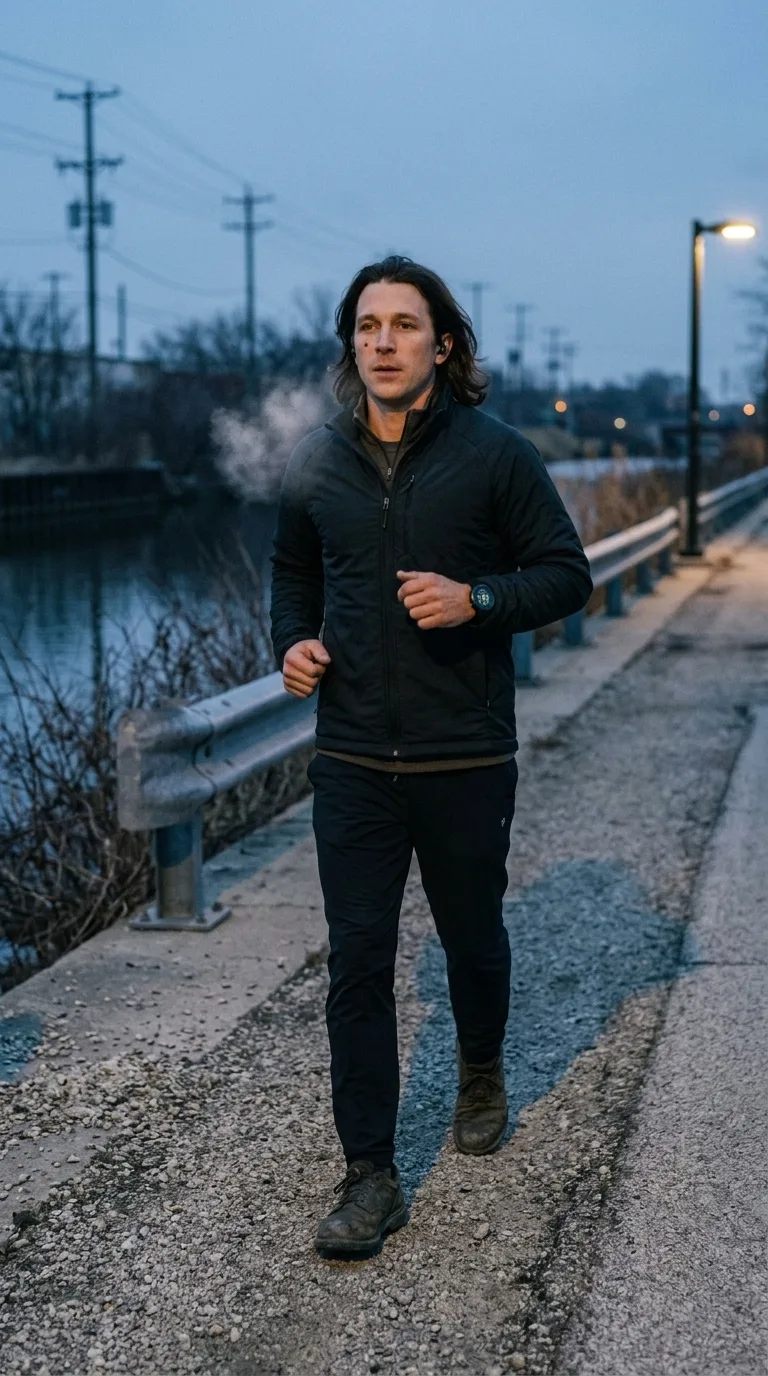
Rarest thing about him: Out for a run — common, 1 in 41
Season 1seed 1113152020 · engine v11
Character card
lineage 2NZHHJ
His body-swap story
@connor.waskiewicz, wearing Marcus Odom, rolled the wheel on and woke up as Joaquin Barrera, spent under a minute in him, then spun the wheel and woke up as Travis Hollowell
Marcus Odom's knees are bad in the desert cold, and that is not why you are leaving him. The trailer is dark, and the swamp cooler ticks on the roof. You are standing at the kitchen counter in a body that was yours for under a minute, with a goatee you have not stopped touching, and the phone is lit in your hand. The wheel is already open on it. It was not the knees. It was the cleft in the chin, the quiet, the way you stood at the sink and could not think of one thing you wanted. You pay. You spin.
Cold, all at once. Your lungs are full of it, and the ground comes up through the shoe and your weight is already moving. You are mid-stride on gravel, and the left foot is about to land. It does not land. You take two steps to catch the rhythm, and the running resumes on the other foot, arms lower. Your breath shows in front of you. The watch on your wrist buzzes a split you never held.
You do not stop. His body will not let you, and it is a good body to run in: the lungs are open and the thighs are warm, and there is a tightness behind the right knee that loosens with each stride. Water on the left, black and slow. Light on the right, a streetlamp going orange against a blue sky.
The jacket comes first. The zipper pull knocks your chin, and the cuff is damp where he wiped his nose on it. He put it on in the dark, in a kitchen, one sleeve and then the other, the way he does every morning, standing at the door listening to the building's pipes. Under it is the gray shirt, soft from a hundred washes, and the memory of lacing the boots: he laces them by the front hooks and ties a double knot, because his father did. He wears the work boots to run in. It is a habit, and he is stubborn about it.
Your hand goes to your face. He does that, and you find it out because the fingers do it on their own, a drag along the jaw, smooth because he shaved last night at a truck-stop sink. With the touch comes a flash: a cab, the dash lights, a dispatcher's voice reading a load number, and the long loneliness of a man who likes it. He likes the miles. He is alone and it suits him. There was never anyone to call at the end of a haul, and he has made peace with that, or something like peace.
The earbud hums in your ear. Then the name arrives with the weight of the watch against the bone of the wrist. Ismael. His brother. You know that name from the other side, from Pittsburgh, from a doorman's lobby and a phone that rang and rang. Here it comes up in him as a dull, warm ache, a Sunday call he owes and keeps putting off. He is Catholic the way a man is who has stopped going and not stopped counting. There is money in an account he does not spend, and a drink he gave up, and a cigarette he still reaches for with two fingers.
The canal bends, and your breath goes ahead of you in a cloud.
You slow, and the watch lights blue. Then you hold your hand up in the lamplight and turn it over: the knuckles, the callus at the base of the fingers where a wheel sits, the pale line where a watch has been. It is a stranger's hand and it is yours.
"Hello, Joaquin," you say, and your breath smokes into the lens of the dawn.
Nothing in you answers. You wonder how long. Maybe the sun comes up on you here. Maybe the wanting is already stirring under the ribs, small and patient, and you are still running.