Ismael Barrera
Fictional. Generated by AI — not a real person, and no likeness of one is intended.
39, doorman in Pittsburgh · rolled by @connor.waskiewicz · card — no film
History
who has worn him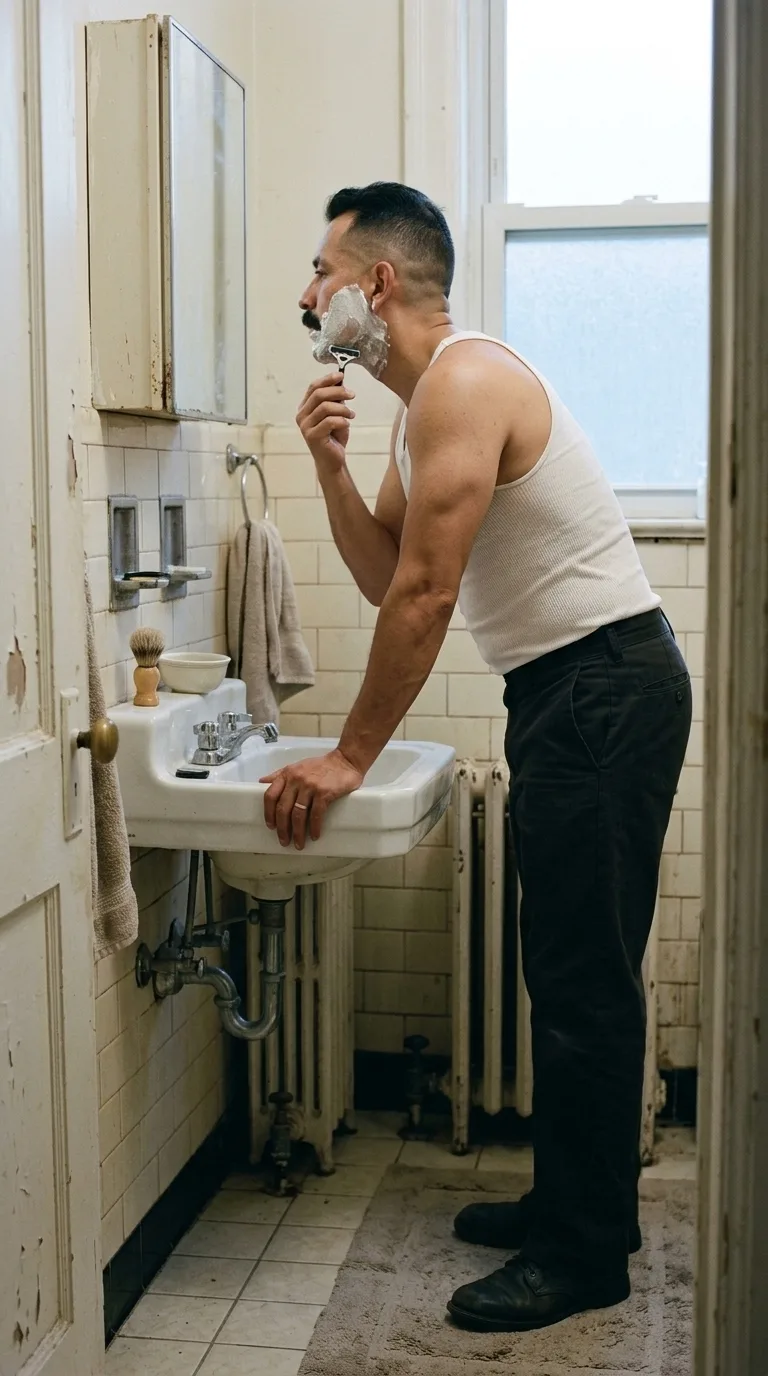
Rarest thing about him: Doorman — uncommon, 1 in 2,442
Season 1seed 1412489954 · engine v11
Character card
lineage 2NZHHJ
His body-swap story
@connor.waskiewicz, wearing Esteban Cordero, rolled the wheel on and woke up as Ismael Barrera, spent under a minute in him, then spun the wheel and woke up as Dean Kowalczyk
You are leaving Esteban Cordero because of a leg.
His leg, the left one, which wouldn't be still. Four hours and eighteen minutes in him, and you have stood at a kitchen window in Boston before light with the heel drumming the linoleum, and nothing you did would stop it. Then you saw why. There was a voicemail from a sister he hadn't called back, and his thumb kept hovering over it. You could have pressed it. You didn't. You didn't want his sister's voice in your ear saying a name that was now yours to answer to. The leg went on drumming. The phone stayed dark. The wheel was already open on the screen, and the 1434th spin was only a tap.
You tap.
The razor moves.
It moves up the jaw against the grain, and it does not stop at the corner of the mouth where something in this body expects to stop. There is foam on half your face, cool and then warm where the steam from the tap has reached it. Your weight is forward, one palm flat on the cold lip of a porcelain sink, and the other hand is already finishing what it started. The blade goes faster than the man who began this would have let it. The second half is done before you've decided anything.
Then the rest comes in through the skin.
The porcelain under your palm gives you a kitchen first: a woman's voice, mid-argument, and the sink is a different sink, and he is gripping its edge the same way, to keep his hands from doing something worse. The thing on your finger is gone but the ring finger knows it. There is a pale band there, and the thumb goes looking for the metal that isn't there. It finds skin, and the flash is her, Lucía, handing the ring back across a table without a word, and him saying thanks as if she'd passed the salt.
The undershirt clings thin and ribbed against your back. It is the one he puts on first, always, before the rest. You feel him in the dark of a building, pulling it over his head at some hour nobody else is awake, the cotton still warm from the dryer in the basement. Beneath it the body is good: shoulders that carry, a stomach that has been disciplined, thighs that stand for ten hours without complaint. Standing is the job. Standing and opening a door.
Your left leg is bouncing. You hadn't noticed. It bounces on its own, a small furious metronome, and when you press it still it hums like a held breath. You know where that comes from now: the nights he quit smoking, two years of them, every craving gone down into the knee. Sober, too. A different hunger, older, with a date behind it. He keeps the date. A coin in a drawer, a sound in the hallway of a church basement he doesn't call a church. He says he believes in something. He just doesn't say what.
The trousers are pressed black wool, stiff at the crease, and they give you the closet. The gray coat on its hanger by the door, heavy, gold braid at the cuffs, the white gloves folded on the shelf above. Every morning he dresses the way you would lay out a person: gloves last, cap last of all. The shoes on your feet are polished to black glass, and the polishing comes back, a rag, a Sunday, his daughter sitting on the tub's edge asking why he shines them when nobody looks at feet. Because they do, he tells her. Because someone always does.
Two of them. A girl and a boy. The boy's front tooth coming in crooked. They live across the city with their mother and he has them on weekends, and the rest of the week he has other people's children: the ones he lets into the prewar lobby, the ones whose names he learned before their parents'. He holds the door. He remembers the dog. Under the awning, on the cold days, in the late light that comes slant over the backyard steps, he is somebody a whole building leans on and nobody sees. He is worth almost nothing, a few thousand dollars and a pension that doesn't exist. You feel that too, flat and plain, like a floor.
The air smells of soap and radiator dust. Steam ticks in the pipe behind you.
You straighten. The mirror gives you a mustache untouched, black and full, one side of the jaw gone clean, the other still white with foam. You look at your hands. The razor is in the right one. The left has the pale band, and you turn it over, and the knee keeps drumming.
"Okay," you say, and the voice is lower than the last one, and easy in the chest. "Okay, Ismael."
You rinse the blade. You do not know whether this is an hour or a year.