Javier Melendez
Fictional. Generated by AI — not a real person, and no likeness of one is intended.
33, electrician in Miami · rolled by @colin.hasbrook · card — no film
History
who has worn him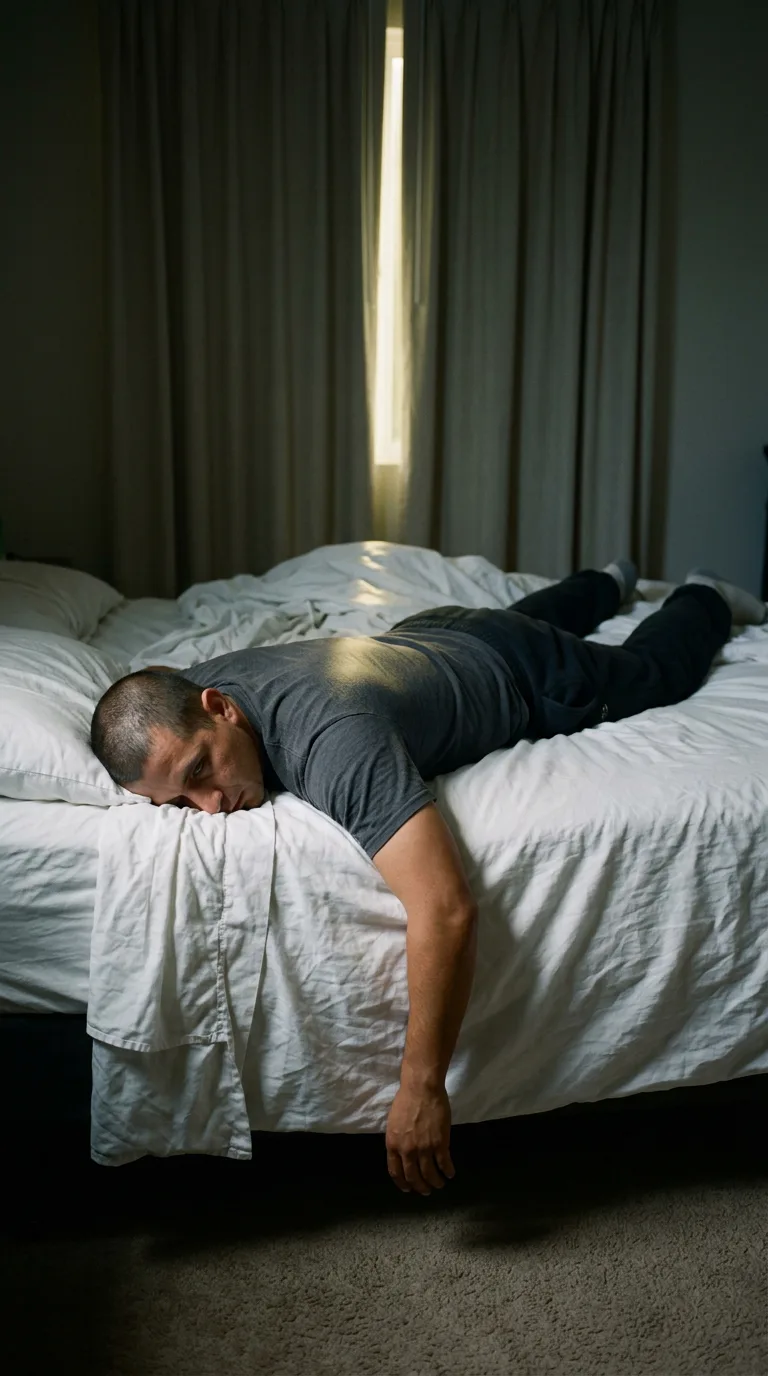
Rarest thing about him: A cleft chin — rare, 1 in 24
Season 0seed 1618447265 · engine v10
Character card
lineage 2NZHHJ
His body-swap story
@colin.hasbrook, wearing Peter Vaskovich, rolled the wheel on and woke up as Javier Melendez, spent under a minute in him, then spun the wheel and woke up as Harold Sakamoto
---
Peter Vaskovich's apartment smells like the mover he is — cardboard dust and the ghost of somebody else's basement. You've been him less than a minute and already you know why you're leaving. It's not his body, exactly, though the skinny-fat of him, the ache already starting behind the knees at forty-one, doesn't help. It's that he just checked his phone out of habit, the way you keep doing in every one of them, and there was nothing on it worth reading. No one waiting up. Five hundred and forty-eight men and you keep landing back in this — the quiet after, the apartment that isn't yours holding still around you, asking what now. You know the answer. You always know the answer. You open the laptop that isn't yours either and you go to the page with the wheel on it, and Peter Vaskovich, who has been alive inside your wanting for less than sixty seconds, spins it without ever knowing he existed at all.
The breath changes first. Ragged, then even, one long pull that isn't yours to take credit for — the body does it before you've finished arriving. You're face-down in sheets that smell like fabric softener and someone else's shampoo, an arm hanging off the mattress into cool air, and you feel that arm — heavier than Peter's, shorter, thick through the forearm — draw itself up on its own timing, not yours, like the body remembers a posture you haven't chosen yet. It rolls you onto your back. Hands fold at your chest. Streetlight comes through a gap in the curtain in one clean vertical line, and somewhere behind you, close, someone else breathes in her sleep.
It is the middle of the night here too, but wrong in the body — too rested, too easy, like a man who worked a double and is only now getting the sleep he's owed. That wrongness is the first thing that isn't information, just feeling, and it isn't yours.
Then the shirt.
Not on you now — it's on the doorknob of the closet, hung there for a job that's still hours off — but your hand knows it before your eyes open all the way, the particular weight of a Dickies work shirt gone soft at the collar from washing, and it gives you Javier reaching for it that morning, the real one, the one his body remembers underneath this borrowed sleep: the name patch stitched crooked because he sewed it on himself after the first one fell off in the wash, JAVIER in white thread he's proud of and never mentions. Sleeve by sleeve, elbows first, the fabric already gone shapeless where he's pulled it on ten thousand mornings, smelling faintly of drywall dust no washing gets all the way out. He buttons it one-handed, fast, thinking about the panel he left half-terminated the night before, the breaker that kept tripping in a house on the water where the owner keeps asking when, when, when, like electricity is something you can rush.
The belt — tool belt, not the one he sleeps in, but his hips know its weight so well that even empty they ache a little for it, a permanent tenderness at both hip bones, thirty-three years old and already carrying it like fifty. Pliers worn smooth. A level he's had since his first year, cracked vial, still true. His hands know conduit the way another man's hands know a guitar — bend, measure, bend again, the small triumphant click of a fitting seated right. He is good at this. He has always been good at this, and it is the one thing in his life that has never once let him down.
The mattress under you gives him back too: her weight beside him, the girlfriend, the warm particular shape of her turned away in sleep, and the low permanent ache underneath everything that is not about her at all — an ex, a woman he does not let himself think about on purpose, who left with a version of him he liked better, and who he still, three years later, sometimes almost calls by accident. And a child somewhere in this city who has his chin, that same cleft, undeniable, a joke people make at first meeting that never once stops landing.
He takes medication for something he doesn't talk about, a small bottle in the bathroom cabinet his fingers know without needing to look, and some nights, like this one, it lets him sleep clean through, dreamless, which he has learned to be grateful for instead of suspicious of.
He does not drink. He stopped years ago, quietly, without a story attached, the way some men just stop.
You feel all of it land in a body five inches shorter than Peter's, thirty-three instead of forty-one, every muscle economical and used, calluses on both palms that don't match Peter's soft mover's hands at all — these have done finer work, wire-stripping, hair-fine adjustments, patience Peter never had.
You lift your hands off the sheet and look at them in the streetlight — small scars from strand wire, not scars the facts would call scars, just wear, just weather, just a life. Green eyes you can't see but feel behind, somehow, the particular alertness of a man whose sleep is never quite as deep as it looks.
Beside you she stirs, not waking, and somewhere in the apartment a baby monitor hisses static into the dark.
You say it low, mostly to the ceiling, mostly to nobody:
"Okay. Okay, I'm here."
Underneath it, already, quiet as static: how long this time.