Héctor Reyes
Fictional. Generated by AI — not a real person, and no likeness of one is intended.
52, bouncer in New York · rolled by @colin.hasbrook · card — no film
History
who has worn him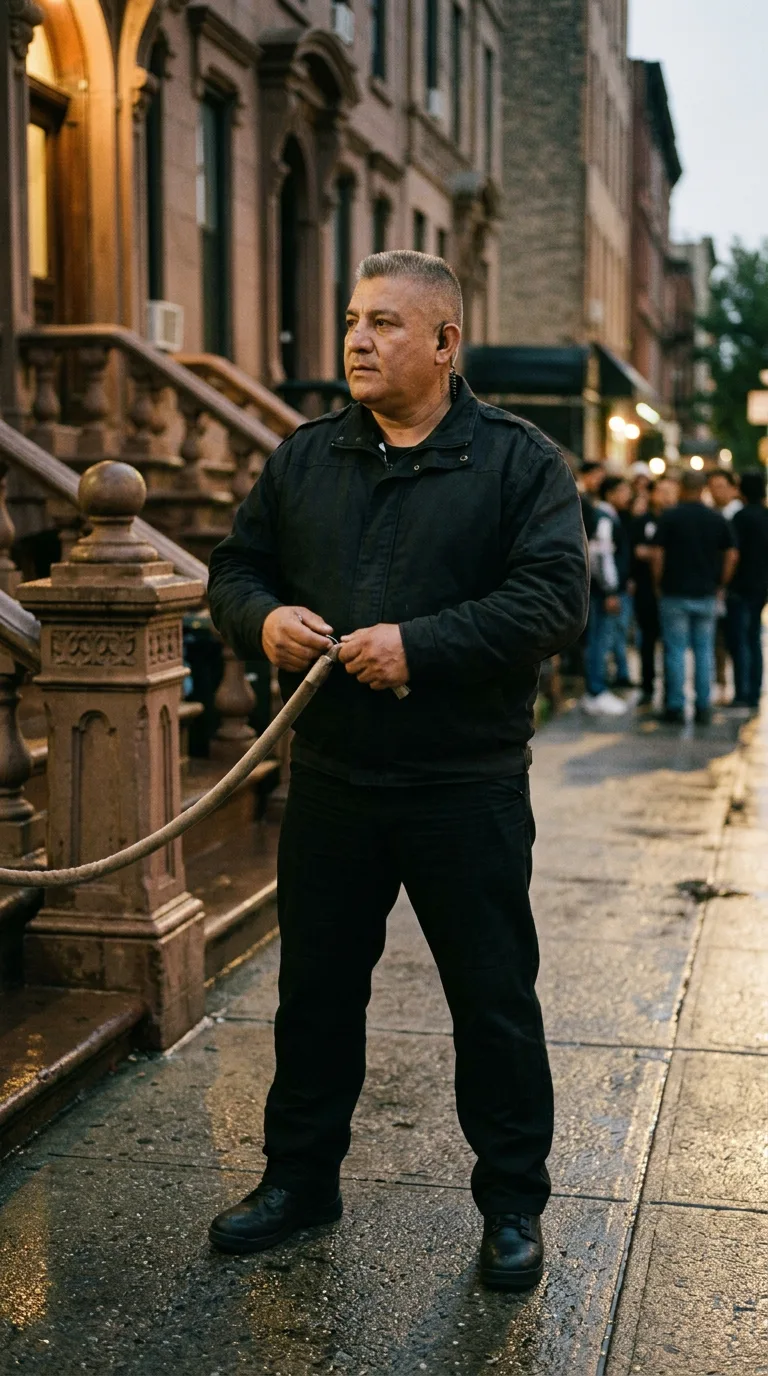
Rarest thing about him: Asthma — rare, 1 in 41
Season 0seed 429419097 · engine v10
Character card
lineage 2NZHHJ
His body-swap story
@colin.hasbrook, wearing Manny Figueroa, rolled the wheel on and woke up as Héctor Reyes, spent under a minute in him, then spun the wheel and woke up as Kyle Petrakis
The paint smell never leaves Manny Figueroa's hands, not really, not even now, standing in his own kitchen at two in the afternoon on a Monday with a brush he hasn't dipped in twenty minutes. He's been him less than a minute and already the wanting is back, already the itch under the itch. Sixty-three years old, average build, dark brown hair going gray at the temple in a way the mirror keeps pointing out. Good hands. Steady hands. A house painter's patience. None of it is enough today. The kitchen light is doing something flat and gray through the blinds, the kind of light that makes a Monday afternoon feel like it's already over before it started, and that's the exact feeling that sends him back to the site — not boredom with the man, just the flatness of him, the sameness of a life spent climbing the same ladders. He opens the laptop on the counter, still tacky with a thumbprint of eggshell white on the trackpad, and the wheel is already loaded from last time, patient, colorful, waiting like it always waits.
He spins.
You are gripping a rope.
It is thick and damp under your palm, salt-stiff, and your other hand is a few inches behind it on the same length, and there is a half-second where the motion that was supposed to happen — clip the carabiner, step back, let the line go taut across the stanchion — comes out wrong, fumbled, the hook missing the eye entirely. You do it again, slow, deliberate, like a man checking his own work for the first time in a decade. Then you do the next ten clips the same way. Checked. Every one. Sodium light is coming down orange over wet stone, and there is a line of people down the block in the kind of clothes people wear to be looked at, and none of them notice that the man at the rope has gone somewhere else for a second and come back different.
The jacket is the first thing. Heavy canvas, worn slick at the cuffs, a season's worth of cold nights soaked into the collar, and touching it brings back the morning it was pulled on — Héctor's shoulders rolling into it in a bathroom that still smelled like his girlfriend's coffee, the zipper catching the way it always catches, a habit of yanking it twice before it seats. He'd stood in front of the mirror that morning the way he stands in front of it every morning, unimpressed with what was there, the nose still a half-inch off from a night twenty-six years back that he doesn't tell the story of anymore because everyone at the club has heard it. Gray crew cut, tapered close, flat on top — a barber on Nostrand who's cut it the same way since Reagan. He'd pressed two fingers to his sternum before leaving, an old tic, checking that the air was moving right, because some mornings it doesn't, some mornings the walk to the train turns into a fight for breath and he has to stop by a stoop not unlike this one and wait it out, inhaler in the jacket's inside pocket where his hand goes now without thinking, brushing its shape through the canvas like touching a rosary.
The rope again — its damp weight keeps giving him back pieces of nights. Ten thousand times he's held a line like this one, and his body remembers all of them at once, a blur of faces let through and faces turned away, a young man's chin lifted at him once and Héctor's voice, flat and final: not tonight, papi, come back sober. He remembers his girlfriend's laugh through the phone on his break, low and easy, and the sound of his two kids — grown now, one of them with a kid of her own — calling him on Sundays because that's the day he's reliably not working. He remembers church, the particular hush of a Sunday service he half-dozes through some weeks, tired down to the marrow, and how he asks forgiveness after for the dozing and for other things too, small things, a drink more than two some nights, a temper he keeps on a leash tight enough that people mistake him for calm. His jaw is already tight now, has been tight since before you arrived, a clench that isn't anger so much as a man's engine idling. Fifty-two years old, heavy through the middle, the ache riding low in both knees from thirty years of standing on concrete, lungs that catch sometimes on cold air like tonight's, though tonight isn't cold, tonight is only wet.
The boots know the stoop's third step is higher than it looks. The earpiece coiled behind your ear carries a smell of vinyl and old sweat that isn't unpleasant, just his, just years of it. Somewhere behind you the bass from inside thrums up through the stone and into the soles of his feet, and that, too, is a memory — decades of nights measured out in other people's music, never his own, a man who prefers the radio in his own car tuned to something with words he can sing along to, off-key, alone.
You look at your hands. Broad, callused at the base of each finger, a half-moon of white paint that isn't there, isn't from this man, is only leftover feeling from the one you left standing in a Philadelphia kitchen an hour behind this one. You turn them over under the sodium light like you've never seen the backs of them.
"Hey," you say, to no one, to the line, to the rope still humming faintly with tension in your grip, "I'm alright — go ahead."
And the line moves, and you let it.