Gregory Amsler
Fictional. Generated by AI — not a real person, and no likeness of one is intended.
46, stay-at-home dad in Los Angeles · rolled by @ramon.cardenas · card — no film
History
who has worn him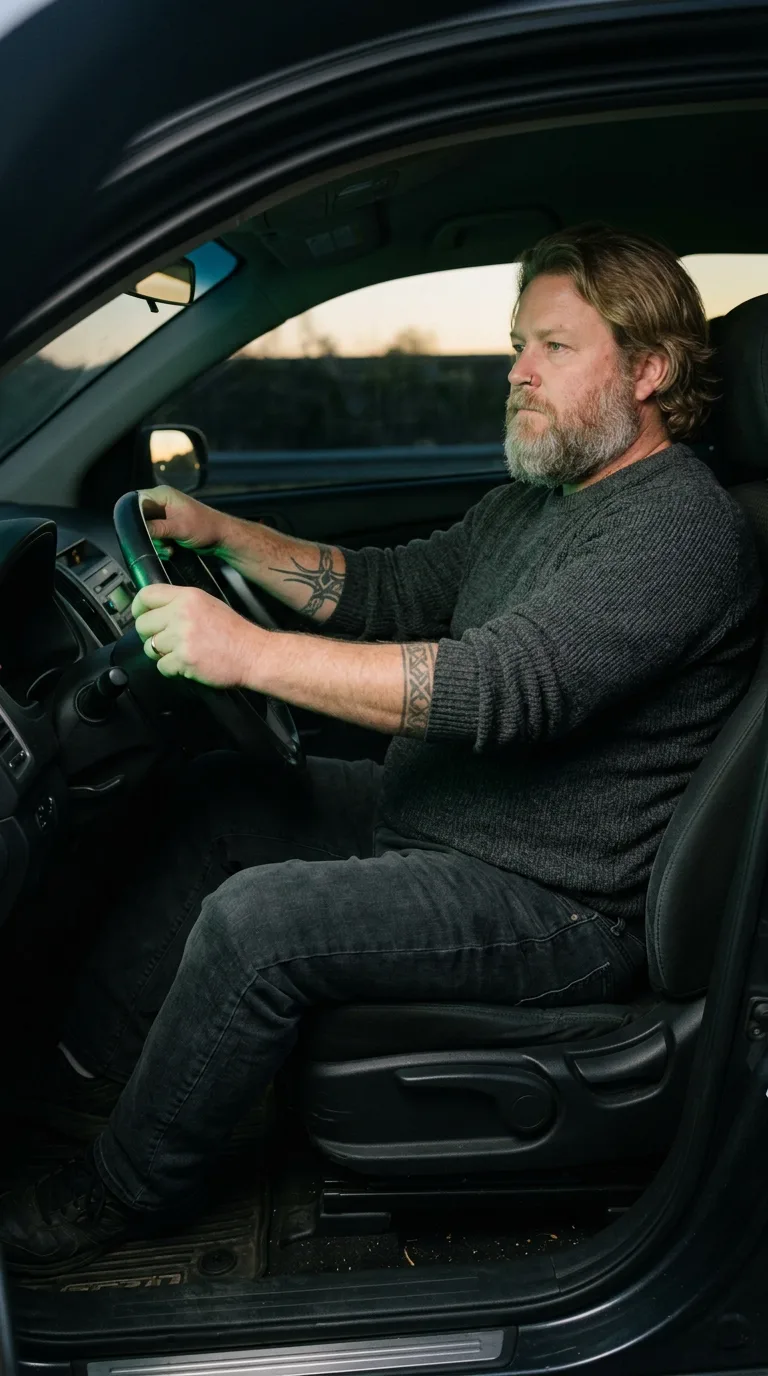
Rarest thing about him: Nose — common, 1 in 71
Season 1seed 339076647 · engine v11
Character card
lineage GAM5PT
His body-swap story
@ramon.cardenas, wearing Sal Ferriero, rolled the wheel on and woke up as Gregory Amsler
Sal Ferriero's forearm aches where the drywall bucket bit into it yesterday, and that ache is the whole problem. One day in this body and already the job is asking things of it that the job used to ask of somebody younger. You stand in his kitchen — his kitchen, a foreman's rental with a folding table and no photographs on the walls — turning the phone over in his big scraped-up hand, and the ache decides it. Not fear, not guilt. Just a small, practical dissatisfaction, the kind you'd feel about a car that pulls a little to the left. You open the site. The wheel is already spinning before you've admitted to yourself why.
The car drifts a foot toward the line and pulls itself straight, smooth, like a hand correcting a hand. Both palms come off the wheel and land again lower, wider, softer — a stranger's grip finding a stranger's wheel — and you feel the whole weight of him settle onto you at once: heavier through the middle, shorter in the seat, beard-warmth against a jaw that wasn't there a breath ago. The signal ticks on for an exit three miles early. You don't fight it. You don't know yet that you should.
Your hands — his hands — are still at ten and two for a second, out of habit that isn't yours, and then they drop to the wheel's bottom arc, the way a man drives when he's not really thinking about driving, when the road is a groove worn into him. The dash light is green-gold on his knuckles, and one knuckle has a callus you didn't put there. A thin ring of metal in the nose catches the light when he — when you — turn your head to check the mirror, and the sensation of it, faint and foreign, is the first thing he gives you: a flash of a tattoo parlor in Highland Park, twenty-six years old, a friend daring him, the ring going in and him grinning through watering eyes. Gone before you can hold it.
The wheel under your palms brings more, layered, arriving in no order at all. Ten and two on this same road, a thousand nights of it, the particular hum of this particular engine, a country station he keeps meaning to change and never does. The tribal ink on the forearms — done at twenty-three and twenty-five, two separate fits of the same bad idea, and neither of them regretted, exactly, just outgrown, the way the arms themselves got heavier around the ink until it looked less fierce and more like something a dad has. The wedding band on the left hand is warm from his own skin and it opens wide: a courthouse in Van Nuys, his wife laughing at something the clerk said, her holding both his hands and neither of them able to stop smiling, eleven years gone by now, easy in a way marriages aren't supposed to stay easy but this one mostly has.
Under that, quieter, a name you weren't looking for: Theo. Not recent. A softness that comes with the name that has nothing to do with the wife and doesn't contradict her either, just sits alongside — a man he loved before all this, who is somewhere else now living some other version of a life, who Gregory still thinks about on nights exactly like this one, headlights and empty road and nobody to perform for. The feeling that comes with it is not longing exactly. It's more like a door he keeps oiled so it won't creak, just in case he ever wants to open it again, knowing he won't.
The shirt against your back — his sweater, dark and soft, worn thin at the elbows — gives you this morning in fragments: pulling it over his head in the bedroom before the sun, careful not to wake her, the smell of fabric softener and himself, a small ordinary vanity about the gray coming into his beard that he indulges for exactly four seconds in the bathroom mirror before he stops caring, the way he always stops caring. Downstairs, a small hand had grabbed two fistfuls of his sweatpants leg and refused to let go until he crouched down and made a face, and the boy laughed the laugh that undoes him every single time, the laugh that is the actual center of his whole day, every day, in a way nothing else in his life is. The dinosaur backpack. The bear that goes everywhere. The laundry basket balanced on one hip like it weighs nothing, because compared to some things it doesn't.
His body tells you what it knows without asking: the low ache across the lower back that thirty extra pounds put there sometime in his thirties and never took away, the particular ease of the shoulders that comes from carrying children and baskets and groceries for years until the carrying became the shape of him, the soft gut he stopped fighting somewhere around forty and made peace with the way you make peace with weather. Nothing dramatic in it. Just a body that has been used gently and constantly for a decade of ordinary devotion, and is a little tired the way that kind of use makes a body tired.
The car finishes its unbidden turn onto the wrong exit, and the hands on the wheel — his hands, cuticles picked ragged along both thumbs, a habit he's never noticed himself doing — ease off the gas without your telling them to. They know this stretch, whether or not it's the right one.
You lift your right hand off the wheel first, into the dash glow, and look at it: thick fingers, a ring, a torn cuticle at the thumb going pink where he's worried it raw without meaning to. You turn it over once, like it might read differently on the back.
"Wrong exit," you say out loud, to no one, in a voice that isn't the one you walked in with — and you don't correct the wheel yet, and you don't know for how long you won't.