Gilbert Navarrete
Fictional. Generated by AI — not a real person, and no likeness of one is intended.
45, mechanic in El Paso · rolled by @connor.waskiewicz · card — no film
History
who has worn him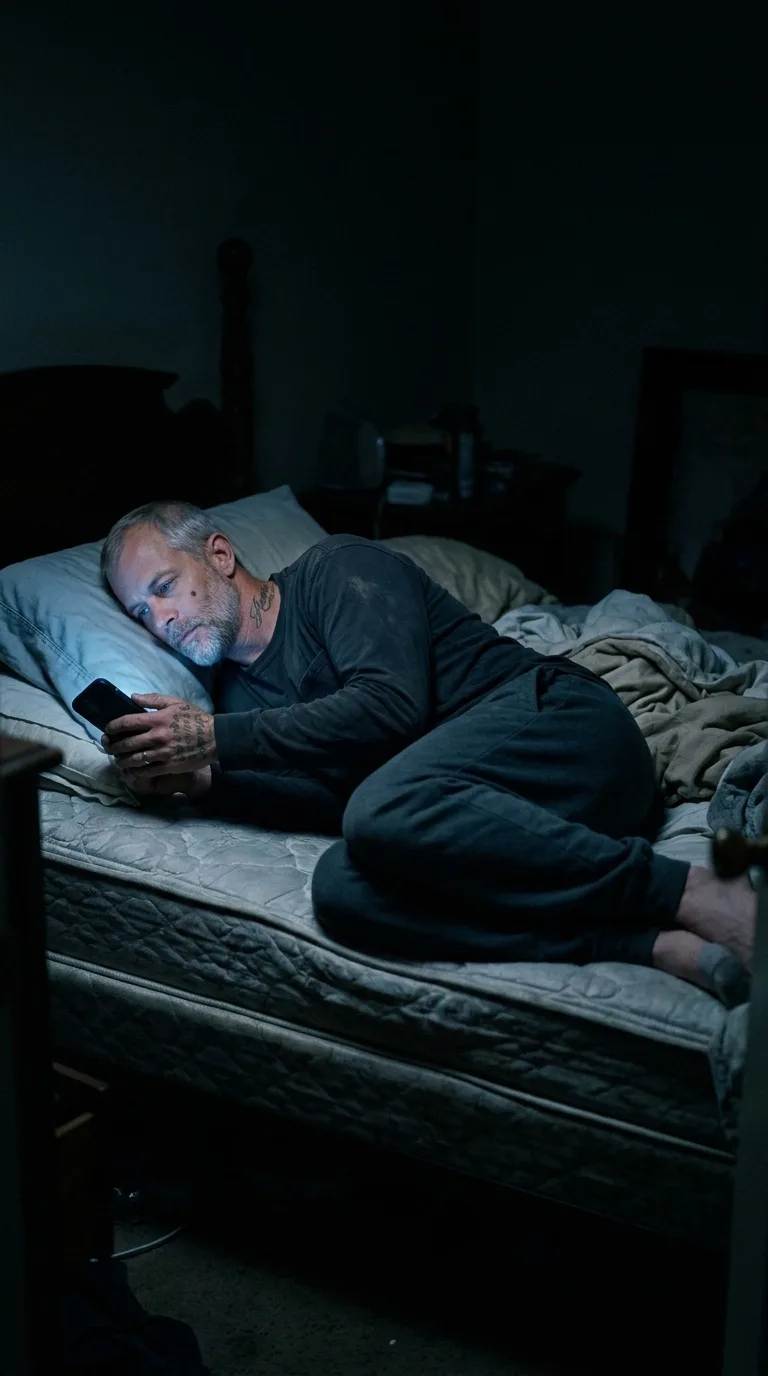
Rarest thing about him: Hand or neck (visible) — common, 1 in 87
Season 1seed 1976732896 · engine v11
Character card
lineage 2NZHHJ
His body-swap story
@connor.waskiewicz, wearing Colton Rusk, rolled the wheel on and woke up as Gilbert Navarrete, spent under a minute in him, then spun the wheel and woke up as Owen Margolis
You are Colton Rusk, twenty-one, and your knees are fine, which is the problem. Everything works. The restaurant keys are on the dresser in a dish shaped like a pepper, and the apartment hums with someone else's sleep. In the dark you stand at the window of a man you have been for under a minute, and nothing in him is wrong. That is what sent you back. It is too easy. He has never once been tired in a way that mattered, and you can feel you will not learn anything in him. The brown eyes keep watching a parking lot that wants nothing from you. So you open the phone and pay, and the wheel turns the way it always does, ticking down through faces.
Then you are lying on your side, and the light is in your face.
A phone sits six inches from your eyes, blue and close. Your thumb stops mid-scroll on something you do not read. The mattress is thin and gives under your hip. Someone is asleep in this house or near it, and the air is cool and dry with a trace of dust. You are heavy in the shoulders, and your right leg is already bouncing under the blanket, a small steady jitter you did not order. You make the thumb go again. It goes faster and steadier than whatever it was doing before, flicking past everything he had stopped on. You have no wish to read any of it.
The sleeve against your forearm is soft, washed thin, and it knows him. The memory arrives with its own feeling. It is a morning in the dark, before the heat, his husband's back turned in the bed and the turquoise wall of the house going gray at the window. He is pulling the work shirt on over his head, one arm and then the other, and the cuffs are stiff with old grease that will not wash out. He does it quietly so as not to wake the man. He loves him in that quiet and does not say so. The feeling is plain and warm and has no words in it.
The band on your left hand is cold when your thumb turns it. A whole afternoon opens. A courthouse, a borrowed jacket too tight across the back, and a priest afterward who blessed them anyway on the steps. He had cried in the car, a little, with the heater on in July. Then the children are there, two of them, loud in a kitchen, one with a scraped knee holding out a foot to be looked at. His hands know exactly how to hold a small ankle. Your hands know it now.
Your tongue finds the pouch tucked under the lip. A sting and a mint, and then a year of it: the drinking he gave up, the night he poured it out in the yard with the sprinklers ticking, and the nicotine he kept because a man needs one thing. The pouch is the one thing.
You taste the dust. You feel the ache low in the back, a mechanic's ache, forty-five years of leaning under cars. The shoulders are strong and the knees complain a little, and the gray scalp feels cool at the crown where the hair has thinned. There is a mole on the cheek that you feel only because the screen's light is warm on it. Under the thumb on the ink at the neck's edge is a name and a date, and you do not need to know whose. His chest tightens anyway, and you let it.
The leg keeps bouncing. You hold the phone away and look at the hand. The lettering runs across the knuckles, the ring is plain gold, and the nails are rimmed black no soap reaches. You turn it over. The palm is rough and warm and entirely yours for now.
You look up into the dark and say, low, so you do not wake anyone, "Okay. Hello."
Then you wait to feel whether the wanting comes back, and how soon.