Colton Rusk
Fictional. Generated by AI — not a real person, and no likeness of one is intended.
21, restaurant manager in Dallas · rolled by @connor.waskiewicz · card — no film
History
who has worn him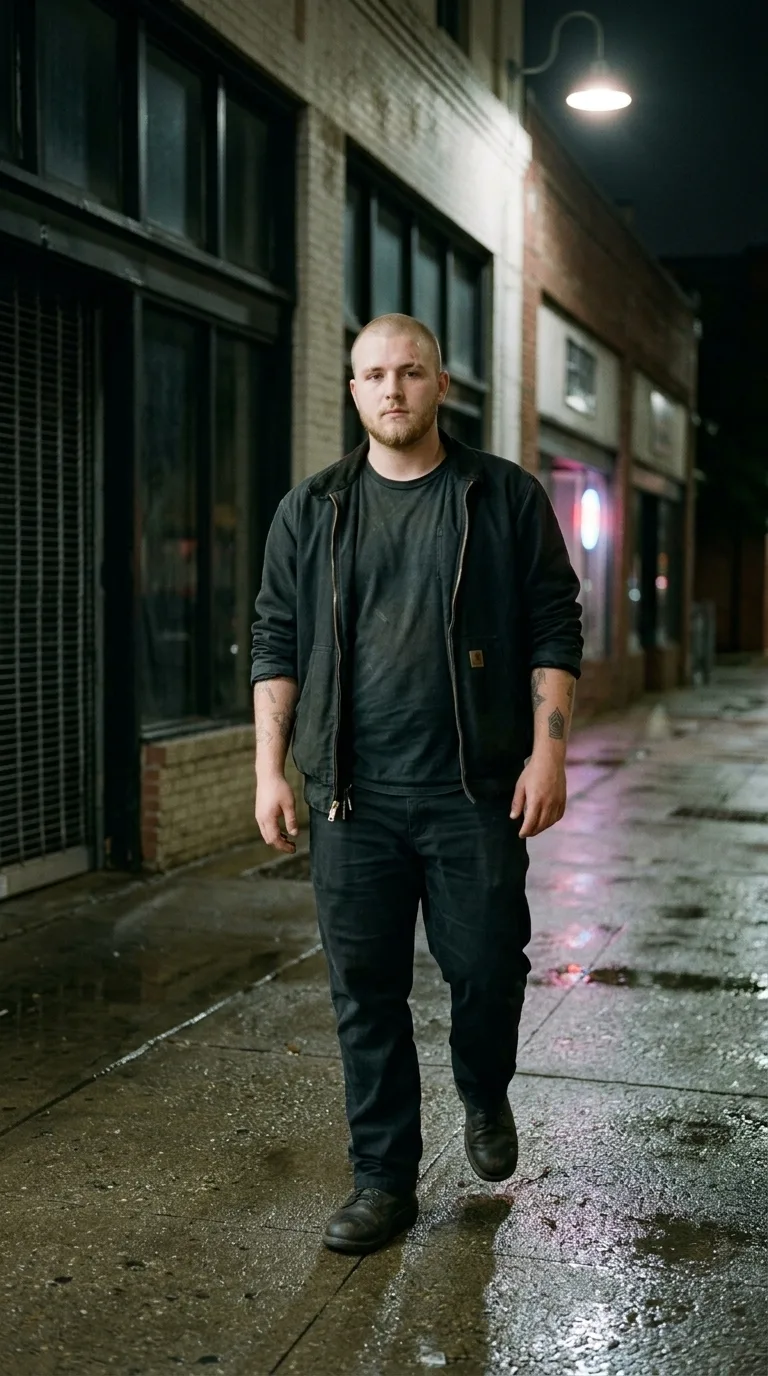
Rarest thing about him: Drunk, walking home the long way — common, 1 in 64
Season 1seed 944219667 · engine v11
Character card
lineage 2NZHHJ
His body-swap story
@connor.waskiewicz, wearing Curtis Lindahl, rolled the wheel on and woke up as Colton Rusk, spent under a minute in him, then spun the wheel and woke up as Gilbert Navarrete
You are standing in Curtis Lindahl's kitchen in Houston, and the whole house is asleep. His boots are by the door, black to the ankle with other people's engines. You have worn his body for less than a minute and already you know the trouble with it: the knuckles are split from a seized bolt, and there is a stiffness in the left shoulder that tells you what it is going to be like in the morning. Your palm is flat on the counter, on a cold ring left by someone else's glass. It is not the body's fault. It works, and it is what you asked for. But when you reached for a thing you wanted, the hands closed on nothing, and you stood there wanting it, and the wanting did not go away. So you open the page with the wheel on it. It is the middle of the night and nobody is awake to see you do it.
The wheel turns. Curtis goes out like a pilot light.
Wet air. The kerb is gone from under your foot and the whole big weight of him pitches forward, and your hand slaps down on the roof of a parked car, cold and beaded with rain. You hold. A shoe that was scuffing stops scuffing. Your breath comes out as beer, sour and warm, and the street swings once and settles. Closed shops, a lamp buzzing overhead, puddles holding pink neon.
The jacket comes first. Canvas, stiff at the cuffs, open on a black T-shirt, and when your fingers close on the lapel the cloth hands you a morning: his arms going into the sleeves in a hurry, the left one first because the right shoulder is lazy, and a small square patch of leather at the pocket he picks at when he is nervous. He has put it on over the shirt he wore to work, because the shirt was his good one and he did not want to ruin it on the walk. He is twenty-one and he is proud of the shirt. He runs the host stand on Fridays, the dining room so full the door will not close, and he is good at it. He can seat a party of eight with a look.
The car roof is cold under your palm and gives you nothing. The belt does. Keys hang from it, a ring of them, and when they knock against your thigh you get the heavy brass of the back-door key, the walk-in's padlock, a rush of cold air and a case of limes, closing alone at midnight with the dishwasher still thundering. He likes closing. It is the only hour the place is his.
Your leg is bouncing. You did not tell it to. It is the right one, heel up and down, even with all his weight on the car, and you know it is something he has always done, through exams and funerals and the wait outside his father's door. You can't stop it. You stop trying.
Then the sleeve. You push it back and there is the ink on the forearm, the chevrons and the unit's crest, and the skin remembers the needle before you do: a shop in Killeen, a buddy laughing, the stencil cold, and the way he said I'm doing it, and did. He was proud then too. There is a girl in it, later, a recent one. Her name is not given, only the weight of her, an apartment door shut gently rather than slammed, which was worse. That is why the drinking, and the long way home. The beer is a wall he walks beside and does not look over.
The scar over the eyebrow itches as you lift your hand to it, and the memory that answers is a fall, a bike, a gravel driveway, a mother's hands. You let it go. It is not yours.
Under all of it the body is plain and heavy and warm. A soft belly over the belt, thick thighs, a back that has stood for ten hours and is going to be sore. The shoes pinch. The head is padded in alcohol, and everything arrives half a second late.
You let go of the car. The scuff does not come back; your stride lands even and quiet. At the corner, you turn left, which is not the way home.
You raise your hands under the lamp and turn them over. Square palms, the tattoo, the pale seam of an old burn on one thumb. Warm, and yours for now.
"Okay," you say, in his voice, low and a little slurred. "Okay. You'll do."
The street says nothing. Somewhere under the words is the question you cannot put down: how long, and when it will start again, the wanting, and whether you will still be him when the sun comes up.