Gerald Novotny
Fictional. Generated by AI — not a real person, and no likeness of one is intended.
61, manager (mid-level) in Chicago · rolled by @colin.hasbrook · card — no film
History
who has worn him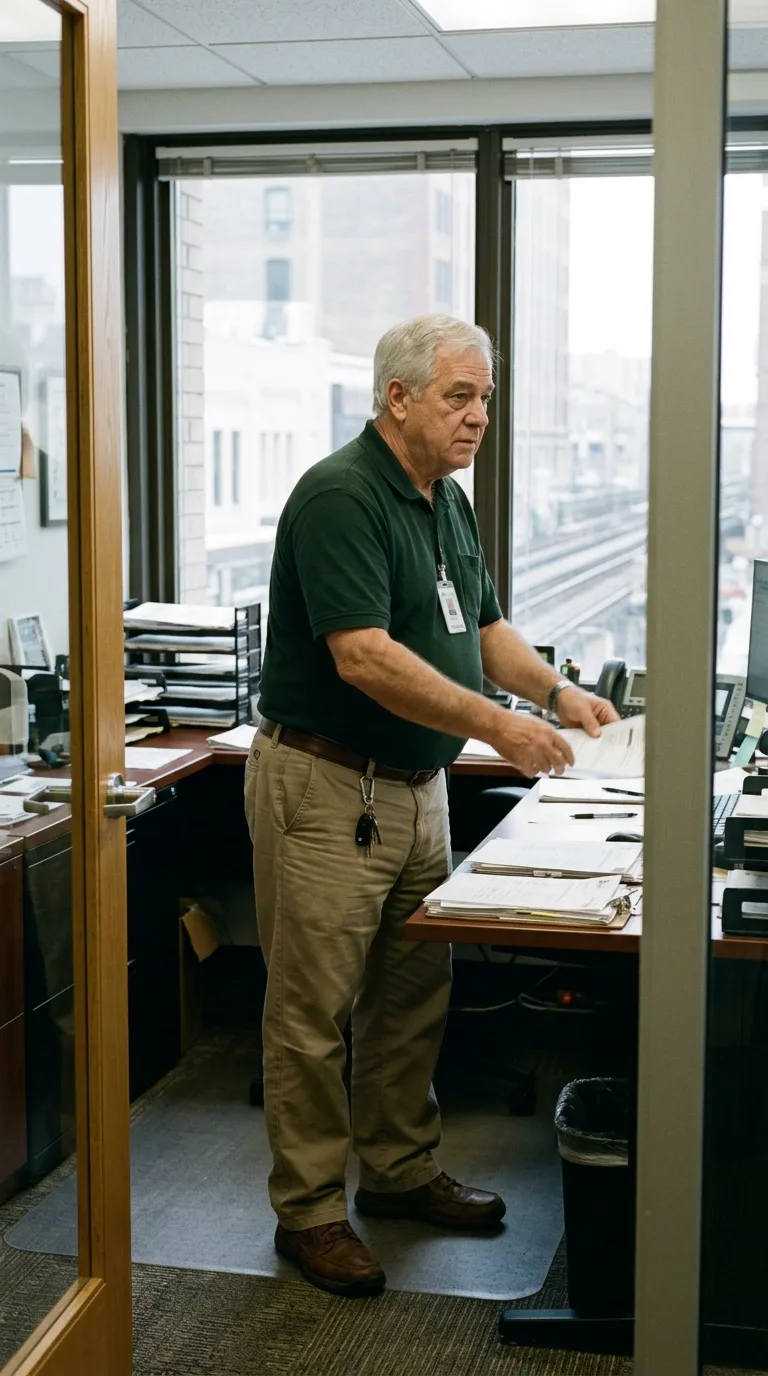
Rarest thing about him: Nicotine pouches — common, 1 in 31
Season 1seed 1887264623 · engine v11
Character card
lineage 2NZHHJ
His body-swap story
@colin.hasbrook, wearing Arturo Meléndez, rolled the wheel on and woke up as Gerald Novotny, spent under a minute in him, then spun the wheel and woke up as Colin Petrakis
Arturo Meléndez's hand is on a coffee mug that says WORLD'S OKAYEST BOSS, a gag gift from an assistant manager who left for a warehouse job in Bethlehem two years back, and you hate this mug, you have hated it for the entire forty seconds you have owned this body. The birthmark on his face itches in a way that isn't physical. You didn't even unpack him. You spun into a man mid-decision — heavy, tired, wearing a life that fits like a coat one size small — and something in you sat down in his chair and thought: no. Not boredom exactly. More like impatience, the specific kind that comes from being 794 men deep and still feeling, every time, that the next one might be the one where something actually happens. Arturo's life was fine. Fine is the whole problem. You reach for the site before his coffee's even gone cold in his hand.
You land in daylight.
That's the first wrongness — light where you expected the dim hum of a strip-mall office at two in the afternoon Philadelphia time, and instead a flat gray Chicago morning coming through a wall of glass, brick and steel and the underside of the L rattling past close enough to feel in the floor. A piece of paper is between two fingers, halfway to a stack. The motion stutters — you set it down wrong, pick it back up, set it down again, correct, slow, like a man double-checking a signature he's signed a thousand times. Nobody in the open office beyond the glass door looks up. Why would they. A manager pausing over paperwork is not a headline.
The body is heavier through the middle than Arturo's, but shorter, softer somehow even at the same rough weight — five-seven, dad-bod solid, the kind of frame that carries its weight in the belly and lets the shoulders stay narrow. Green eyes. You feel the freshly shaved jaw first, smooth in a way that surprises you, no drag of stubble, and gray-silver hair with a little length on top that isn't currently doing anything because his hand isn't in it yet.
Then his hand goes to his own face — old habit, not yours, pure reflex — two fingers dragging down his cheek toward his jaw, and that's the door. It swings open.
The polo shirt is the first thing that talks. Dark green, cotton gone thin at the elbows from years of desks, and it gives you a bathroom mirror at six-forty this morning, this exact shirt coming off a hanger because the blue one was in the wash, an old habit of pulling it on and tucking the ID badge under the collar so it doesn't flip. Gerald Novotny. Thirty-one years at this company if you count the two mergers, which he does, out loud, to anyone who'll let him. The belt gives you the notch he's worn into it, third hole from the end, tightened by hand this morning without looking, the way you knot a tie you've tied ten thousand times. The keys against his hip — house key, car key, a St. Christopher medal his mother put on the ring in 1987 and he's never taken off — give you a kitchen in Logan Square, coffee already poured, Denise's voice from the other room asking if he saw the number for the plumber, and the particular unhurried ease of two people who have made peace with each other's mornings a long time ago. No wedding ring. He thought about it once, years back, decided rings and machinery don't mix and never revisited the decision, and something in that not-revisiting feels like the whole man.
The papers under his fingers now — inventory counts, initialed in his own cramped hand — give you the job itself: twenty-six years of this floor, this glass box with the door that's supposed to stay open and mostly does, the particular tired satisfaction of a shift that runs clean because you've made it run clean for a quarter century. He likes his people. He covers for the ones who need covering. He has never once been the reason a shipment went out wrong, and he checks that fact against himself the way other men check their pulse.
The shoes — brown, broken in at exactly his stride — give you Sunday mass with Denise, the incense, the specific guilt of a nicotine pouch tucked under his lip during the homily because his hands wanted something to do and his mouth couldn't have a cigarette in a pew. A daughter, grown, in Milwaukee, a phone call every Sunday night he never misses. A body that aches in the lower back by three every afternoon and otherwise still does what he asks of it — the reach to a high shelf, the crouch to a low one, the long stand at this desk that thirty years of standing have made almost comfortable.
None of it is dramatic. All of it is his, entire, unbothered, a life built the way this floor was built — level, checked twice, holding weight it was never meant to be tested against.
You look down. Your hand — his hand — is broad and thick-fingered, a thin white watch loose on the wrist, and you turn it over slowly the way a man might check for a splinter.
"Okay," you say, to the empty doorway, to the trains going by outside. "Okay."
Somewhere behind you, in another city, in a chair that isn't yours anymore, a mug is going cold.