Gary Provo
Fictional. Generated by AI — not a real person, and no likeness of one is intended.
50, janitor in San Francisco · rolled by @colin.tarwater · card — no film
History
who has worn him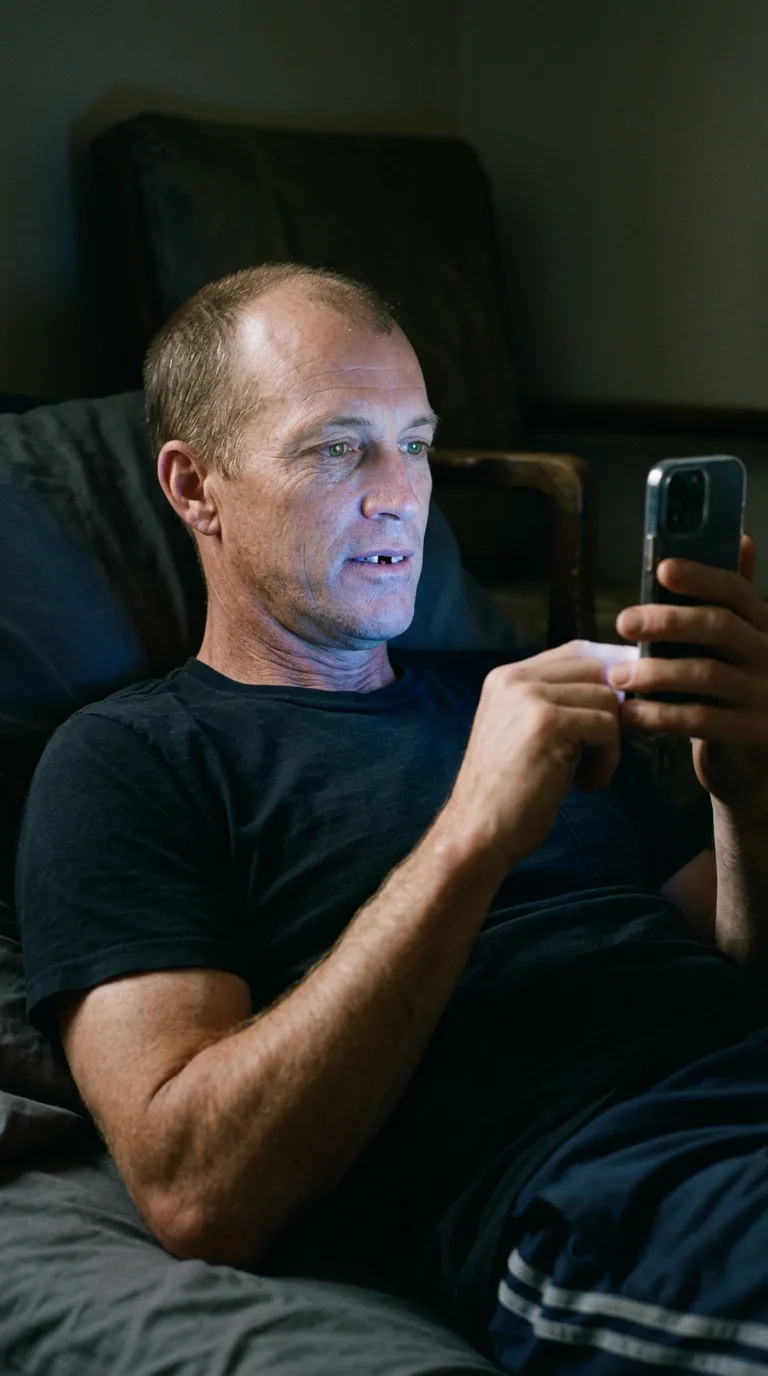
Rarest thing about him: A missing front tooth — epic, 1 in 124
Season 0seed 1274866067 · engine v10
Character card
lineage COEU7T
His body-swap story
@colin.tarwater, wearing Raymond Duckworth, rolled the wheel on and woke up as Gary Provo, spent under a minute in him, then spun the wheel and woke up as Dennis Yamashiro
---
Raymond Duckworth's uniform still smells like the sleeping car — dry-cleaned wool and coffee and other men's cologne — and you have been him for less than a minute, standing in the little closet-sized crew berth at the end of a corridor that sways when the train takes a curve. Fifty-nine years old, silver hair combed the way he combs it, a beauty mark on his jaw you keep catching in the mirror like it belongs to somebody else, because it does. You made him get up. You made him look at the mirror bolted to the wall, and something about the beauty mark and the collar and the whole neat, tired, put-together look of him just — itched. Seventy-seven men and this one is fine, this one is *fine*, he has a pension coming and a decent face and a job people respect, and that is exactly the trouble with him. There is nothing left to find out. You know already how tonight ends and tomorrow and the shift after that. You want the part where you don't know yet. You take out your phone — his phone — and you go to the site with the wheel on it, alone in the little berth, Tuesday night, New York already dark outside the window, and you spin.
—
The light doesn't move. That's the first thing: the phone is still six inches from a face, blue and steady, and the thumb under it stutters once and then keeps going, faster now, flicking past a video of a dog and a headline about the 49ers and a text from someone named Denise that was sitting there unread. You are lying on your side in a bed that is not a train berth, in a room with a low ceiling and a window at the top of the wall letting in the color that is not quite night yet — that flat gray-gold of a San Francisco evening sliding into the garage under somebody's house. Your — his — chest goes up and down slower than Raymond's does, a bigger chest, and there's a whistle way down in it on the inhale, faint, old, familiar to whoever owns these lungs and entirely new to you.
The shirt is not on you yet — that's tomorrow's shirt, hung on the closet door, you'll learn — you're in a black T-shirt gone soft at the collar, and the second your shoulder shifts against the pillow you get the first flash: not words, just the smell of bleach and orange-oil floor cleaner, so specific and so full that you nearly gag on a smell that isn't there. A corridor. Lockers. The particular echo of a mop bucket's wheels on waxed linoleum after the last bell.
His name comes up slow, the way names do when they're not being handed to you but grown, out of the shirt, out of the mattress, out of the phone still warm and humming in his hand — Gary. Gary Provo. Fifty years old. You feel the missing tooth before you know why it's missing — your tongue finds the gap on its own, an old habit that isn't yours, and gets a flash of a softball, badly caught, twenty years back, and a beer afterward that tasted like copper.
The mattress under you is thin, a futon really, and there's a step of cold that the pillow doesn't cover, coming up off a concrete floor that's inches under the bed frame. That's the garage. That's the whole memory arriving in a lump now that you've settled into the shape of it: a house up on Twenty-Third Avenue with a bay window and a family who is not his living upstairs, and him down here, under it, paying six hundred dollars into an envelope on the first of the month because the divorce took the actual house and left him this. The driveway outside cuts down so steep his knees complain on the way up it in the rain. He doesn't complain about it out loud. There's nobody up there he'd say it to.
The keys are not in your hand right now but you know their weight anyway, remember it through the fact of the belt loop they usually hang from — a school-issued ring, heavier than a house key ring, a small carabiner clip that he bought himself because the first one the district gave him broke. Room 14, room 22, the boiler room, the gym annex, the door to the roof that nobody's supposed to have. He likes the building best at the hour he's alone in it. The kids' noise gone out of it like water out of a tub, and just him and the buffer machine humming down a hallway lit by the security lights, one sneaker squeak on wet floor and then nothing. He has been doing this fourteen years. He was, before that, briefly, in his twenties, going to be other things — none of them landed — and there was a woman, Denise, whose name is still in his phone half a foot from your face right now, who married him at twenty-six and left at forty-one, no kids, no fight really, just a slow leak of two people out of the same rooms until there was only him left in them. He still thinks of her on Sundays. He goes to Mass some Sundays and not others and never examines the pattern.
The asthma is old too — a childhood thing that never entirely left, and his hand, when it's not busy, keeps drifting up over the bald crown of his head, feeling the stubble there the way you'd check a stove is off, an old tell nobody but him ever noticed doing. It's doing it right now, this second, phone forgotten a beat, palm over scalp, skin warm under it.
You look down. The thumb is still on the glass, and you make it stop.
You look at the hand — his hand, wide-knuckled, a callus at the base of the first finger from thirty years of mop handles and pallet dollies and a floor buffer that kicks left if you don't lean into it — and you turn it over slow in the blue light like it might tell you something the shirt and the mattress haven't already.
You say, out loud, to no one, in a voice with a gap in it where a tooth should be: "There you are."