Frank Costanzo
Fictional. Generated by AI — not a real person, and no likeness of one is intended.
63, bartender in New York · rolled by @marco.villagrana · card — no film
History
who has worn him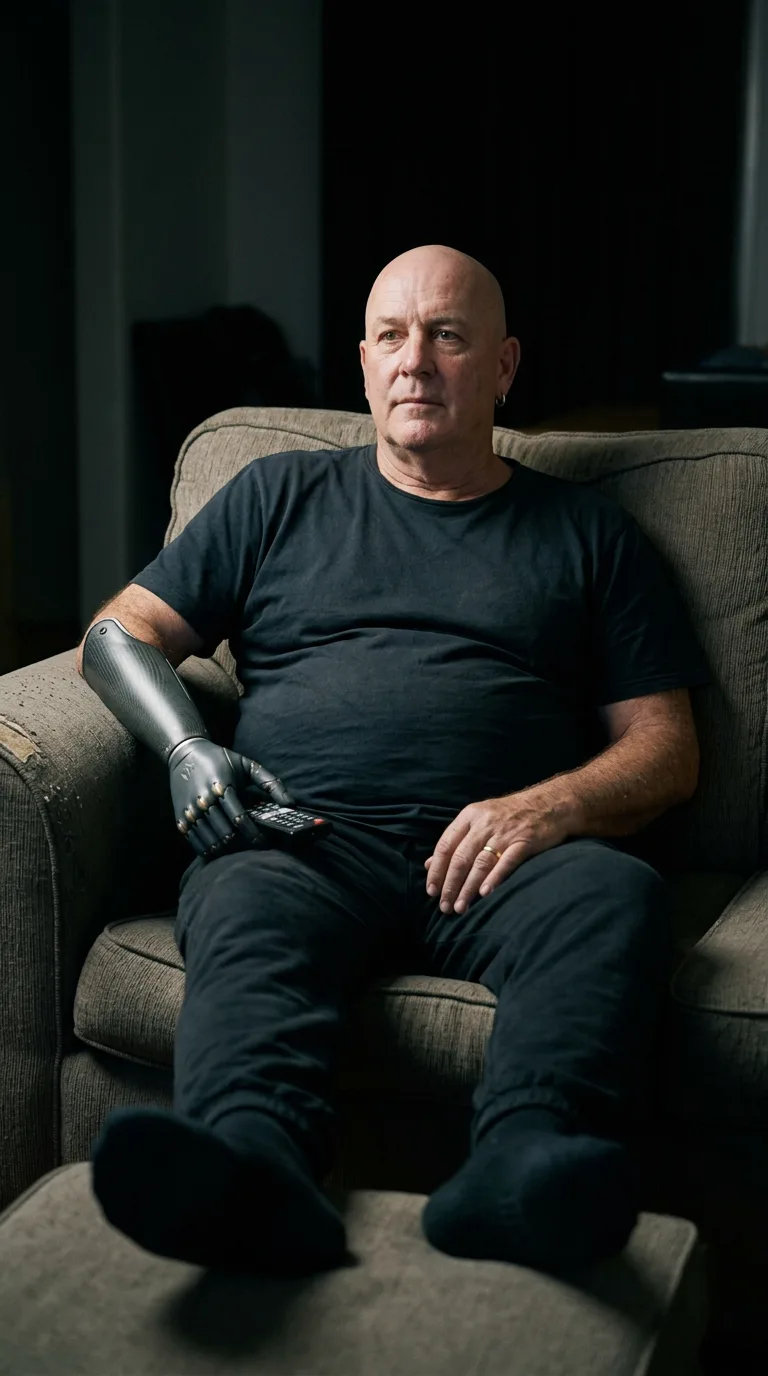
Rarest thing about him: Prosthetic hand or forearm — epic, 1 in 354
Season 0seed 535627518 · engine v10
Character card
lineage LJL8SV
His body-swap story
@marco.villagrana, wearing David Chen, rolled the wheel on and woke up as Frank Costanzo, spent 3 minutes in him, then spun the wheel and woke up as Isaac Rendón
---
You are two minutes into being David Chen, and already it isn't enough.
You know this feeling. You have known it seventy-one times now, in seventy-one different weights of body, and it always arrives the same way: not as boredom exactly, but as a kind of hunger that has nothing to do with the body doing the wanting. David Chen stands in his own kitchen in Atlanta with a phone in his skinny-fat hand, the delivery app still open, a route half-planned for tomorrow morning, and you feel the ache in his lower back from nine hours in a Corolla and you think, already, *not this one, not tonight.* His heterochromia eyes — one brown, one pale — blink at a microwave clock that means nothing to you. Sixty-one years old and his knees complain when he shifts his weight. You gave him two minutes. That is more than you gave the last four.
It isn't cruelty. You would not call it that. It is just that you have found the thing you actually came here for, seventy-one times over, and it is never the man — it is the spin. The half-second before the wheel stops. So you open the site again, David Chen's thumb doing it, David Chen's kitchen light overhead, and you pay, and you spin, and the wheel does what it does.
—
The show cuts to a bright frame and your head comes up off a couch cushion that isn't there anymore.
You are sitting straight-backed in the dark, a remote settling out of your grip onto a cushion arm, and the room around you smells like somebody else's house — fabric softener, cold coffee, the particular mildew of an old brownstone radiator. Your body is heavier than the one you left, wider through the middle, and there is a cool dead weight along your right forearm that does not feel like an arm at all. The television throws blue light across a stranger's living room. Whatever was funny on the screen a second ago does not reach you. You do not laugh.
Your left hand — hairy-backed, thick-knuckled, a plain gold band on the ring finger — comes up on its own and drags once across the top of your head, and only then do you understand it is bald, all the way, skin smooth under your palm. Something in the earlobe catches light when you turn your head: small, cold, a hoop.
Then his shirt tells you who you are.
It's a black button-down, sleeves rolled twice at the forearm, and the second your attention lands on the fabric it opens like a door — a whole morning arriving sleeve-first. You are standing in a bedroom in this same brownstone, the towel already looped over your shoulder for later, and you're working your prosthetic hand through the cuff the way you've done nine thousand times, the carbon fingers curling against the fabric with a precision your flesh hand never had even before. Frank. Your name comes with the shirt, unforced. Frank Costanzo, buttoning up for a Wednesday close-open double, telling yourself in the mirror that it's fine, it's fine, you've done this shift a thousand times, the anxiety a low hum under the ribs that the little orange bottle in the medicine cabinet keeps down to a hum and not a scream.
The couch under you gives another flash — Sunday mornings, the kids small on this same cushion, before it was recovered, before the fabric changed twice. Your wife's laugh from the kitchen, decades of it, layered thick as paint. The wedding band on your left hand is warm from your own skin and it brings her whole, suddenly, sharper than a photograph: the terrible flowers she picked for the wedding, thirty-some years gone now, and neither of you caring, because you were twenty-six and sure.
The dead weight on your right arm gives you the rest, and it is not a small thing to remember. Not an accident exactly — the story arrives with no drama in it, just a night at the bar, a broken glass, an infection nobody caught in time, and then a hospital, and then this: matte titanium fingers that you learned to trust more than you ever trusted the hand you were born with. Your body remembers the years of relearning — how to crack an egg, how to twist a cap, how to pour a shot without looking, until the prosthetic became the reliable one and the flesh hand the sloppy backup. Behind the bar it's an asset now, a thing regulars ask about, a story you tell exactly the same way every time because the real version is boring and the good version gets you a bigger tip.
Your feet, sock-only, are cold against the wood floor where they've slipped off the ottoman. That's real too — not memory, just now, this weight, this age, sixty-three years sitting heavy in a body that carries itself a little apologetically these days, dad-soft through the middle, strong still in the forearms from twelve-ounce pours and kegs muscled up basement stairs. Nothing hurts exactly. Something aches the way everything aches at sixty-three. You are, underneath all of it, tired in a way that has nothing to do with tonight, and sober by a decision you made a long time ago and have not once regretted, not through the divorce scare in your thirties, not through anything.
Two kids. Grown now, gone from this house, texted about twice a week. A wife asleep or reading upstairs, unaware that anything in this room just changed.
You sit in all of it a second longer than you need to.
Then you look down at your left hand, turn it over, watch the wedding band catch the TV light, and lift your eyes to nothing in particular — to the dark room, to wherever the next spin happens to be waiting.
"Okay," you say, out loud, to no one. "Okay, Frank."