Family doctor in Dallas
Fictional. Generated by AI — not a real person, and no likeness of one is intended.
35, family doctor in Dallas · rolled by @klaus.dietermann · card — no film
History
who has worn him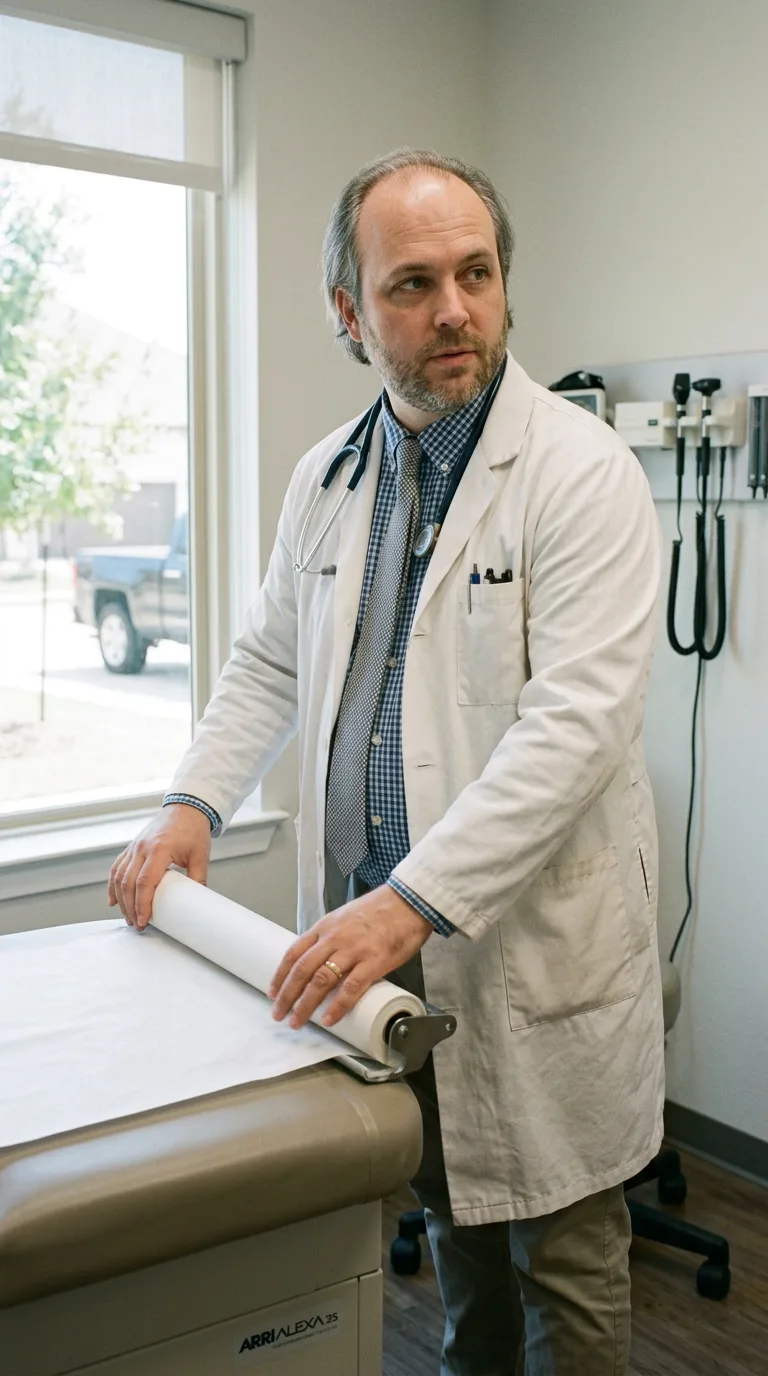
Rarest thing about him: Smokes and vapes — common, 1 in 52
Season 1seed 1310815880 · engine v11
Character card
lineage KEPHG1
His body-swap story
@klaus.dietermann, wearing Travis Bledsoe, rolled the wheel on and woke up as an unnamed body, spent 13 minutes in him, then spun the wheel and woke up as Owen Kittredge
---
The headset is still warm against your ear when you make the decision. Travis Bledsoe's hand — your hand, now, for however long "now" means — hovers over the mute button while a customer named Diane explains, for the third time, that her modem is blinking orange and she considers this a personal insult. Ten minutes ago you were someone else entirely, and ten minutes in you already know everything you need to know about this: the cubicle walls the color of oatmeal, the manager two rows over who breathes through his mouth, the particular Kansas light coming gray through blinds that don't quite close. It is the middle of the morning here and it feels like the middle of nothing. Diane is still talking. You open the site in the other tab, the one still loaded, the wheel still spinning lazy little decorative circles like it's glad to see you again. You don't even finish the thought that decides it. You just click.
—
The paper crinkles first. That's the sensation that arrives before anything else does: crisp white paper under a wide, soft body, one hand flat on the exam table roll and the other hand — his hand — pulling the roll forward to lay fresh sheet down for the next patient, a motion so old it doesn't need a mind attached to it. Except for half a second it does. The roll catches wrong, crooked, and the hand stops, and does it again, slower, watching itself do it like it's never done it before. Then does it nine more times, checked, each pass deliberate, on a job that stopped needing checking about eight years ago.
Outside the window a pickup truck sits in a driveway that belongs to a house that looks like six other houses on the street. It is the middle of the morning here too, except here "here" means Dallas, and here the light is doing something different — clean and flat and already hot at the edges of the glass — and none of that adds up to why a family doctor is at work at this hour except that it doesn't need to add up to anything. It just is the hour. It is always some hour or another, somewhere.
—
The coat comes first, because it's already on. White cotton, a little heavier than it looks, and with it comes a whole cold morning eleven years back — a residency hallway, an attending saying *you'll grow into the coat, Fielder,* and the joke landing wrong because he never has grown into anything, not really, not the coat and not the belly it hangs off now either. Dad bod, his wife calls it, fondly, cupping it like a secret at 6 a.m. before either kid's awake. Her name arrives with the ring — plain gold, a little tight these years — and it's Renata, and she is currently, somewhere in this same city, forgetting to eat lunch because she's got the pediatric dentist office and their daughter's retainer trouble on her mind, and he loves her the specific tired way you love someone you've stopped performing for.
The pen in the breast pocket — he reaches up without thinking, an old tic, and that touch drags up a whole decade of exam rooms, a thousand identical mornings, throats and ears and the particular relief of a diagnosis that isn't serious. He likes the job most days. Some days he hates it in the specific way you hate something you're good at and can't quit — a malpractice scare four years ago that came to nothing but left him checking his own charts twice, a patient who died anyway despite him doing everything right, the funeral he went to because nobody made him and he went anyway.
The shirt against his back — blue gingham, ironed by him, not her, because he likes the fifteen minutes alone with the board and the steam before the house wakes up — gives up this morning whole: standing in the closet in his boxers, the tie already picked because it's the only clean one, the half-thought about whether he has time to smoke one on the back step before the kids come down. He did. Leaned against the siding in the gray-blue almost-day, lighter out of the coat pocket though the coat wasn't on yet, thumbing the wheel twice before it caught, watching the cherry come up, thinking about nothing in particular, which is the whole point of it. His hands do that without him — flip the lighter, worry it, put it away — the way another man's knee might bounce.
The stethoscope collar-weight at his neck brings back the two kids by their names and their faces at once, too fast to hold — a boy's soccer cleats by the door, a girl half his height already arguing with him about screen time like she's twenty — and under all of it, quieter, something that isn't quite church anymore but isn't nothing either: a sense, walking into work most mornings, that whatever this is, it's going somewhere, that being useful to people counts for something on a ledger he can't see. He's never said that out loud to anyone. He wouldn't know how without sounding like an idiot.
The exam table under his palm is cool and it's the one thing in the room that isn't asking anything of him, and for a second — his last second, though he doesn't know to count it — that's a comfort.
—
You look down. The hand on the paper roll is soft through the knuckles, a doctor's hand that has touched a thousand strangers gently and never had to lift anything heavier than a chart, ring snug on the fourth finger, and it is nothing like the leaner younger hand you had ten minutes and one whole life ago. You turn it over once, feeling the small unfamiliar ache in the wrist that's just how this wrist has always felt, apparently, for thirty-five years.
Then you look up, out the window, past the truck, into the flat white light, and you say, to no one, in a voice that isn't yours yet but will answer to it:
"Sorry — where were we."