Fadi Haddad
Fictional. Generated by AI — not a real person, and no likeness of one is intended.
62, fisherman in Pittsburgh · rolled by @tyler.iverson · card — no film
History
who has worn him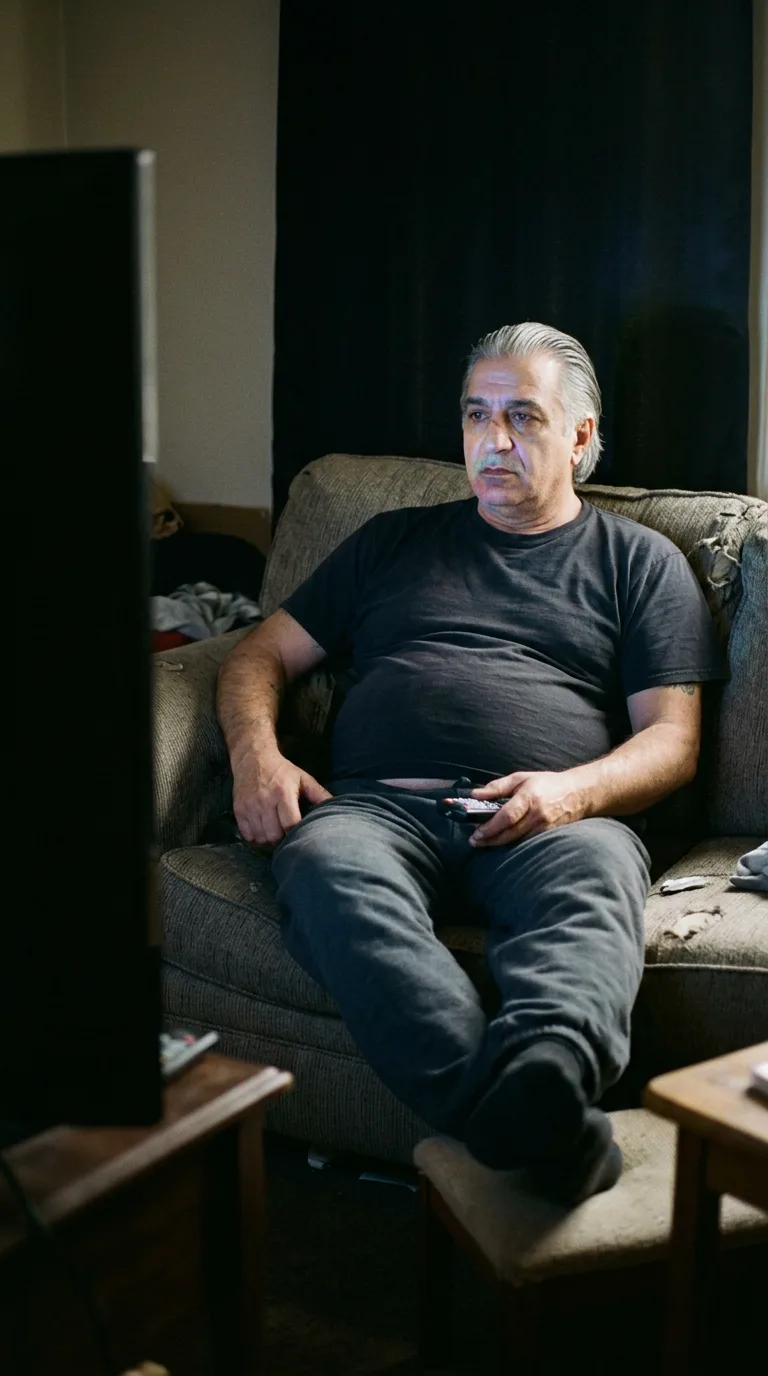
Rarest thing about him: Fisherman — rare, 1 in 158
Season 0seed 1781685729 · engine v10
Character card
lineage 9IC4OB
His body-swap story
@tyler.iverson, wearing Colton Ferriday, rolled the wheel on and woke up as Fadi Haddad, spent 3 minutes in him, then spun the wheel and woke up as Ryan Hoefling
Colton Ferriday's apartment smells like other people's cooking, foam containers stacked by the door he hasn't taken out yet. You've had him one day and one hour and the whole time your left knee has ached in a way that shouldn't belong to somebody eighteen, a phantom soreness that isn't his and isn't yours either, just the residue of twenty-one other men leaking through. The job is dead tonight. The tips are dead. You spent forty minutes this evening standing in his shower feeling how thin his arms are, how little weather has touched him, and you thought: not yet, this one's fine, this one's young and quick and nobody would choose to leave him. But boredom doesn't ask permission. It just sits behind your eyes at eleven at night in a room that isn't yours, in a body too light to be interesting anymore, and it says spin.
You open the laptop propped against a pizza box, go to vessel.cards, and put the wheel in motion out of nothing you'd call a reason if someone asked. It stops.
The remote is already loose in your hand, and your hand is not the hand you had a second ago — it's broader, the knuckles thicker, a faint tremor of nicotine-free steadiness that's just age. The room snaps from a car's dashboard glow to a television throwing colors across a dark living room, and you are sitting, not standing, sunk into a couch that exhales dust when your — his — weight settles wrong into it. Bigger. Heavier. A gut pressing warm against a t-shirt. The show on screen cuts to something bright, some ad, and in the flash of light you feel yourself sit up straighter without deciding to, spine responding to sixty-two years of habit before you've caught up to owning it.
The couch is the first thing that talks. Worn corduroy under your forearm, and it gives you an evening — not this one, an old one — him and a woman whose name arrives as *Denise* before her face does, the two of them laughing at something forgettable on this same cushion a decade ago, her feet in his lap, the particular ease of a couple who'd stopped needing to perform for each other. Gone before you can hold it. The remote in your palm is warm from his hand and it gives you thumb-callus, the specific weight of clicking through channels alone for years now, an ex-girlfriend's number he still has saved under a name that isn't romantic anymore, just familiar, like a buoy marker.
The gum. There's a piece going soft and forgotten in his cheek and the moment you notice it your jaw works it once, twice, on its own, a decades-deep habit that needs no permission from you at all — his mouth knows what to do with itself.
The shirt against your back gives you the most, because it's the same shirt, this exact one, from this morning, and putting it on comes back sleeve by sleeve: rising before five, joints stiff in that specific way where the right hip complains until the third or fourth step, taking the gray shirt off a hook by feel because the room was still dark, pulling it over a body that's carried this belly comfortably for twenty years, no shame in it, just weight settled where weight settles. Then the orange bib overalls afterward, the smell of them — fish, brine, rubber gone soft with age — hauled on over the shirt, suspenders clipped at the shoulder with a motion so old it doesn't require watching his own hands do it. Boots that already know the shape of his feet. A cap pulled low against a wind that comes off three rivers at once.
The boat gives you the most of all, though you're not touching it — it's close enough, remembered through the callus in his palm, the rope-burn toughness there: forty years of nets, the give and pull of them, the particular ache in his lower back that arrives every single dawn like a bill collector, and under it, not despair, something steadier — a peace that comes from doing one thing with your hands since you were young enough that Beirut was still a smell in the house and not a place. Fadi. The name comes with the boat, surer than anything else has come. Fadi Haddad, and the water at first light the color of a nickel, and nobody on it who needs him to be anything but capable.
The high blood pressure sits in his temples as a low, familiar hum, medication he sometimes forgets and sometimes doesn't, a doctor's voice saying *you have to watch this, Fadi* in a tone he's learned to nod through.
No children. That absence has a shape too, something he decided rather than something that happened to him, and it doesn't ache the way you'd expect — it just sits there, settled, the way empty rooms in a house settle once you've stopped waiting for someone to fill them.
The television is still running its ad. Your — his — mouth, out of a decade of habit, is set for a laugh that used to arrive right about now at this exact joke, and it doesn't come, and the room doesn't notice, and neither does anyone else, because there is no one else, at nearly midnight, alone with a couch and a broken nose he took forty years ago on a deck that pitched wrong under him.
You look down. The hands in your lap are wide, spotted faintly at the knuckles, a nick healed pale across one thumb from a hook that got away from him once. Not your hands. Not Colton's thin quick ones either. You turn them over like they're new, because they are.
"Okay," you say out loud, to the empty room, to no one, your voice deeper than you expected and rough with an accent that isn't yours until it is. "Okay, Fadi."
The gum starts working again in your cheek, on its own, and you let it.