Ezra Cantu
Fictional. Generated by AI — not a real person, and no likeness of one is intended.
24, boxing trainer in Rural Texas · rolled by @colin.hasbrook · card — no film
History
who has worn him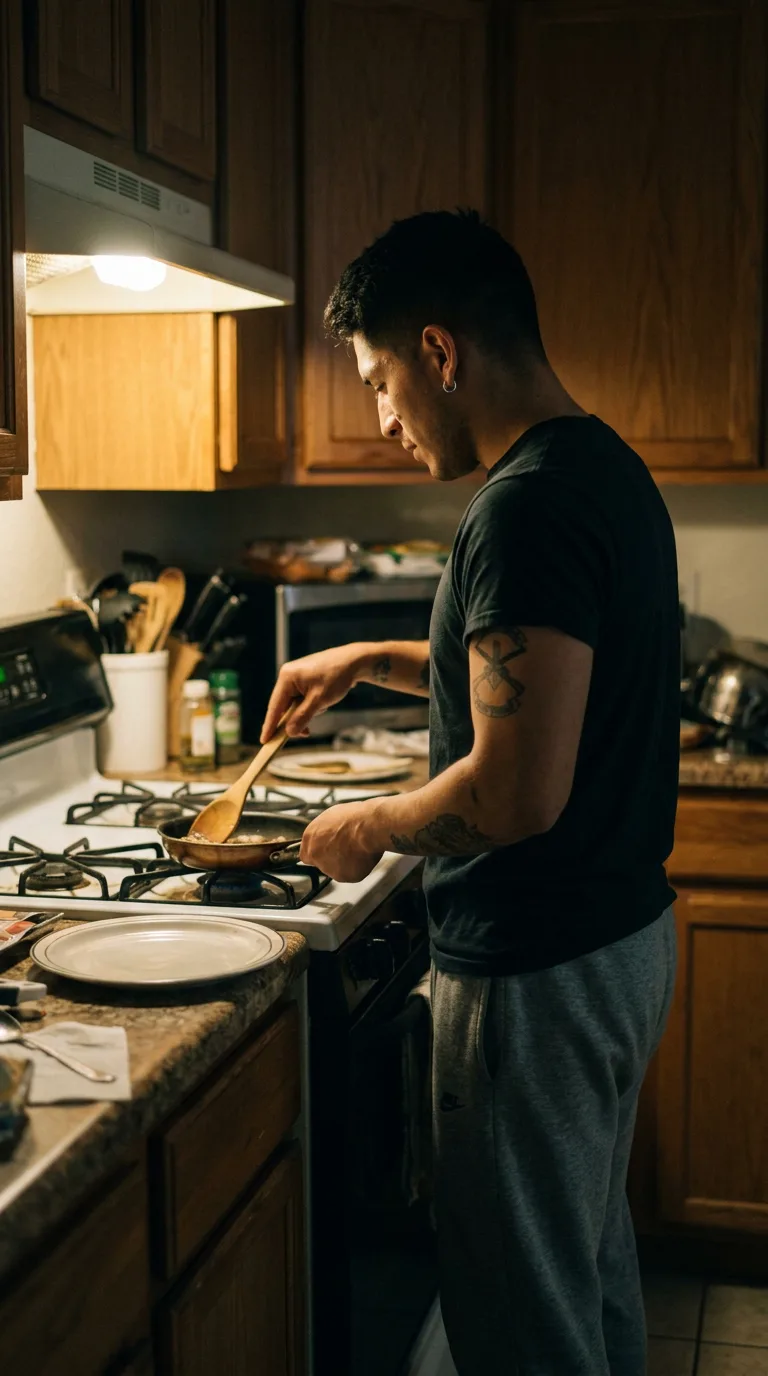
Rarest thing about him: A few, scattered — rare, 1 in 14
Season 0seed 401528830 · engine v10
Character card
lineage 2NZHHJ
His body-swap story
@colin.hasbrook, wearing Paul Yankovich, rolled the wheel on and woke up as Ezra Cantu, spent 7 minutes in him, then spun the wheel and woke up as Javier Lozoya
Paul Yankovich's kitchen smells like caulk and old coffee, and you have been him for less than a minute, standing in his dad bod at his own counter, and already you know you are not staying. It isn't the gut or the glazier's ache in the shoulder or the flat Boston light through the blinds. It's that you spun four hundred and twelve times to get somewhere, and this — this soft, sanded-down, nothing-happening life — is not somewhere. Paul had a girlfriend who left a note on the fridge. Paul had a Sox game muted on the counter TV. You did not travel four hundred and twelve men to watch a muted Sox game. You go to the laptop still open on the table, the one with the wheel already loaded from last time because Paul, bless him, never closes tabs, and you spin again before you've even decided to.
The gravel road exhales dust that isn't there yet — that comes later, in the memory. Right now there is a spoon in your hand, wooden, worn pale on one edge, and a pan hissing something with garlic in it, and your body's weight is different immediately, lighter, younger, balanced up on the balls of the feet the way a man stands who has spent a decade circling other men. The stirring stops mid-circle. Starts again the other way. You salt the pan without tasting it — his hand does that on habit, not yours — and then, before you've caught your breath in this new chest, this hand of his reaches up into the cabinet and brings down a second plate and sets it next to the first.
The spoon is the first thing that talks to you. It has a callus-memory in the handle, a worn groove where his thumb always falls, and through it comes a whole ordinary Tuesday — no, this Tuesday, an hour of jump rope and mitt work with a fifteen-year-old named Beto who has a wicked left hook and no patience, the gym's fluorescents buzzing, the bags still swinging when everyone else had already gone home. Ezra Cantu locked the gym himself. He always does. He likes the sound the chain makes on the door.
The shirt against your back gives you the morning — not this morning, an ordinary one, the kind that comes back as a blur of habit: he'd pulled it over his head one-armed, still hopping to get the other leg into his sweatpants, laughing at something on his phone, a text from Marisol that said something about her sister's wedding and did he still have the gray suit. He does. It's in the closet of the house at the end of this gravel road, the water tower a gray coin on the horizon out every window, barbed wire fencing off a pasture that isn't even his.
The mole on his cheek is not something he thinks about, but you feel where his own fingers have touched it a thousand times without noticing, the way you touch a doorknob. The hoop in his ear he got at nineteen on a dare from his cousin and kept because Marisol likes it. The insignia on his arm is heavier than that — a unit, three years, a friend named DeLuca who didn't come home, and under your palm, gripping the spoon, there's a flash of a transport plane's cold floor and then, mercifully, the memory lets go before it finishes, the way his own mind lets it go, most days.
The second plate is the loudest thing in the room. Marisol is due at six-thirty, and some late, warm, unclenching part of him — the part that survived DeLuca, survived his own father leaving early, survived enough — believes fully that she will walk through that door, because that is what she does, every Monday, without fail, and he has learned, slowly, to let himself believe a thing like that. He is twenty-four years old and he has a body that knows how to take a punch and a body that knows how to hold a mitt still for a scared kid and a body that, right now, without asking you, wants to keep cooking.
You look down at the hand around the spoon — his hand, tan, scarred faintly across two knuckles in the way of a man who has thrown a lot of jabs at heavy bags, the tattoos on the forearm catching the range hood's light. You turn it over once, like checking it for damage that isn't there.
"Smells good," you say, out loud, to the empty kitchen, in his voice, and you don't know yet if you mean the stew or the borrowed evening or the fact that somewhere out there, a woman is driving toward a door that's about to open on someone she has never met.