Ethan Kowalczyk
Fictional. Generated by AI — not a real person, and no likeness of one is intended.
25, line cook in Denver · rolled by @colin.hasbrook · card — no film
History
who has worn him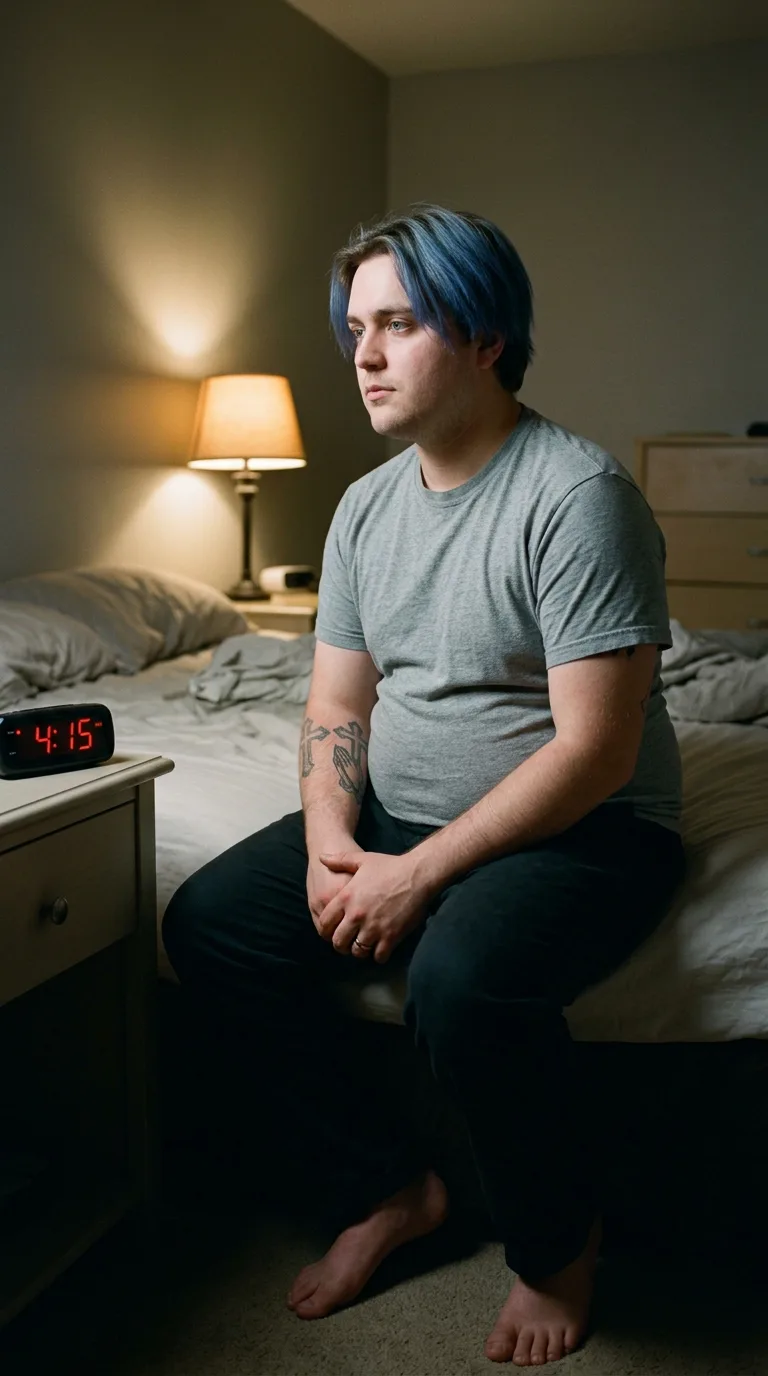
Rarest thing about him: Unitarian or liberal faith — epic, 1 in 99
Season 0seed 895830540 · engine v10
Character card
lineage 2NZHHJ
His body-swap story
@colin.hasbrook, wearing Kenji Ohashi, rolled the wheel on and woke up as Ethan Kowalczyk, spent under a minute in him, then spun the wheel and woke up as Gary Ostrowski
Kenji's hands smell like brake cleaner and you have had them for nine minutes.
That is the whole complaint, really, if you were forced to say it out loud, which you never would be, because there is nobody to say it to. Nine minutes in a bay in a town so small the Sunoco is the landmark, and already you know the shape of the rest of the day the way you know the shape of a room you have only seen once: the busted knuckle on the left hand that isn't even yours yet but will ache by four, the guy leaning in the office doorway who is going to want to talk about the Browns, the specific gray Monday light that means nothing is going to change here for the rest of your natural life. You spun into a man mid-shift, mid-afternoon, and mid-shift is the truest thing about him. You did this to yourself twice before — different men, same bay, same light — and you are starting to recognize the feeling that sends you back, which is not boredom exactly. It is the sense of arriving somewhere and finding out the walls are already up.
So you go to the site on your break, sitting on a folded shop towel so you don't get gear grease on a stool that isn't even yours, and Kenji's phone — his actual phone, thumbprint and everything, because apparently the wheel is generous like that — opens vessel.cards without you needing to think about it. The wheel sits there being a wheel. You put money down that isn't strictly money and give it a spin without deciding to, the way you crack your own knuckles without deciding to, a thing your hands do while your head is elsewhere.
—
The room comes to you sideways, tipped, because you're already moving when you land: knees hitting a bedspread, hands loosely together, the amen still warm in his mouth. He'd started to rise. You catch him — catch yourself — halfway up, and the momentum that was carrying him toward standing turns into you sinking back down onto both knees instead, the smile sliding off his face like something set down too fast. Forehead to the bedspread. Dark hair, a fringe of it dyed the color of a gas flame, falling forward over the nightstand clock, which reads a time that has no business being called the middle of the day, except that it is, here, where the mountains put their shadow down early some afternoons and a man who works a dinner service sleeps through the part of Monday that other men call morning.
You feel him the way you always feel the beginning of one of these — as weight, first. More of it than Kenji, softer in the middle, a body that has spent its adult life on its feet twelve hours at a stretch and eaten standing up in a walk-in the rest of the time. Knees that know tile floors. A tattoo pulling faintly against the skin of the left arm, cross and praying hands, half under a t-shirt sleeve. A ring on the left hand, plain, warm from his own hand rather than from anyone touching it lately.
—
The bedspread is a cheap chenille thing and it gives you a Christmas — his and hers, before the his and hers meant anything except two people who'd just moved in together, a fake tree from Walmart wedged in the corner of a bungalow that didn't have room for it. Marisol laughing at how bad he was at the lights. That's her name arriving with the fabric under your forehead, unbidden, the way all of it arrives: not given, found, the way your tongue finds a chipped tooth.
The t-shirt against your back is doing its own work. It's the one he sleeps in, gray, thin at the collar from washing, and it hands you the morning he put it on — not this morning, some morning, all of them folded into one because he wears three like it in rotation — sleep-heavy, the apartment quiet because Marisol left for her shift before he was even really awake, him sitting on the edge of this exact mattress in the dark before his own shift, three-something on the clock, the specific ache of a body that cooks dinner service and therefore lives its life running four hours behind the sun. He'd learned to pray like this, quick and half-embarrassed, somewhere around year two of the marriage, not because anything in particular happened but because his mother did it and it turned out you can absorb a habit through a wall over twenty years without noticing. He doesn't take it that seriously. He'd tell you that himself, if you were someone he'd tell things to. Amen, and up, and into the kitchen, and the day.
The ring gives you a wedding in a backyard, folding chairs, somebody's uncle playing acoustic guitar badly and everyone loving it anyway. The tattoo, when your right hand's fingers brush it without meaning to, gives you the tattoo shop itself, nineteen years old, a dare from a girl who is not Marisol — Casey, and here's the thing the flash won't let go of easy, that this is a body that still keeps a slot open for an ex-girlfriend it swears it doesn't think about, a text thread that got quieter but never quite closed, nothing anyone's done wrong, just a door left unlocked out of laziness more than anything else. Marisol doesn't know how often. He doesn't either, really, which is its own kind of answer.
Your knees know the walk-in floor. Your right forearm, when you flex it against the bedspread, knows the particular fast economy of a man who can turn six tickets at once without looking at his hands, knows the burn line healed over on the inside of the wrist, knows the weight of a hot pan the way your own hands — Kenji's hands, nine minutes ago, wherever they are now — knew a torque wrench. Your mouth, dry from being open on a half-laugh a second ago, wants a nicotine pouch, wants it specifically and immediately, a small clean hunger that has nothing to do with you and everything to do with him. He quit drinking three years back without much ceremony, just stopped, the way you stop doing something that was never really working for you anyway, and this is what filled the fifteen minutes drinking used to fill.
Under your palms, still pressed together out of habit though the prayer's already broken, you find the strangest small thing: Casillas. Not this body's memory — yours, riding along underneath it, nine minutes old and already fading at the edges the way they all do once you leave. Rogelio, bald and squat and sure of himself in a way that had nothing to do with size, a farm outside Miami, dirt instead of tile under his feet. You wore him for less than a minute, spun again almost before his weight had settled into you, and this man kneeling on the bedspread worked a line next to him once, some kitchen, some year, traded him a lighter for a rag, never thought about him again after that shift ended. You have stood on both sides of a nothing. It amuses you in a way you don't examine.
—
You lift your forehead off the bedspread and look at your hands, pressed together like you're still finishing something you weren't really praying in the first place. There's blue hair falling into your eyeline. The ring catches the lamp.
"Okay," you say, out loud, to the empty room, in his voice, easy and a little rough with sleep still in it. "Okay."
You turn the left hand over, palm up, like you're checking for something that isn't there, and you don't know yet how long you're going to want to be a man who prays without meaning it in a house that smells like someone else's cooking. You never know. That's always been the whole point.