Ernesto Salas
Fictional. Generated by AI — not a real person, and no likeness of one is intended.
64, longshoreman in El Paso · rolled by @colin.tarwater · card — no film
History
who has worn him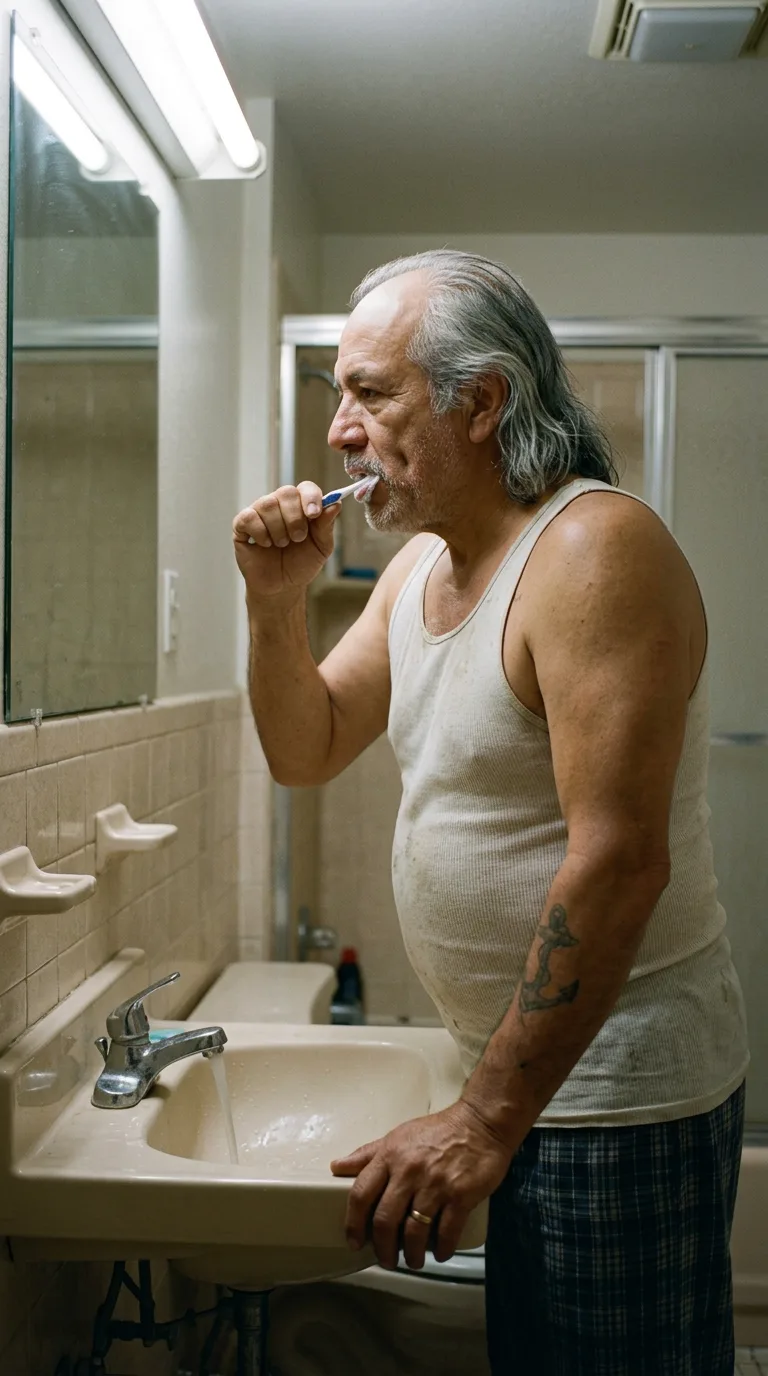
Rarest thing about him: Muslim — epic, 1 in 56
Season 0seed 987656450 · engine v10
Character card
lineage COEU7T
His body-swap story
@colin.tarwater, wearing Gary Okafor, rolled the wheel on and woke up as Ernesto Salas, spent under a minute in him, then spun the wheel and woke up as Marquis Delahoussaye
Gary Okafor's hand won't stop tapping the kitchen counter. Three in the morning, Las Vegas, and you're standing at his granite island in his good robe, and the tapping is yours — his fingers doing it, but the restlessness underneath is nobody's but your own. Eight hours and fifty-nine minutes in this heavy, comfortable body, this good life with its paid house and its sleeping wife down the hall who is not your wife, and already the walls of him have started to feel exactly as wide as they are. That's the thing about a body that works: it stops being interesting almost immediately. You made your money in it once already this life — some other spin, some other man's ledger — and Gary is only a place you're resting, the way you rest between drinks you don't need. You open the laptop. The site loads slow, the way it always does, like it's making you wait on purpose. You do not think about what it costs the men. You have trained yourself very carefully not to.
You spin.
The foam is already in your mouth. That's the first thing — not a room, not a name, just mint and salt and a mouth that isn't asking your permission, mid-stroke on the lower left molars, and you finish the stroke because the arm was already committed before you got here. Water running. A mirror with a man in it who is not the one you left, heavier through the middle in a different way, hair silver and long at the sides, gone entirely off the top of his head like a tide that isn't coming back. You move the brush to the other side, slower now, working the back molars with a care that isn't yours yet either — it's his, arriving a half-second behind the motion, the way a habit arrives before the man who owns it wakes up enough to claim it.
You rinse. Twice. You set the brush bristles-up, out of the grey standing water in the cup, the way it has apparently always gone, though you didn't decide that — your hand did, on its own authority, before you had one.
The tank top is against your back and it comes first, easiest, cotton gone thin at the seams: a Tuesday, some Tuesday, hundreds of them, pulling this exact shirt over this exact gut in a bedroom with the blinds already bright at 4 a.m. because El Paso doesn't believe in darkness past a certain hour of the summer. Work starts before the sun does. You've been doing this thirty-one years, the shirt says, thirty-one years of the gantry crane's shadow crossing the dock like a sundial nobody asked for, of steel containers coming down out of the sky on chains thick as your wrist, of learning young never to stand where a load could reach you if the chain let go, because a load doesn't care what a man had planned for the rest of his life.
The plaid pajama bottoms give you more — sitting on the edge of a bed that dips on his side from thirty years of dipping, a woman's breathing beside him, Elena, her name arrives with the smell of her side of the room, her lotion, and underneath that a whole marriage: her voice reading Quran on Friday mornings low enough not to wake the kids when the kids were still kids, her hand flat on his back at 2 a.m. more times than either of them ever counted, pressing into the exact bad place at the base of his spine where thirty-one years of hauling and hooking and standing on concrete have settled into something that never fully leaves, not even now, not even standing still at a sink. His hands ache the good kind of way, the way that means they've been used right. They tap the porcelain edge of the sink without him telling them to. They have never once in sixty-four years managed to sit still when his mind wasn't occupied elsewhere, drumming on steering wheels, on church pews — no, not church, never church, he catches himself on that thought and corrects it gently, the way you correct an old joke: masjid, Friday, the carpet under his knees, his father's voice teaching him the movements when he was seven and didn't understand a word of it yet and loved it anyway.
The wedding band is cool and then warm against your finger and it gives you the most, because a ring worn thirty-some years holds a marriage the way a groove in a stair holds a footstep — not as a memory exactly but as a shape the metal itself seems to remember. Three kids, or more; a wedding in a backyard with folding chairs; an argument about money once that nearly broke something and didn't; her laugh, which comes with no image at all, just the fact of it, arriving in your chest like a held note.
The dimples arrive last and strangest, because you can't see them — you feel the muscle memory of them, a face that has been doing this same small warm thing at rest for sixty-four years whether he meant it to or not, so that men on the dock call him "smiley" behind his back with real affection, not mockery, because a face like that in a place like that is a mercy nobody asks for and everybody's grateful for anyway.
Your knees ache. Your lower back has a permanent low hum in it, dock-issue, container-issue, gantry-crane-shadow-issue, the ache of a body that has spent three decades saying yes to weight it shouldn't have. Never had a drink in that whole time, not one, never needed the smoke the other guys leaned on during break — his hands found other things to do instead, tapping, drumming, some tell that was never nicotine and never needed to be.
You look down. His hands, brown and thick-knuckled, the anchor tattoo faded blue-green on the forearm from some long-ago year the shirt hasn't told you yet, the ring catching the fluorescent light over the sink. You turn the hand over like it might have an answer written on the palm. It doesn't. It just aches, patiently, the way it apparently always has.
You look up into the mirror, into his own eyes looking back out of a face you didn't earn and don't plan to give back.
"Bismillah," you say, out loud, to no one, in his voice, because it's the first thing his mouth wants to say and you let it, this once, before you decide what yours wants to.