Efrain Bautista
Fictional. Generated by AI — not a real person, and no likeness of one is intended.
37, youth pastor in Honolulu · rolled by @colin.hasbrook · card — no film
History
who has worn him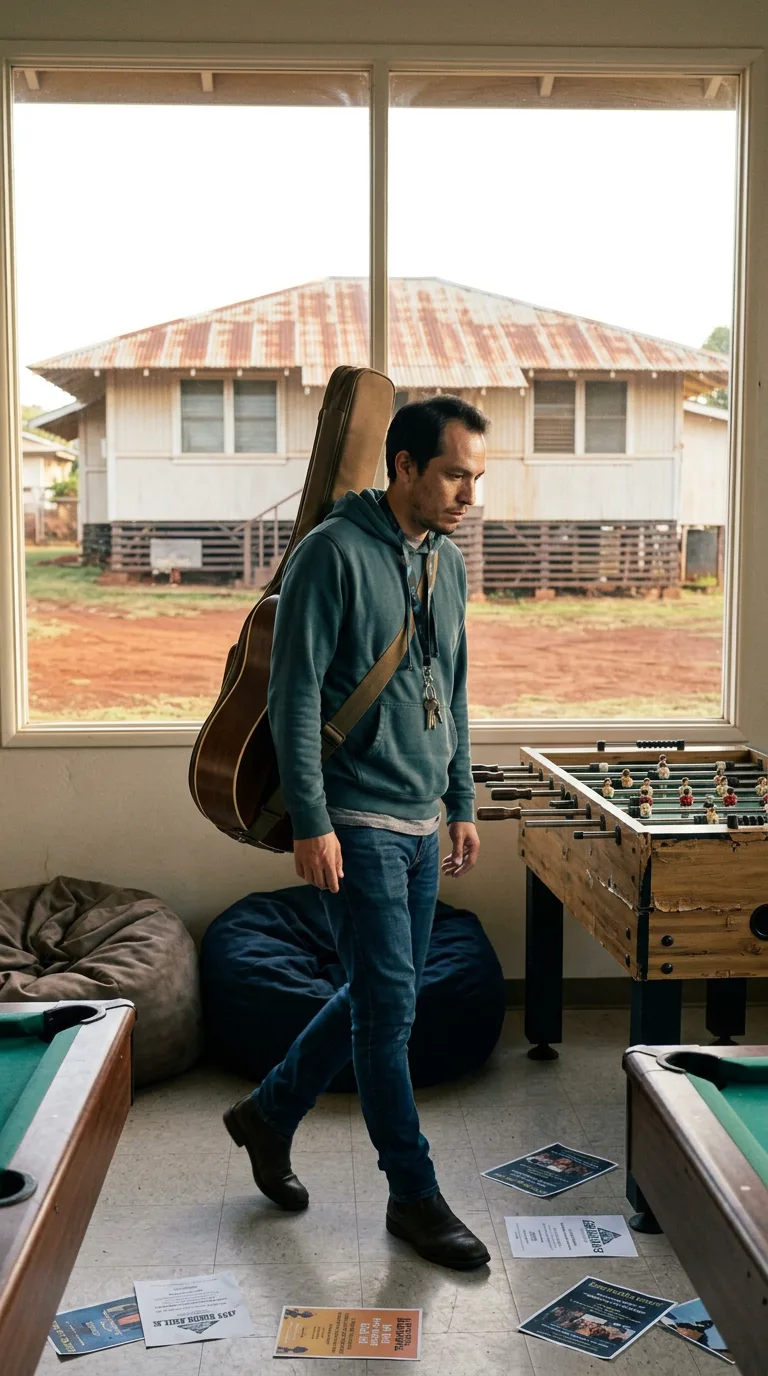
Rarest thing about him: Youth pastor — uncommon, 1 in 2,455
Season 1seed 188618907 · engine v11
Character card
lineage 2NZHHJ
His body-swap story
@colin.hasbrook, wearing Dominic Salcedo, rolled the wheel on and woke up as Efrain Bautista, spent 7 minutes in him, then spun the wheel and woke up as Roger Ambrose
The griddle is still hissing when the wanting comes back.
You are Dominic Salcedo, twenty years old, an apron gone translucent with grease at the hip, and you have been him for one hour and one minute, and it is already not enough. The body is good — quick, young, forgiving of the heat — but a line cook's Thursday afternoon in Small-town Ohio is just a ticket rail and a flattop and the fry timer going off under the noise of the kitchen radio, and you spun into it last time wanting exactly this, and now, an hour in, you already know every motion it has to offer. That is the whole shame of it: the wheel gives you a life and it takes about sixty minutes to learn its ceiling. You wipe your palm on the apron — his palm, not yours, but it answers to you now — and you think, one more, just to see, and you go back to the site with a burger half-built behind you and the register unmanned, because nobody has ever stopped you and nobody ever will.
You pay. You spin. The wheel does not care that it is Thursday afternoon here and Thursday, technically, six hours behind and an entire ocean over, there.
The rhythm breaks.
You are somewhere dim and gray-blue before the sun has decided anything, a guitar case's weight dragging one shoulder back, a strap of woven cord crossing your chest, a ring of keys knocking cool against your sternum with each step. Your foot is already forward, mid-stride, on tile the color of old teeth, and it comes down wrong — flat, hesitating, like a man who has forgotten how his own knee works — and then the next nine steps come out deliberate, measured, checked, a walk that has not needed checking in years suddenly needing it badly. Beanbags slump at the edges of your sight. A foosball table's little frozen players catch the corner of your eye. Fliers lie face-up on the linoleum, and you register, distantly, that you almost stepped on one and didn't.
You do not know it happened. Nothing in this face knows it happened.
The guitar case is the first thing that speaks. Its weight sits against your shoulder blade exactly where a strap has cut a groove into a hoodie for years, and touching the strap without meaning to, your — his — fingers close on the worn place in the cord and it comes up through you like a held breath let go: a folding chair, fluorescent light, fourteen kids half-listening, and him picking through three chords of a worship song written by somebody younger and blonder than he'll ever be, and not caring, because the two kids in the back who never sing are singing. Efrain Bautista. The name arrives with the memory, not before it, the way his own name would never announce itself to him — it's just there, underneath, the way the floor is there. He has carried this guitar into this room on this rusted-roof campus more Thursdays than he could count if you asked him to, and he has never once minded that the case is heavier than the instrument deserves.
The keys next — cheap steel warmed by his sternum, a church key, a house key, a mailbox key, a lanyard printed with a pattern he means to replace and never does. They give you the house on posts: red dirt yard gone dusty white at midday, tin roof ticking as it cools each evening, a coffee maker that takes four minutes too long, and him sitting alone at a table built for four, which does not bother him nearly as much as his mother thinks it should when she calls from town on Sundays. Thirty-seven and unmarried and the aunties have long since stopped being subtle about it. He lets it go past him like weather. There is no one he is grieving. There was no one, ever, worth the grief.
The hoodie is the deepest one — teal, soft with age, and your arms find, without being told, the exact give of the cuffs, the way the zipper pull sits a half-inch crooked from a snag years back. This morning — his morning, the one just gone, still warm in the weave — comes through sleeve by sleeve: him standing in a bedroom with one window and the sky outside still more gray than gold, pulling a gray tee over his head first, feeling the freckles on his own nose without looking at them, the beard he keeps meaning to either grow out or shave off and instead just leaves, patchy, apologetic, at both cheeks. He'd pulled the hoodie on next, one arm and then the other, shrugged the guitar strap over top of it, felt for his keys on the hook by the door without looking because his hand has done it every day for six years. He'd said, out loud, to no one, "okay," the way he does most mornings, not a prayer exactly but close enough to one that it counts.
His body under all of it: six feet of him, average through the middle, no particular ache anywhere except the low, permanent stiffness behind one shoulder from the case's strap, hands calloused at three fingertips from steel strings and nowhere else, because these hands have never done manual work, only this — chords, doorknobs, a whiteboard marker, a Bible with a cracked spine he doesn't like to admit is cracked. He is not tired. He is early-morning clear, the kind of clear that comes before caffeine and before the first kid shows up wanting to talk about something that happened at school that he will have to be careful and good about. He believes, plainly, that today is going to be a fine ordinary day, because every day he has ever had here has mostly been.
You look at your hands.
They are not young. There's a thin white seam of a scar you don't remember earning because it isn't yours to remember, freckles scattered clear to the knuckle, a callus riding the pad of the middle finger like a second joint. You turn the right one over, slow, and the guitar case shifts against your back with the motion, and outside the window the tin roof across the yard is just starting to take the first real light.
"Didn't feel a thing," you say, and it comes out in his voice, low and a little rough with morning, and you don't know yet if that's relief or something closer to guilt wearing relief's clothes.