Dwight Arceneaux
Fictional. Generated by AI — not a real person, and no likeness of one is intended.
50, machine operator in Seattle · rolled by @glenn.aldercy · card — no film
History
who has worn him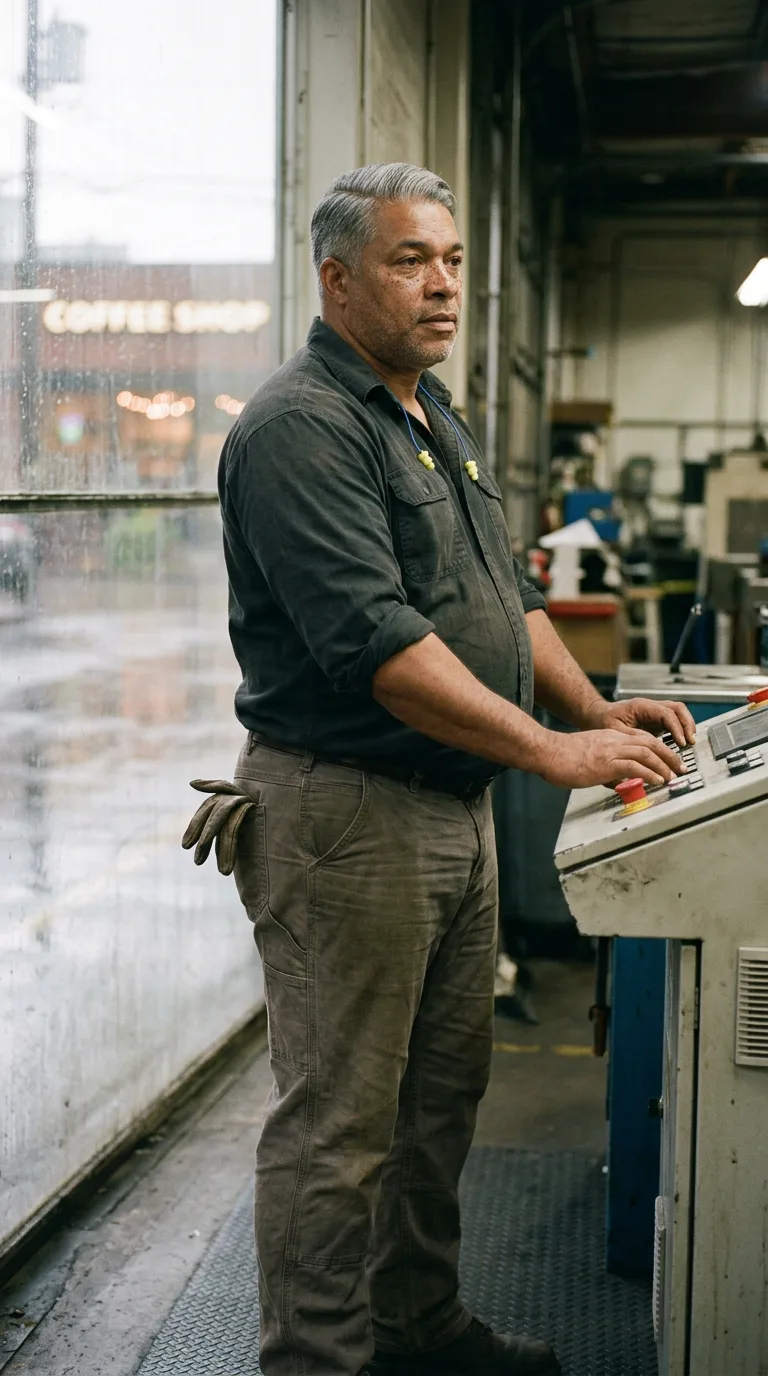
Rarest thing about him: 6'4" — uncommon, 1 in 103
Season 1seed 769536766 · engine v11
Character card
lineage EU5SNZ
His body-swap story
@glenn.aldercy, wearing Cody Mersereau, rolled the wheel on and woke up as Dwight Arceneaux, spent 1 minute in him, then spun the wheel and woke up as Gary Dunmore
You are sitting on the edge of a twin mattress in a Phoenix apartment that smells like bleach and old takeout, wearing hands you have had for one minute, and already they are not enough. Cody Mersereau's hands. Skinny wrists, a gap in his front teeth you keep running your tongue over out of some leftover reflex that isn't yours, a mop handle still leaned against the wall where he — where you — left it before sitting down to do this. He is twenty-seven and he cleans a building at night and there's a jar of coins on the dresser that wouldn't cover a tank of gas. You picked him up twelve spins ago for reasons that felt urgent then and now sit in you like a held breath you forgot to let out. He has been you for a minute. One minute of a life, used up on sitting here, phone in his lap, thumb over the screen. It isn't boredom, exactly. It's that the jar of coins is the first thing you saw when you landed in him, and something in you — old, and not his — recoiled from the arithmetic of it. You want weight again. You want a body that has a life stacked up behind it worth taking.
You spin.
The rain is the first thing — gray light through a wet window, a sign across the street glowing COFFEE SHOP in a color that isn't quite real behind the water on the glass. Then weight. A lot of it, settling into you like a held door swinging shut: shoulders, gut, the particular ache of standing on a concrete floor for hours. Your hand — his hand — is on a control panel, two fingers resting on a dial you did not choose to touch, and the motion that was traveling through the arm a half-second ago stutters, misfires, repeats itself slow and correct. The line keeps spooling plastic out in a long gray ribbon to your left. Ear protection hangs loose around a thick neck. Nobody on the floor looks over. Why would they. A man paused for a second in the middle of a job he's done ten thousand times is not a thing a factory notices.
The shirt is what gives him up first — worn cotton against a back twice the width of the one you had a second ago, soft from washing, a little damp under the arms from the floor heat. It comes in pieces, the way touch always does: a tug of memory from the collar, buttoned by thick fingers in a dark bedroom at an hour when Seattle is all one color. Dwight Arceneaux dressing for a graveyard shift, fifty years old, standing in front of a mirror he doesn't really look into anymore, pulling this same shirt over his head because it's the one that doesn't pull at the shoulders. Outside his window, Sunday morning for everyone else. For him, two in the morning, the middle of a night that other people are asleep inside. He stopped noticing the wrongness of that years ago. There's a particular loneliness to a scheduled life nobody keeps time with, and it comes through the fabric like heat off a stove — not dramatic, just there, a low hum under everything he does.
The gloves tucked in his back pocket bring his ex-wife's name up without asking — Renata — and a kitchen in a house that isn't his anymore, her hand flat on the counter telling him this wasn't about the hours, it was about what the hours did to him, how he came home each time a little less in the room. No malice in the memory. Just a fact, worn smooth with handling, the way he's turned it over so many times it doesn't cut anymore. No kids came out of that marriage to complicate the leaving. Just the two of them, and then just him.
The control panel under your palm gives up the longest thread: fifteen years of this line, the exact pressure a button needs before it clicks, which gauge lies by two degrees, the particular smell of hot resin that used to make him sick in his first month and now smells like nothing at all, like air. His body knows this machine better than it knows most people. The calluses across his palm are a record of it. His knees ache in the specific way of a big man who's stood on concrete for half his life. His knuckles are a little swollen — arthritis starting early, or starting on time, hard to say. Under the nail of his index finger there's nothing, because he bites them, has bitten them since he was a kid in a pew in a church that still has his first name in a baptismal book somewhere, candle smoke and his mother's hand flat on his back keeping him still. He doesn't drink anymore — gave it up without ceremony, the way you give up something that was making a bad time worse — and the last cigarette he had is far enough back that his body has mostly stopped asking. What's left is a man built out of discipline nobody applauds him for: shows up, does the count, drinks his coffee black from the shop across the street on break, goes home alone to an apartment that is clean because he keeps it that way out of habit, not hope.
The freckles come through last, strange, almost funny — a flash of his mother laughing at them when he was nine, calling them God's own handwriting, like it was a thing to be proud of instead of just a thing that was his. He forgot that sentence for forty years and it is suddenly entirely present, her voice and all.
You look down. The hand on the panel is broad, gray-dusted at the knuckle hair, a dry crack across one thumb that stings faintly when you flex it. Not your hand. Was never going to be your hand. You lift it off the controls and turn it over once, like checking it for a wound that isn't there, and the line keeps running without you, plastic spooling out steady into the catch bin like it doesn't know anything changed.
You look up into the wet gray light coming off the window, the coffee sign blurred behind the rain, and you say, low, to no one on the floor who'd hear it over the machines:
"Okay. Okay, let's see what fifty gets me."