Dwayne Colter
Fictional. Generated by AI — not a real person, and no likeness of one is intended.
50, manager (mid-level) in Philadelphia · rolled by @fabian.otero · card — no film
History
who has worn him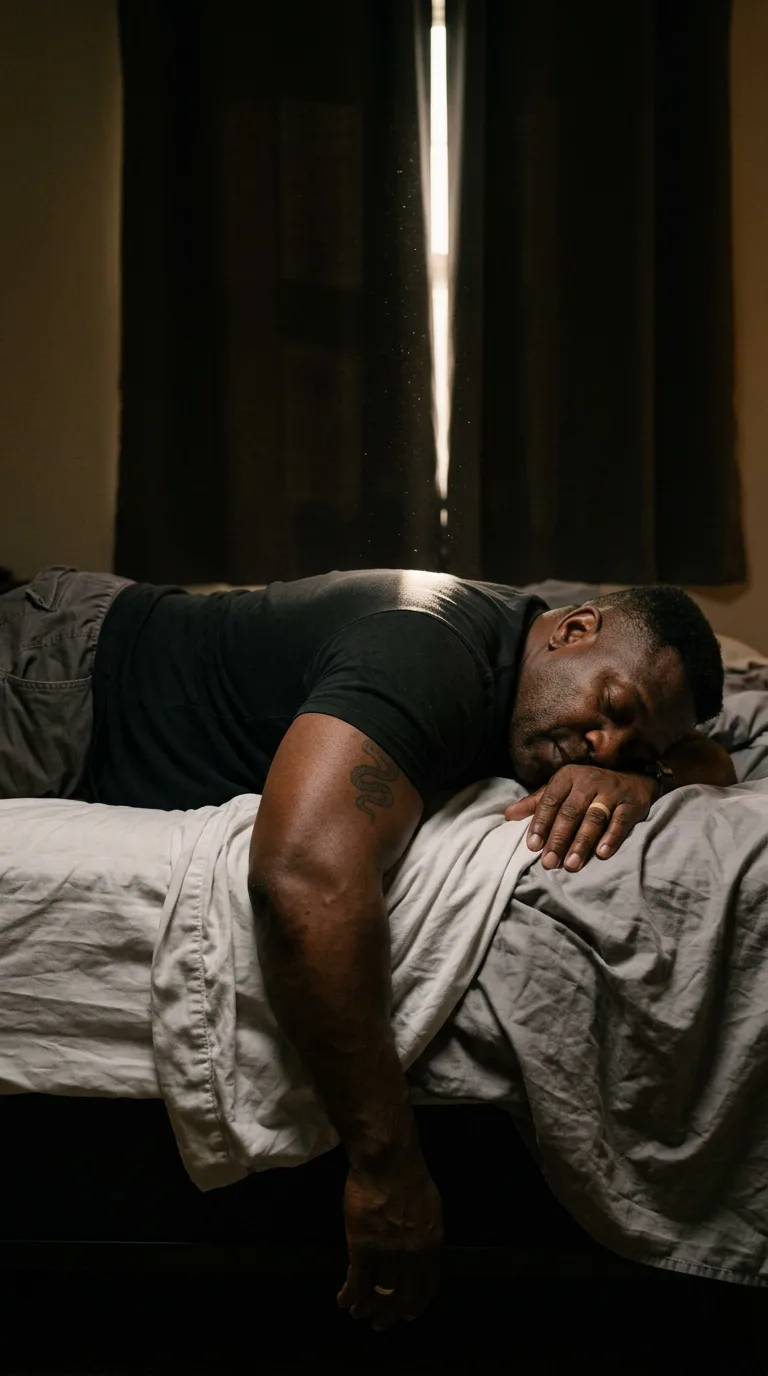
Rarest thing about him: One earlobe — legendary, 1 in 104
Season 0seed 1014328034 · engine v10
Character card
lineage HM5MG9
His body-swap story
@fabian.otero, wearing Craig Bellamy, rolled the wheel on and woke up as Dwayne Colter, spent 52 minutes in him, then spun the wheel and woke up as Rolando Cepeda
You are standing in Craig Bellamy's kitchen — his bald head, his blue eyes, his bare feet on cork flooring that still smells of the darkroom chemicals two rooms over — and you already know this was a mistake. Not a disaster. Just wrong, the way a shoe is wrong half a size up. Craig has a bad knee from a bike accident nobody told you about until you felt it complain on the walk from the bedroom, and his left hand won't stop wanting to check a phone for messages that are never there, an old tic belonging to somebody's marriage that ended before you arrived in him. You have been him for two minutes and you have learned more about his loneliness than you wanted. The wheel gave you a photographer with a good eye and a bad knee and a habit of reaching for a phone that has nothing on it, and none of that is a life, it's a leftover. So you go back to the site with his hands, because they're the only hands you have, and you spin again before you can talk yourself out of it.
The body that catches you is heavier through the middle, shorter, and already lying down — that's the first thing, the drop of it, the mattress taking weight that wasn't there a half-second before. Somewhere under you a knee doesn't ache. Somewhere at the end of an arm hanging off the bed, a hand you don't own yet is going numb against the floor, and then it isn't hanging anymore, it's rising, folding up onto a chest that's wider than the one you just left, and the breathing beneath you changes key, ragged smoothing into even, like a record settling into its groove. Streetlight comes through a gap in the curtain in one bright seam, and you lie there behind a stranger's shut eyes in the stillest two seconds you've had all night.
Then the room starts talking to you through his skin.
The sheet under the forearm gives you a flash of Tuesday — no, Wednesday, past midnight, the tail end of a quarter he stayed late finishing, because the memory carries its own clock and it says late, says tired, says he was down here reviewing numbers on his phone until his thumb slid off the screen. The pillow under his jaw gives you nothing, pillows never do, they're too new to him, but the T-shirt against your back is old enough to talk: gray cotton gone soft at the collar, worn a hundred times, and it opens into a morning eight, nine hours ago — his hands, thick-fingered, working the buttons of a shirt he doesn't remember choosing, tie already knotted loose around his neck the way he's done it for twenty-some years since somebody's mother taught him once and it stuck. Under that memory is the office: glass walls, door propped open on purpose because a closed door in that building reads as a man with something to hide, and he has spent a decade making sure nobody thinks that of him. Mid-level, comfortable, the kind of decent money that buys a rowhouse outright and still leaves him bored some Tuesdays wondering what the department above him looks like from inside.
The tan line on the ring finger gives you a longer one — not a flash but a whole year unspooling slow, a woman's voice going flat with him at a kitchen table not unlike the one you just left in Seattle, a daughter's face at maybe nine years old caught between two people who'd stopped being able to be in a room together without doing math on who'd hurt whom worse. It ended clean, as these things go. He kept the house. She kept most of the friends. He tells himself, most days, that this was fair.
The tattoo on the right arm — a small badly-drawn snake, done on a night that the skin remembers better than he lets himself — gives you shame, plain and specific, a twenty-six-year-old in a shop that shouldn't have been open that late, a bet he lost, a design he picked because the good ones were too expensive and he was too proud to walk out once he'd sat down. He has covered it with sleeves for twenty-some years out of something like an apology to himself.
The earring gives you almost nothing — just the ordinary weight of it, put in so long ago he forgets it's there until something catches it.
And his hand, lying open now against his own chest where the wheel folded it, wants a lighter. Not urgently. It's the middle of the night and he's asleep and even asleep some worn groove in him notes the absence and doesn't wake for it. A pack a day for thirty years lives in that want, low and constant, a hum under everything else, along with a heart that works too hard for a body this size and hasn't complained yet in any way he's willing to hear.
You lie in the dark another moment, borrowed chest rising and falling in a rhythm that was his before it was yours, tan line cool where a ring used to sit, snake inked wrong on an arm gone thick with twenty years of a desk job and whatever this body does at a gym on weekends out of guilt. Fifty years old. Divorced. Comfortable. Not unhappy, exactly — just a man asleep in the one posture, hands folded like church, that he has never once fallen asleep in on his own.
You bring your hand up in front of your face, in the dark, and turn it over. It's a stranger's hand, wider than the last one, a paler crescent where the tan line sits, and it already knows, better than you do, how to find a lighter in a dark room without looking.
You say, to no one, in his voice, low enough not to wake a house that's already empty: "Not yet, then."