Douglas Renner
Fictional. Generated by AI — not a real person, and no likeness of one is intended.
53, restaurant manager in El Paso · rolled by @colin.hasbrook · card — no film
History
who has worn him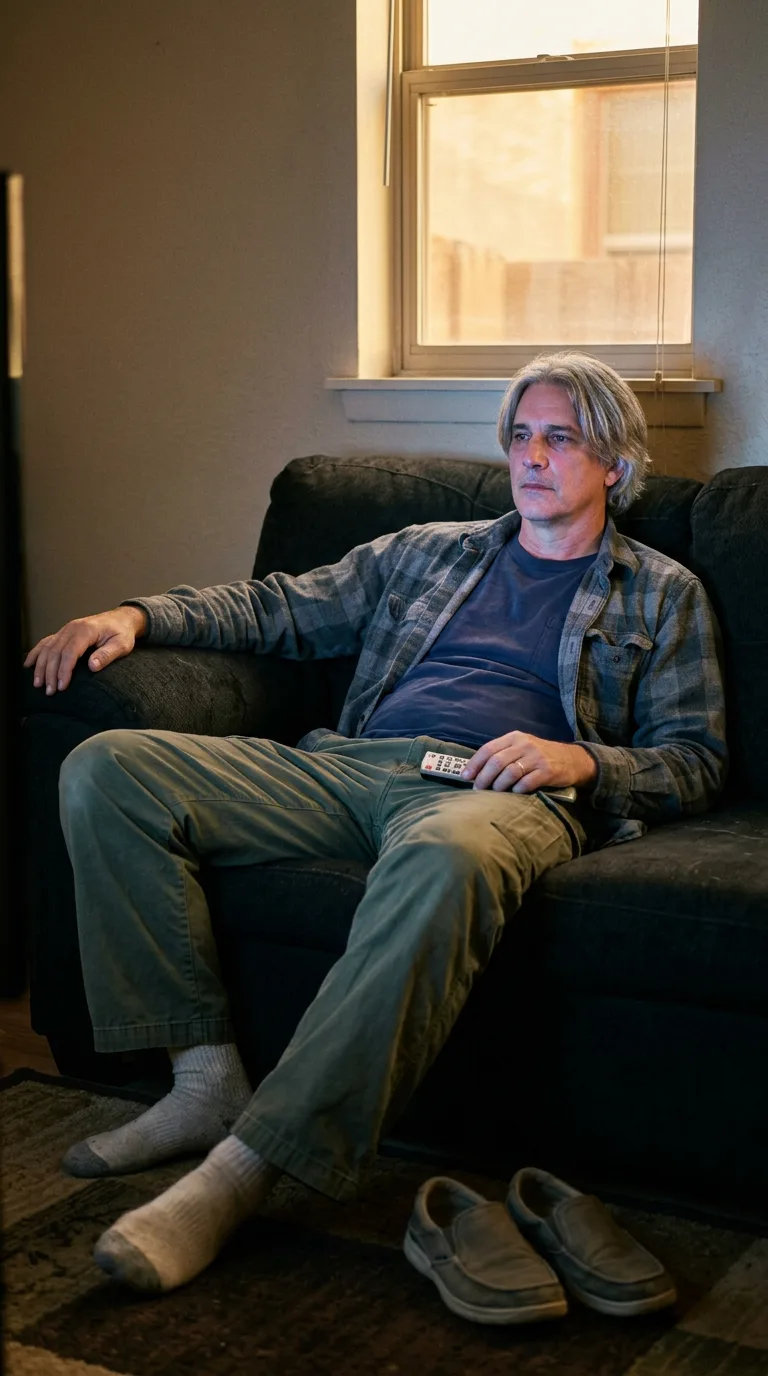
Rarest thing about him: 6'3" — common, 1 in 52
Season 1seed 1281612696 · engine v11
Character card
lineage 2NZHHJ
His body-swap story
@colin.hasbrook, wearing Weston Kirchner, rolled the wheel on and woke up as Douglas Renner, spent 1 minute in him, then spun the wheel and woke up as Ernesto Villalba
Weston Kirchner's hands are wrong before you even look at them — thin, blond hairs on the knuckle, a nervous tremor you didn't ask for and don't want. You've had this body four minutes and every one of them has been spent standing in somebody's kitchen — his kitchen, you suppose, though nothing in it feels claimed — staring at a phone with a cracked screen that isn't yours either. The heterochromia eyes water in the bright kitchen light for no reason. There's a smell of instant coffee going cold on the counter. Somewhere behind this face is a man between jobs, and you can feel the shape of that failure sitting in the room like furniture, even though none of his memories have opened yet, even though you never let them. That's the thing about spinning fast: you get the weight without the story. You get restless in a stranger's skin before you've learned a single thing about him worth knowing. You didn't come here to be him. You came here to leave him. You open the site on his cracked phone with his unfamiliar thumbs and you spin.
The room changes before the light does.
You are sitting upright on a couch that exhales under new weight, a remote settling out of your hand onto the couch arm like you'd meant to put it there, like this was always the plan. The television throws a bright frame across a face that is not thin and is not young — heavier through the jaw, a nose bent slightly off true, silver-gray hair falling into the light from a lamp that isn't on. Socked feet. Loafers kicked off on the rug below. A flannel shirt, open, soft with age, hangs off shoulders wider than the ones you just left. You breathe and the breath goes down into a chest that has fifty-three years of dinners in it, comfortable, unhurried, and you sit very still inside all of it, feeling for the edges of a man you don't know yet.
The flannel is the first thing that speaks. Worn thin at the elbows, and pulling it on this morning comes back to you sleeve by sleeve — a closet with more empty hangers than clothes, the particular quiet of a house nobody helps him get dressed in anymore. Under it a plain gray T-shirt, laundered soft, chosen because it was on top, because nothing about the morning was for anyone but him. Your fingers — his fingers — find a groove around the base of the ring finger, smooth and pale, and that's the second door: not a ring anymore, hasn't been in years, but the tan line held on longer than the marriage did. Somebody named Carol, and after Carol, briefly, gloriously, someone named Renata who is not his ex-wife and who he still thinks about on nights exactly like whatever night this is, when the house is too quiet and the TV is just something to point his face at.
The couch cushion under you gives up the shape of a thousand nights like this one. Three kids — Marisol, the oldest, who calls on Sundays; two boys who call less, who have their own kids now, who live in Austin and Phoenix like the state itself was too small for all of them at once. You feel, distantly and completely, the exact weight of the restaurant on his shoulders — Amaya's, the host stand, the specific dread and pride of a Friday dining room at capacity, the tuxedo-black uniform shirt he wears five nights a week, a pen clipped in the pocket he never uses because somehow there's always one already there. Broken nose from a bar fight decades gone, over a woman whose name he no longer says out loud, though her face still comes easier than it should. Quit drinking the year after the divorce, quietly, without a program, just stopped one Tuesday and never told anyone it mattered. Quit cigarettes even before that. Church on Sundays when Marisol asks him to, and alone sometimes when she doesn't.
The remote is still warm in your palm — his palm — from where his hand held it a moment ago, before you were the one holding it. A ring, not on any finger now, turning in memory between thumb and forefinger during the slow parts of every shift, a habit his hands do without him, worn smooth from all the turning. You feel for it and it isn't there, and something in the chest goes quiet and stays quiet, the way an old ache does when you stop pressing on it.
The show plays out its bright joke and this time nobody laughs.
You look down. The hand on your knee is broad, veined, a stranger's hand doing something achingly familiar — reaching for a ring that used to be there — and you turn it over in the lamp-less light like you're checking it's real, like it might still be someone else's underneath.
You lift your eyes to the dark window, to the shape that could be a camera, could be nothing.
"Didn't think there'd be this much left of him," you say, and your voice comes out low, worn, not yours at all.