Douglas Nakashima
Fictional. Generated by AI — not a real person, and no likeness of one is intended.
51, line cook in Phoenix · rolled by @colin.hasbrook · card — no film
History
who has worn him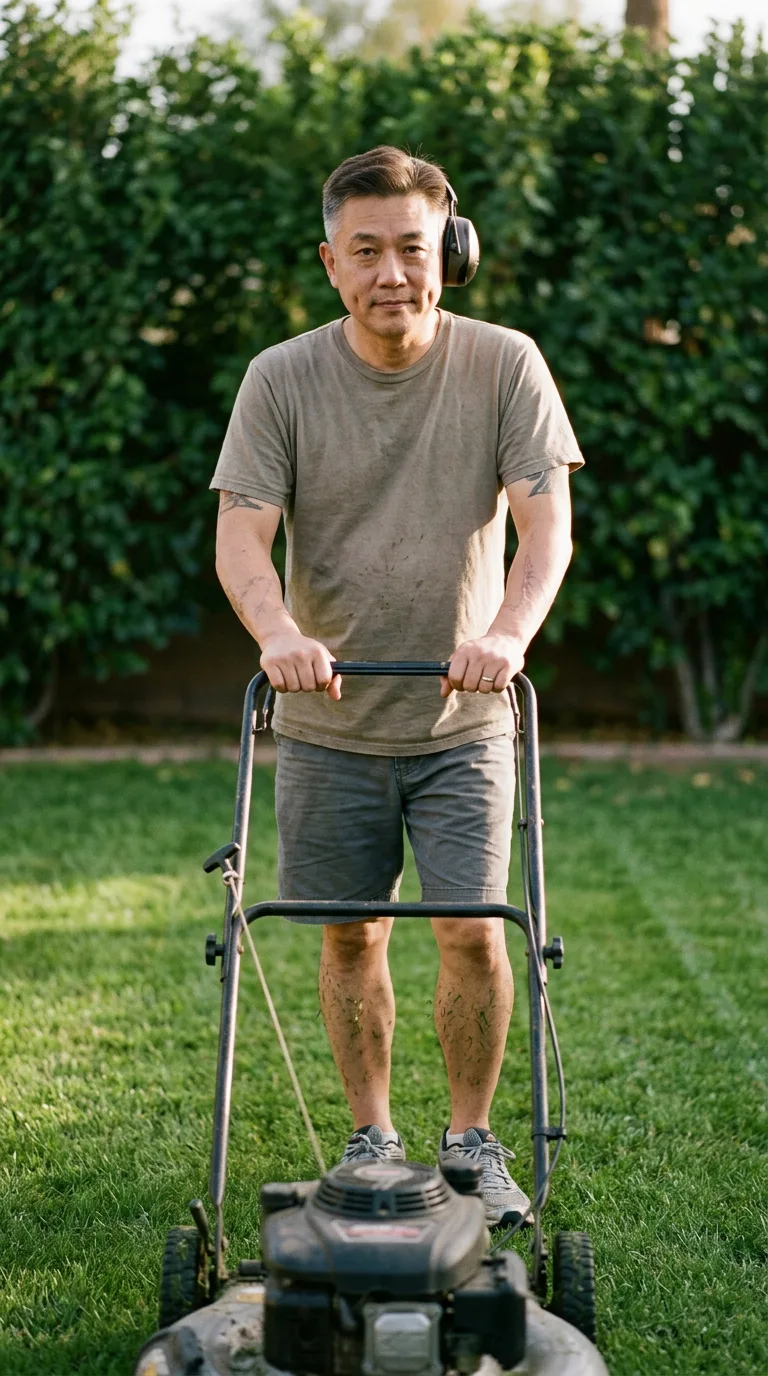
Rarest thing about him: Covers the gray — rare, 1 in 10
Season 0seed 1187512282 · engine v10
Character card
lineage 2NZHHJ
His body-swap story
@colin.hasbrook, wearing Emiliano Cruz, rolled the wheel on and woke up as Douglas Nakashima, spent under a minute in him, then spun the wheel and woke up as Mateo Bolarguez
The groundskeeper's knees ache in a way that isn't yours, not really, even though you've been him for less than a minute of clock time and a whole shift of feeling. You're standing over a flower bed at a Los Angeles office park, gloves crusted with mulch, and the boredom comes up through the soles of his boots like heat off asphalt. Twenty-four years old, this body, and already it complains. Something in the left hip clicks when he crouches. You didn't ask for that. You never ask for anything — you just spin and take what lands — but you notice, the way you always notice, the small tax every body charges for being lived in.
It isn't pain that sends you back. It's the flatness. A hundred and fifty men and this one has nothing you haven't already had — the tattoos are somebody else's story you don't know, the cleft chin is a photograph in a wallet you didn't earn, and there's a woman who calls him at lunch whose voice you don't recognize and don't care to. You spun for a groundskeeper thinking dirt and sun might feel like something. It feels like standing still. Your leg — his leg — bounces once against the shovel handle, an old tic that isn't even his, must be something bleeding through from before, and that decides it. You take out your phone, thumb already moving before the boredom finishes forming into a reason, and you open the page with the wheel on it.
You pay. You spin.
The mower's engine drops a note under your palms and catches again, and your hands — his hands now, thick-veined, faint white scar along one knuckle — stay exactly where they were, on the bar, mid-push. The loose earmuff swings and you feel it settle back over your ear without deciding to move it, some obedience in the body older than you are in it. Grass clippings sting the shins. The next pass runs dead straight, and you feel the pull of the machine, the resistance of overgrown grass, the sun coming down at an angle that says late afternoon even though something in your gut insists it should be night. A cicada winds up somewhere past the block wall.
You are Douglas Nakashima and you don't know it yet, not with words. The name comes the way everything comes: through what you're touching. The rubber grips, foam gone slick with old sweat, give you a flash of a Saturday — of *many* Saturdays, stacked like the crooked rows you're fixing — sixteen years of this same mower, this same yard shrinking and growing as the hedges did. The t-shirt sticks to your back with real sweat, his sweat, and it opens onto this morning: pulling it over his head in the bedroom while Carol was still half-asleep, the elastic of the waistband already loosening on shorts he's owned since the youngest was in middle school. Three kids. Not two. You know it precisely, the way his memory insists on precision — Danny at culinary school in Scottsdale learning the same trade the father never called a trade in front of him, the twins, Mia and Grace, off at whatever their Monday is, one still living at home and slamming a door about something small enough to already be forgotten by both of them.
Your back — his back — throbs low and constant, a hot wire along the lumbar that has been there so long it has stopped being news, the price of thirty years bent over a flat-top, of reaching into low ovens, of standing twelve-hour Saturday doubles at a restaurant that isn't named here because it doesn't need to be, only felt: the clang, the ticket rail, the particular relief of the walk-in's cold air on his forearms between fires. The wedding band on the left hand is warm from the sun and it gives you a wedding, a small church, evangelical, his mother crying not from sadness, Carol's dress too warm for a June like that, and seventeen — no, eighteen — years since, and it has held.
The dimples are there even now, at rest, pushed faintly into cheeks that aren't smiling, an old joke Carol makes that he can't scowl convincingly to save his life. You feel that fact land like something almost funny, almost sad, sitting on a face that used to be someone else's and is now, apparently, permanently amused-looking no matter what's underneath.
His leg wants to bounce. It always wants to bounce, some motor that runs under him whether he's thinking or not, and even mid-stride behind the mower you feel the ghost of it, a rhythm looking for a chair to sit in.
You look down.
The hands on the bar are wrong in every way that matters and exactly right in the ways his own hands have made them — a callus map you didn't build, a burn scar pale along one forearm from a fryer splash years back, the ring catching light. You lift one off the bar, slow, and turn it over in the blinding Phoenix afternoon, the mower idling under your other palm, grass and gasoline and cut green filling up your breath.
"Huh," you say, in his voice, to no one, and it comes out amused, dimples deepening around a word that isn't really a word — and behind it, unspoken, already the small itch: how long this lasts, whether tomorrow finds you still standing in this yard, in this ache, in this marriage that isn't yours yet feels, for now, like something worth having stolen.