Deshawn Okafor
Fictional. Generated by AI — not a real person, and no likeness of one is intended.
37, streamer in Small-town Ohio · rolled by @colin.hasbrook · card — no film
History
who has worn him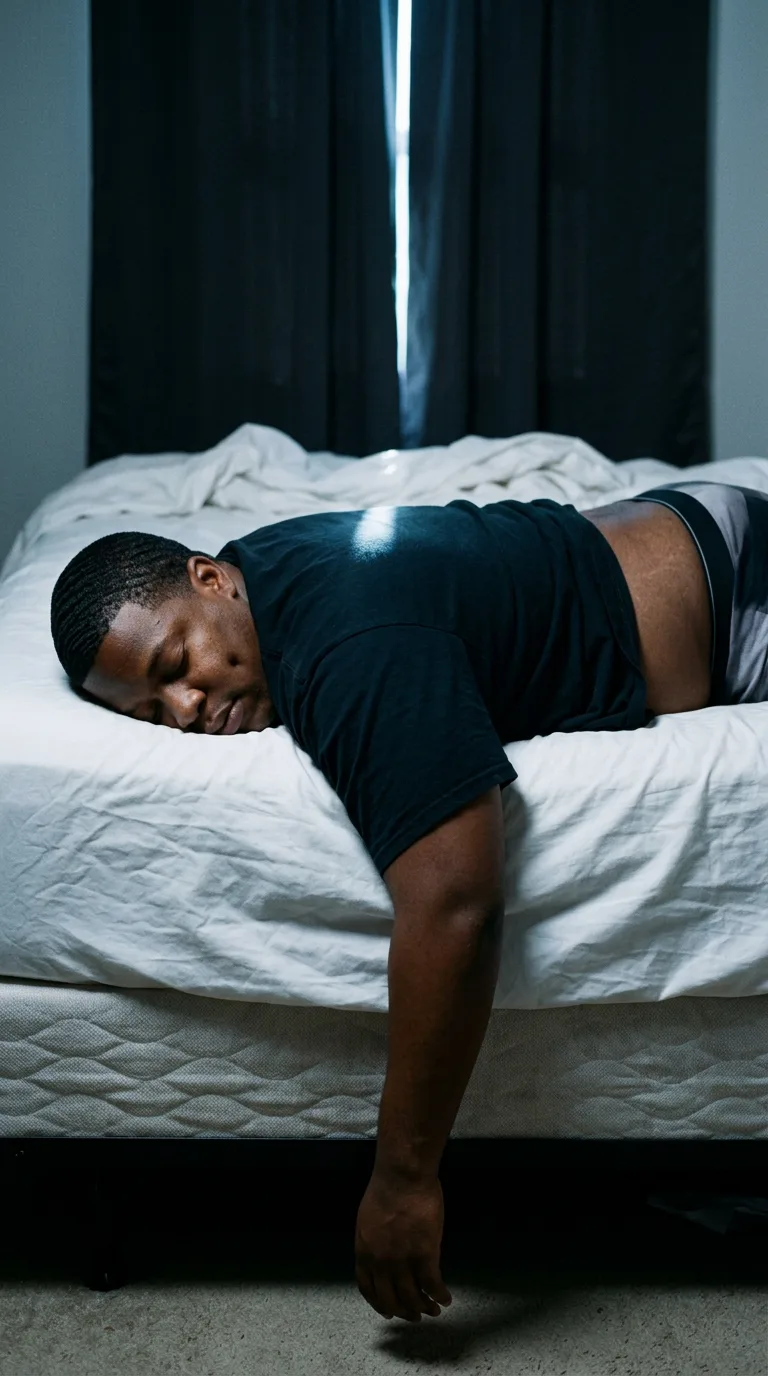
Rarest thing about him: It's a problem and it shows — rare, 1 in 33
Season 0seed 852043916 · engine v10
Character card
lineage 2NZHHJ
His body-swap story
@colin.hasbrook, wearing Peter Sasaki, rolled the wheel on and woke up as Deshawn Okafor, spent under a minute in him, then spun the wheel and woke up as Grant Novosel
You are Peter Sasaki for another forty seconds, and Peter Sasaki's knees are the reason you are done with him.
He is standing in a rest-stop lot off I-87, cab door still swinging behind him, and the cold has found every place the arthritis lives — both knees, the left hip, the socket where the real eye used to be before something you never learned about took it. Fifty-eight years in this body and only thirty of your own days, and already you know its whole vocabulary of complaint. The phone is out. The site loads slow on truck-stop wifi, the wheel spinning its lazy graphic while a diesel idles somewhere behind you and someone's dog barks twice and quits. You didn't come back because Peter did anything to you. Peter did nothing to you, which is the whole problem — a man who drives, sleeps, drives, and whose only pleasure left is complaining about his knees to a dispatcher who doesn't listen. Thirty bodies in and you have started to notice the difference between a life and a sentence. You pay. You spin. Somewhere the wheel finds a man for you the way it always does — not chosen, just next — and you feel the lot, the cold, the ache in the hip go all at once, mid-breath, like a door closing on a room you were never that attached to.
The breathing changes first — ragged, then even, one clean breath that isn't yours yet. An arm that has been hanging off a mattress all night draws itself up. The body rolls onto its back on its own, hands folding at the chest, a posture this man has apparently never once used in his life, because something in the muscle resists it for half a second before giving in. Streetlight through a gap in blackout curtains. A ceiling you don't recognize. Warmth — real warmth, southern Ohio warmth, nothing like the cab — and weight in the middle that Peter didn't have, a soft solid heaviness settling into a mattress like it belongs there. You are on your back in a bed that smells like somebody else's laundry detergent and last night's takeout, and the room is dim in a way that has nothing to do with the hour, because it is early afternoon outside those curtains and this man is asleep at a time decent people are at work.
The sheets come first, and they come as exhaustion — a stream that started at 4 a.m. and a raid nobody remembers by the end, chat scrolling faster than eyes could follow, somebody donating just to say a filthy joke, the ring light finally switched off at sunrise like flipping a breaker. Deshawn Okafor sleeps when the stream lets him and not when the sun says to, and the sun has never once respected the arrangement.
Your palm finds the pillow and a whole apartment arrives with it: the desk rig in the next room, three monitors dark now, RGB strip still glowing faint blue along the baseboard because he never remembers to kill the smart plug before bed. The mic boom folded up like a sleeping arm. A studio built inside a bedroom in a two-bedroom rental on the one street in town that still has a stoplight, across from a diner that closed the year before he moved in and has stayed closed since, its sign unlit, a landmark nobody bothered to take down.
Your hand drifts to your own chest without meaning to, and the tattoo under your fingers opens like a door: script letters, a name — Naomi Jean — and a date under it, 2013, and the memory that comes isn't sharp so much as it is heavy, a niece who didn't make it past her first year, a sister who couldn't look at him for a while after, a decision made alone in a shop chair to put her someplace he'd never stop touching. He runs his thumb over that spot most mornings without thinking about it. You do it now without meaning to either, and it costs something you didn't budget for.
There's a woman under the memories too, close to the surface, closer than the streaming and closer than Naomi — a girl who used to fall asleep with her feet on this exact mattress, who left four months ago saying he cared more about chat than about her, which wasn't entirely untrue and wasn't entirely fair either, and who he still, some nights, almost texts. The glass on the nightstand isn't water. He knows what he'd taste if he reached for it, and some nights he reaches for it anyway, and this was one of those nights, which is most of why the body under you sleeps this hard, this late, this heavy — 5'6" of him, dad-bod soft through the middle, a heart working a little too hard against blood pressure that runs high whether he drinks or not, waves under his palm when he checks the durag's slipped again in his sleep. Dimples set into a face at rest, like the joke is always halfway told even when nobody's watching.
You feel all thirty-seven years of him settle into the mattress at once — the good stream nights that felt like the whole internet loved him for an hour, the bad ones where three people watched and he kept talking anyway because quitting felt worse, the shirt he pulled on backward once on air and never lived down, the sister who calls every Sunday whether he answers or not.
You open your eyes. Streetlight's gone dim behind the curtain gap, day pressing at the edges of it. You lift one hand off the sheet and hold it above your face, turning it slow — the same hand, the wrong hand, close-cut waves catching what light there is when you tip your head to look past it.
"There he is," you say, to no one, to the ceiling, to whatever's next.