DeShawn Hargis
Fictional. Generated by AI — not a real person, and no likeness of one is intended.
29, tow truck driver in Eastern Kentucky · rolled by @colby.nash · card — no film
History
who has worn him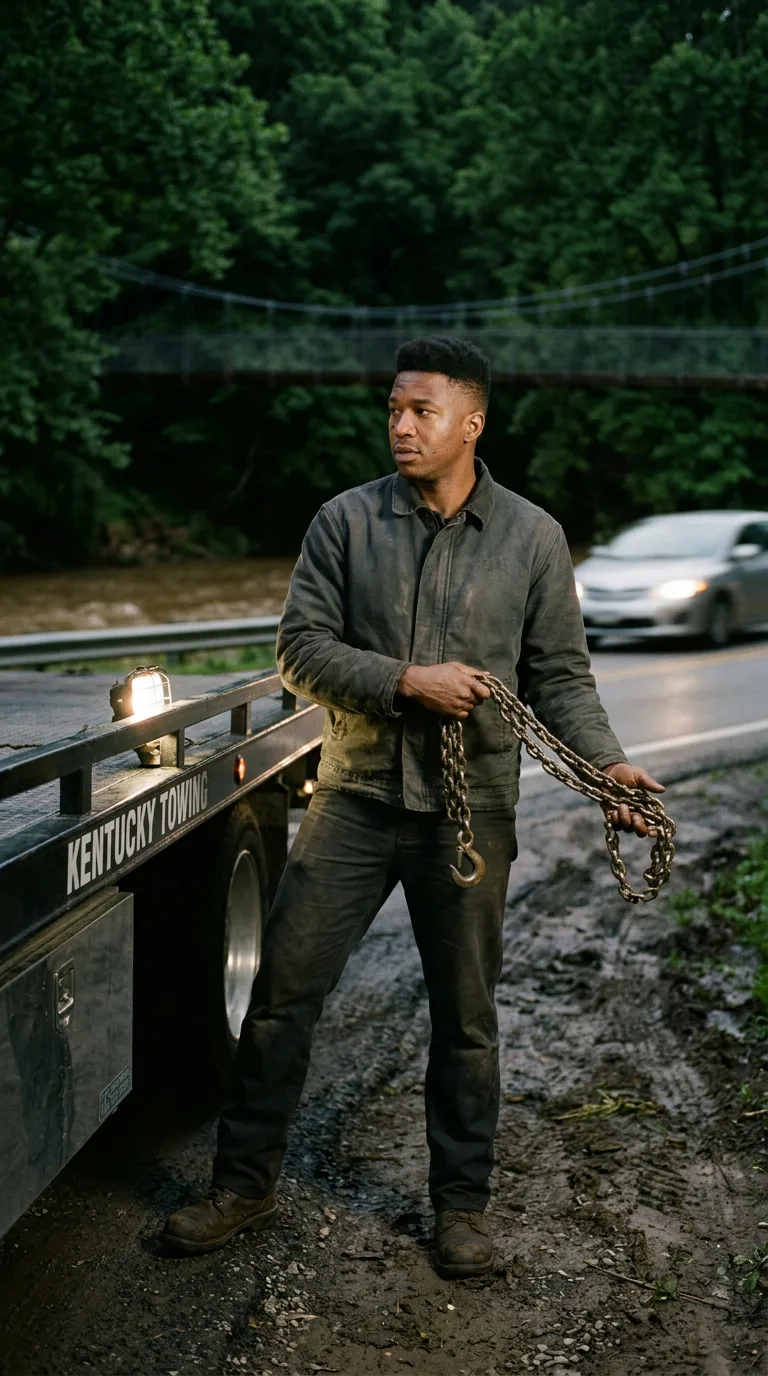
Rarest thing about him: 6'4" — rare, 1 in 76
Season 0seed 1195703975 · engine v10
Character card
lineage E1W54H
His body-swap story
@colby.nash, wearing Marlon Etienne, rolled the wheel on and woke up as DeShawn Hargis, spent 8 minutes in him, then spun the wheel and woke up as Bradley Kosinski
You are two minutes into Marlon Etienne, standing in his dark kitchen in Houston, and already the fit is wrong the way a borrowed coat is wrong — the shoulders too heavy, the knees complaining before you have even asked them to bend. It's not that he's a bad body. It's that he's fifty-two and his feet ache standing still and there is a low hum of tired in him that isn't yours and will never turn all the way off, and you spent eleven years of scrolling before you ever found this site to get away from exactly that hum in your own skin. Two minutes of standing in Marlon's kitchen at 3 a.m. with his family asleep down the hall — a man's whole life humming around you, unearned — is enough to remember why you keep spinning. Not greed, not really. Just: there is a version of not being tired that you haven't tried yet. You open the laptop already sitting on his counter, the blue wheel loading up cold and patient, and you pay, and you spin, already gone before it lands.
The chain is heavier than it should be for half a second, then exactly right.
You're bent at the waist, one boot planted in gravel gone soft with old rain, both hands wrapped around a hook cinched through a link, and your body — his body, tall in a way Marlon's never was, lean where Marlon ran heavy — has already started the correction before you catch up to it: the hook was seated wrong, you feel that in the wrist before you feel it in thought, and you back it off and re-thread it slow, watching your own fingers do it like they belong to somebody standing behind you giving directions. Floodlight off the truck bed. Somewhere off to the left, a car's headlights, patient, waiting for the shoulder to clear. Trees breathing dark on both sides of the road. Your chest is doing a stranger's breathing, slower and lower than any breath you've had in eleven bodies.
The jacket is what opens first — canvas gone soft and pale at the folds, a stain on the left cuff you didn't put there but your shoulders already ache the shape of, ten thousand times reaching into truck beds in weather. Through it comes a morning: him — DeShawn, the name arriving with the collar somehow, the way names do — pulling this same jacket off a hook by the door of a house that smells like the creek even inside, a house up a gravel drive with a cable footbridge crossing brown water down the hill, green so heavy on the banks in summer it looks like it's trying to close the road over. He'd stood in the doorway a second too long that morning, the way he does most mornings now, some low static under his ribs that has a name and a pill bottle and a doctor forty minutes away in Pikeville, and he'd told himself the thing he tells himself — get moving, it passes when you're moving — and it had. Mostly.
The chain in your hands gives you the yard behind the garage where he learned to wrap one, his uncle's voice, *don't ever let it kiss your hand, boy*, the hook cold even in July. Gives you a night two winters back, black ice on 80, a woman's Buick nosed into the ditch and her crying too hard to talk and him talking low and boring at her on purpose until she stopped, hooking the frame by flashlight with his jaw set. Gives you Renee — not gone from him the clean way, just gone the slow way, four years now, and still some nights he catches himself composing a text to her about nothing, a joke, a road he passed, and deletes it before it's finished, and there's an ache in that so ordinary and so worn-smooth it barely registers as pain anymore, just weather.
The boots under you know the exact give of this gravel shoulder without being told. Your back — his back, twenty-nine years old and built long, no complaint in it yet the way Marlon's had complaint in everything — takes the bent-over work like it's nothing, like it's owed nothing, and it is a genuine pleasure, standing here rediscovering a spine that isn't angry at you. Behind you the flatbed's work light hums. Below the hill somewhere the creek is running high and brown with the last rain, loud enough you can almost place it without seeing it, the footbridge cables ticking faintly in a wind you can't feel from here.
You finish the wrap. Correct. Clean. His hands did it without you, mostly — you were just riding along behind eyes that have done this ten thousand times and were, for one half-second, not sure of him anymore.
You straighten up and look down at your hands in the floodlight, unfamiliar and enormous, threaded scars of old rope-burn pale across two knuckles that aren't yours yet and are the only ones you've got.
"Not yet," you say, out loud, to nobody, to the dark trees, to the sound of the creek going by underneath everything — and you don't know yet if you mean the chain, or him, or how long.