Derek Sowinski
Fictional. Generated by AI — not a real person, and no likeness of one is intended.
32, help desk technician in Dallas · rolled by @connor.waskiewicz · card — no film
History
who has worn him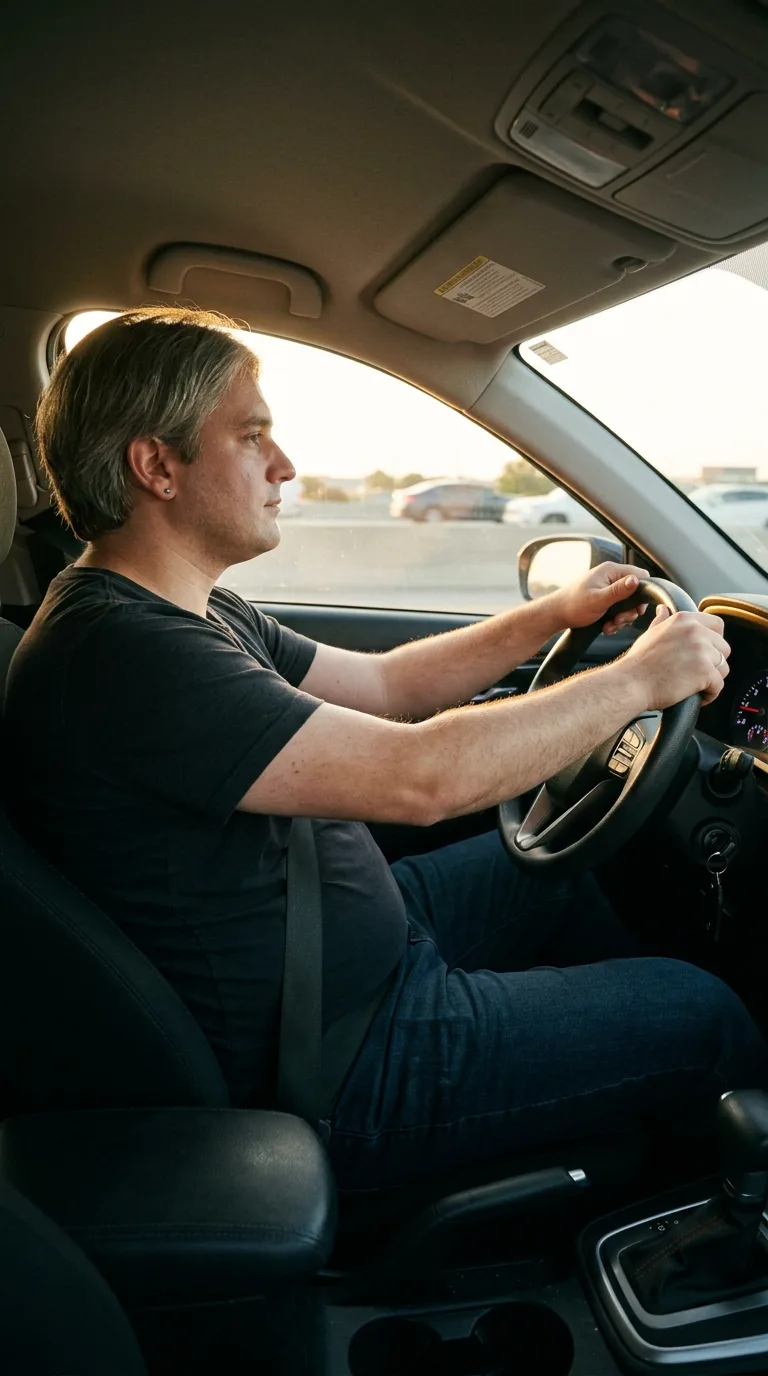
Rarest thing about him: 6'5" — rare, 1 in 229
Season 1seed 94814468 · engine v11
Character card
lineage 2NZHHJ
His body-swap story
@connor.waskiewicz, wearing Colin Brennaghan, rolled the wheel on and woke up as Derek Sowinski, spent 1 minute in him, then spun the wheel and woke up as Andrés Molina
Colin Brennaghan's hands smell like diesel and orange hand-cleaner, and they won't stop shaking. Not from fear. From the cab's idle rattling up through the seat, through twenty-one years of a body that was never yours to begin with, into knuckles you've been wearing for a day and seventeen hours. The dispatcher's voice crackles through the radio about a delay in Harrisburg. You are sitting in a truck stop outside Philadelphia with a gas station coffee going cold in the cupholder, and you already know you're leaving.
It isn't boredom, not exactly. It's that Colin has a body that does things — the dimples, the forearms, twenty-one years old and stupid with muscle — and none of it is interesting anymore, because a body that does things for you is still a body you have to sit inside while it does them. You spun into him for the size of him. You're done with the size of him. There's an itch under his sternum that isn't his, that's only ever been yours, the thing that makes you open the site again no matter who you're wearing. Six p.m. here. Wednesday. The light through the windshield is going long and orange and you think, one more, and you already know that thought is a lie you tell yourself every time, and you open vessel.cards on a phone that isn't yours, and you spin.
—
The seatbelt is already tight across a stomach that didn't used to be there. Ten and two on the wheel. Dash light green-gold across knuckles that are thicker than Colin's, softer, a paler tan line cut into the base of the ring finger like a groove worn into wood. The car drifts a foot toward the centerline — not your doing, just the last half-second of a man's attention leaving his own hands — and then it comes back, smooth, correcting itself as if nothing happened, because nothing did, not to the car. Both hands come off the wheel at ten and two and land again lower, wider, the way a man sits when he's stopped being careful. Behind you the turn signal clicks on, patient, ticking toward an exit that belongs to somebody else's Wednesday.
Three miles from a home you have never seen.
—
The wheel is warm. That's the first thing that comes through, stupid and immediate — the vinyl holds heat all day and gives it back slow, and his hands know this wheel the way you know nothing yet, decades of morning commutes distilled into two palms that settled onto it without thinking. Then the shirt. Black cotton, soft from too many washes, and wearing it brings back a closet with three empty hangers where a woman's blouses used to hang, and how he still hasn't moved his stuff to fill that gap two years later, like leaving it empty were a kind of manners.
The ring-tan on his finger opens wider than the rest. A courthouse, a signature, a woman's face gone thin with the specific tiredness of somebody who has already left before the leaving started. Three kids, maybe four — the memory won't hold still enough to count — piled into a minivan on alternating weekends, the smell of fruit snacks and dried Goldfish crumbs ground into the upholstery, a custody calendar taped inside a kitchen cabinet door so the fridge stays clean. He loves them without any performance about it, the plain unglamorous love of a man who shows up, who is there Tuesday and every other weekend at six, who does not make a thing of it because making a thing of it was never his instrument.
The seatbelt against his gut brings the dad bod up whole — not shame, just fact, a body thirty-two years old that used to play rec-league softball and now mostly sits, under desks, in traffic, on a couch alone three nights a week. Broad through the shoulders still. Soft everywhere else. Knees a little loud going up stairs. His leg is already bouncing against the floor mat, has been the whole drive, a tic so old it isn't even nervous anymore, just idle current with nowhere else to go.
The lanyard is gone — he's not wearing it, it's on the passenger seat, and touching it with a glance rather than a hand still gives you the badge photo, the navy polo, the crossbody bag stuffed with patch cables he loops around his forearm like rope. Under a desk at Idexo this morning, on his knees on carpet tile, the particular satisfaction of a cable finally seating home with a click nobody else will ever notice or care about, and how that click is somehow, embarrassingly, the best part of some days. Fixing what's broken. Nobody screaming at him the way they scream at the support-line calls. Just a green light where there was a red one.
Getting dressed this morning comes last and clearest, because the shirt against your back is still giving it up thread by thread: pulling this same black tee over his head in a new-build bedroom with the paint smell not yet gone, jeans that fit different than they used to, the studs already in both ears from years ago that he forgets he's wearing until he touches his own lobe by accident. Clean-shaven ten minutes before that, razor pulled slow over a jaw that doesn't fight him anymore now that the beard's come in gray-patched and he keeps it off out of habit more than vanity. Combing gray-silver hair down the middle with wet fingers, not looking at himself too long in the mirror, because there isn't anything in that mirror he's currently interested in finding.
No faith he'd put a name to, but something, some stubborn private sense when he's driving alone at this hour that the world is arranged by more than accident. No cigarette ever in this body's whole life. A beer with coworkers sometimes, never more than two.
And under all of it, holding all of it up: the ordinary unremarkable weight of him, nothing wrong with him, nothing especially right, a man built for nobody to write a story about, which is somehow the truest thing you've learned since the wheel first put a stranger's blood in your mouth nine hundred and seventy-six times ago.
—
You look down. The hands on your lap are wider than Colin's, paler, going soft at the knuckle, a ring-groove worn pale into the skin where a promise used to sit. You turn the right one over slowly, palm up, like you're checking it for a wound, and there isn't one, there never is.
"Almost home," you say, to no one, in a voice that isn't yours and is already starting to feel like it, and you lift your eyes to find the road again.