Dennis Yamashiro
Fictional. Generated by AI — not a real person, and no likeness of one is intended.
39, fisherman in New York · rolled by @tyler.iverson · card — no film
History
who has worn him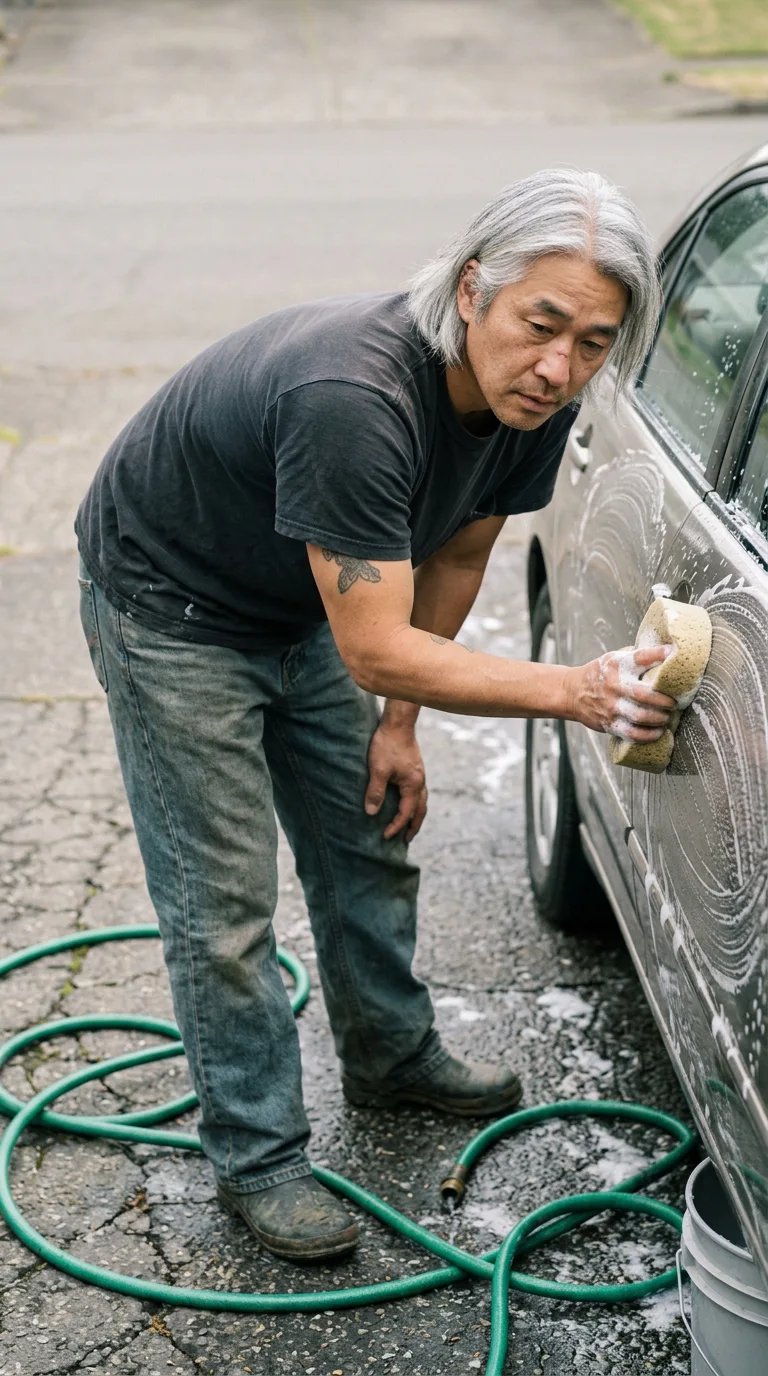
Rarest thing about him: One, upper arm — epic, 1 in 28
Season 0seed 986890643 · engine v10
Character card
lineage 9IC4OB
His body-swap story
@tyler.iverson, wearing Rafael Monteverde, rolled the wheel on and woke up as Dennis Yamashiro, spent 3 minutes in him, then spun the wheel and woke up as Warren Bhatt
---
Rafael Monteverde's knees ache on the porch steps, and that's the whole reason, really — five minutes in and already the left one is singing, an old trail injury this body carries like a debt you didn't take out. You look at these thick forearms, the dimples that come with no smile at all, and think: not this one, not today. It's a Saturday, nobody's expecting a park ranger anywhere, and the boredom is a physical thing, low in the chest, the specific boredom of sitting inside a stranger who hurts. You go back inside, open the laptop, and there's the wheel again, the site's gray hum, the little animation that always looks like it's deciding rather than spinning. You pay. You spin. Somewhere it is not the middle of the morning at all.
Water first — cold, running over knuckles that were dry a second ago. Then weight: shorter than you were, less of you, a lighter frame bent forward at the waist, sponge in a fist that turns small circles out of habit before you even know it's a habit. The hose lies coiled behind you like something sleeping. Soap slides down brushed steel in fans that stop, mid-arc, because your hand has stopped making them. A car door. A cracked driveway. Gray light, no sun, the kind of sky that doesn't commit either way.
The green garden hose is warm where the sun's touched it and cold three feet on, and that contrast alone drops you into a July that isn't this one — a driveway on Long Island, a different car, a boy of maybe six aiming the nozzle at his own sister and shrieking with the joy of getting in trouble for it. Gone as fast as it came. Your hand tightens on the sponge and there it is again, the yellow give of it, foam working into the seams of your knuckles, and you're twenty-six and washing your first boat instead of a car, salt crust instead of dust, your father two feet away not helping, just watching, the way he watched everything you did on boats after that.
The overalls aren't on you now — they're hanging somewhere behind a door in a house that still, after everything, is only sometimes yours — but the memory of putting them on this morning arrives anyway, borrowed off the cotton of the t-shirt you do have on, because a body remembers its own morning even in different clothes. Rubber boots pulled on over wool socks in the dark before six. The suspender clips cold against your chest. A version of this exact routine done four thousand times, boots first, then the bib, the leather stiff in winter and soft as skin by August, and today, a Saturday, none of it — just this shirt, jeans, the ordinary civilian version of yourself that only comes out once a week and always feels, for the first ten minutes, like wearing somebody else's name.
Your lower back complains when you bend for the bucket, a familiar ache settled deep across two disks that have hauled net and hull and crab pot for two decades and are done discussing it with you. Your right hand — this hand, the one gripping the sponge — knows rope in ways it will never forget, coils it without thinking, ties bowlines in your sleep, and right now it is only washing a car and it still moves like it's expecting weather.
The tattoo on your upper arm itches faintly under the sleeve, the way old ink sometimes does for no reason, and touching it — your own forearm, damp — gives you the night it happened: twenty-two, a dare, a shop in Sheepshead Bay that shouldn't have been open that late, a swallow that came out lopsided because the artist was as drunk as you were. You have hated it quietly for seventeen years and never once considered removing it, the way you don't remove things that remind you who you used to be dumb enough to be.
The pale line on your ring finger is the loudest thing in the whole yard. It says nothing on its own — it's just paler skin, untanned, a stripe where fifteen years of sun didn't reach — but your thumb finds it out of habit, rubbing the ghost of a band that isn't there, and that's where Mei-Lin comes in, not as one memory but as a hundred stacked thin as paper: her laugh in a kitchen that smelled like ginger, the two kids asleep in the back of a car on the Belt Parkway, a fight about money that was never really about money, the day she said the word divorce like she'd practiced it in the mirror, which she probably had. You loved her. You still don't entirely know how to stop. The kids call twice a month and it isn't enough and you don't say so.
Your nose aches, low and dull, the old crooked break from a dock line that snapped taut and caught you square — nineteen years old, blood in the scuppers, the other men laughing because you were fine, mostly, and it healed wrong and you never had it fixed because fixing it felt like erasing evidence of a life you'd actually lived. Your shoulders are tired in the way a fisherman's shoulders are tired even on the day he isn't fishing — deep-set, permanent, a tiredness with its own zip code.
This is a Saturday morning and the boat isn't going out and instead there is soap, and a hose, and a car that isn't dirty enough to deserve this much attention, and somewhere in you, quietly, spiritually — not the church kind, never the church kind — there is something like gratitude that a body can still be given a simple task and do it well.
You look down at your hand. It's smaller than Rafael's was, browner at the knuckle, a thin white scar you don't remember getting crossing the base of the thumb. You turn it over once, watching water run off the fingers in a thin bright line, and you lift your eyes to whatever's in front of you and say, to no one, in a voice that isn't the one you had this morning:
"Wrong car."