Dennis Okabe
Fictional. Generated by AI — not a real person, and no likeness of one is intended.
44, janitor in Nashville · rolled by @colin.hasbrook · card — no film
History
who has worn him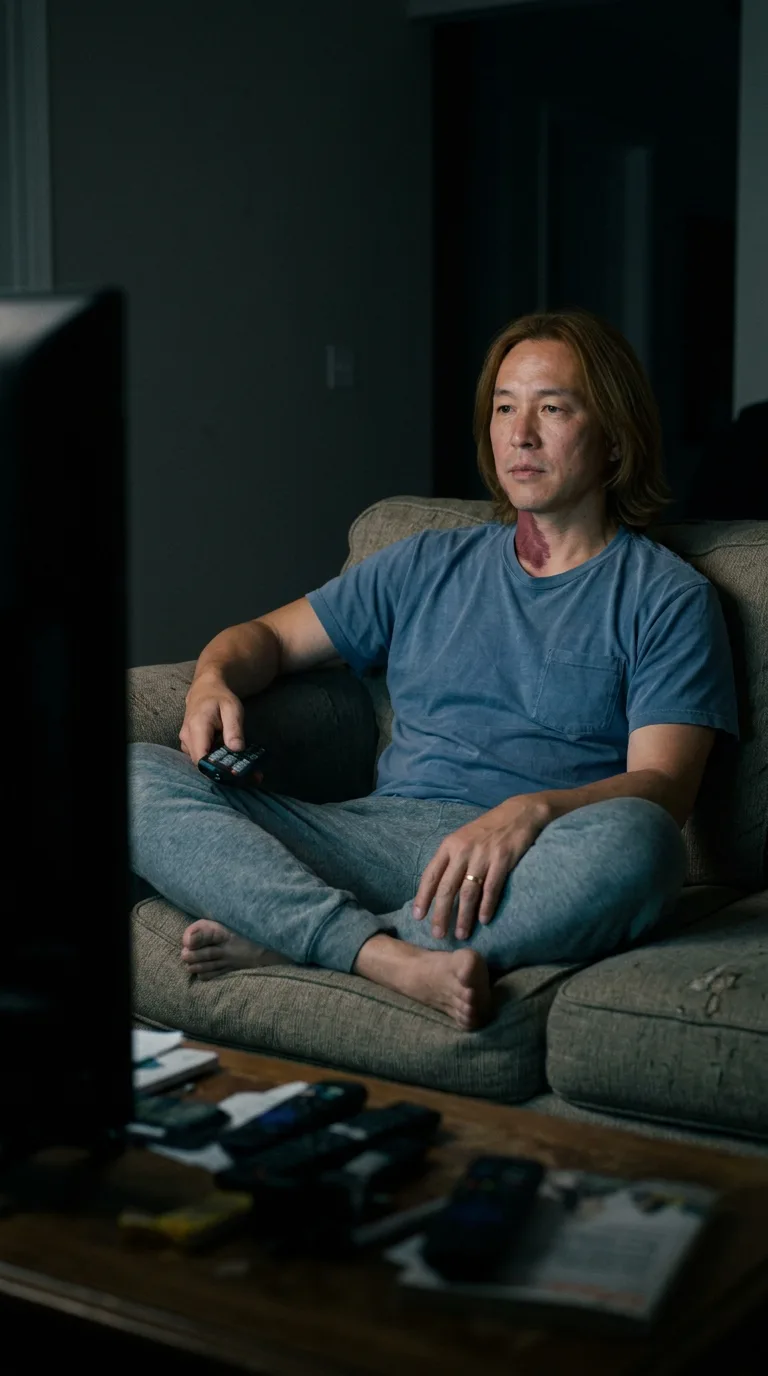
Rarest thing about him: A birthmark on the face — epic, 1 in 95
Season 0seed 100322867 · engine v10
Character card
lineage 2NZHHJ
His body-swap story
@colin.hasbrook, wearing Kevin Stallard, rolled the wheel on and woke up as Dennis Okabe, spent under a minute in him, then spun the wheel and woke up as Terrance Boykins
Kevin Stallard's knee is going under the kitchen table, up-down, up-down, and it has been going like that since before you were Kevin Stallard, some old tic of his own body that you inherited along with the dad bod and the busted left shoulder from a match nobody remembers. It's the middle of a Monday and he should be at practice. He called in sick to his own gym. That's the kind of man you've been for less than a minute — the kind who lies to teenagers about a stomach bug so he can sit at a laminate table with his phone and a card that shows a cushion, a blue shirt, a hand with a ring on it. You didn't even want this one particularly. You wanted the *next* one. Three hundred and thirty-four men behind you and the hunger doesn't announce itself anymore, it just sits in Kevin's chest like heartburn, and you open the site the way another man might open the fridge at midnight not hungry, just looking. You spin because the wheel is there and Kevin's knee won't stop bouncing and somewhere a phone is already dialing back into the dark before you've finished deciding to let it.
The television cuts to a bright frame — some studio audience laughing at something that was funny half a second ago — and you are sitting up straight where a man was sunk low. The remote goes down on the arm of the couch under a hand that isn't shaped like any hand you brought with you: shorter fingers, a plain gold band snug at the base of one, the whole arm lighter, tireder, forty-four years in it instead of forty-three. Bare feet on a rug you've never felt. The room smells like fabric softener and, underneath that, very faintly, like bleach that never fully washes out of a person. You do not laugh at the joke. You watch the rest of the bit with a stillness that isn't yours yet and is already, somehow, more his than yours.
The shirt is gone — he's in a soft old T-shirt now, sweatpants, evening clothes — but your hand finds the collar of it anyway, worrying a loose thread the way he does without noticing, and that's the first door: not this shirt but the *other* one, the gray work shirt, and suddenly you're feeling him button it at five in the morning in a bathroom with the fan going, both kids' toothbrushes still damp in the cup, his wife's hairdryer warm on the counter from twenty minutes ago. Sleeve by sleeve. He rolls the left cuff twice, always twice, because a janitor at Maplewood learned a long time ago that a loose cuff catches in a floor buffer and nearly took a finger off a man named Petrosky in the nineties, a story he tells his own kids like a ghost story. He clips the keys to his belt loop before he puts on the belt, not after, an order of operations thirteen years deep. He touches the birthmark on his jaw in the mirror without meaning to — he always does, one thumb, like checking it hasn't spread, though it hasn't moved an inch since he was nineteen — and there's a whole adolescence folded into that one thumb-drag: kids on the playground, a girl at a bar in his twenties who touched it first and asked if it hurt, and it became, eventually, the least interesting thing about him to everyone who mattered.
The wedding band on the couch-hand warms under your attention and gives you her — not a face all at once but a kitchen, a fight about money four years back that ended with both of them laughing because neither of them could remember what it was about, three kids' worth of noise that never fully leaves a house even when the house is quiet, a rosary he doesn't say enough and feels guilty about exactly on schedule every Ash Wednesday. He quit smoking the year the first one was born and still, fourteen years later, his hand sometimes goes looking for a pocket that isn't there. He drinks maybe twice a month, always a little too much on the second round, always sorry and fine by noon. None of it is a secret. None of it is anybody's business either, and that's the shape of the thing he carries — not a wound, just a life sized for exactly the four walls it's lived in, a school he mops after the buzzer, a cart with a squeaky wheel he's been meaning to grease, a bleach smell that's followed him home so long his wife stopped noticing it around year six.
His leg starts bouncing under the coffee table, the knee doing what it's always done, faster now than the show warrants, faster than he'd have let it go if he were watching himself.
You look down at the hand on your — his — knee, at the band catching the TV light, and you turn it palm-up like you're checking it's real, the way you always do, the way you did with Kevin's hands an hour ago and Suresh's two years before that and three hundred-some men before either of them.
"Little different than a gymnasium," you say to the empty room, to nobody, and you don't know yet if that's relief or something you'll miss.