David Yoon
Fictional. Generated by AI — not a real person, and no likeness of one is intended.
33, teacher in New York · rolled by @colin.hasbrook · card — no film
History
who has worn him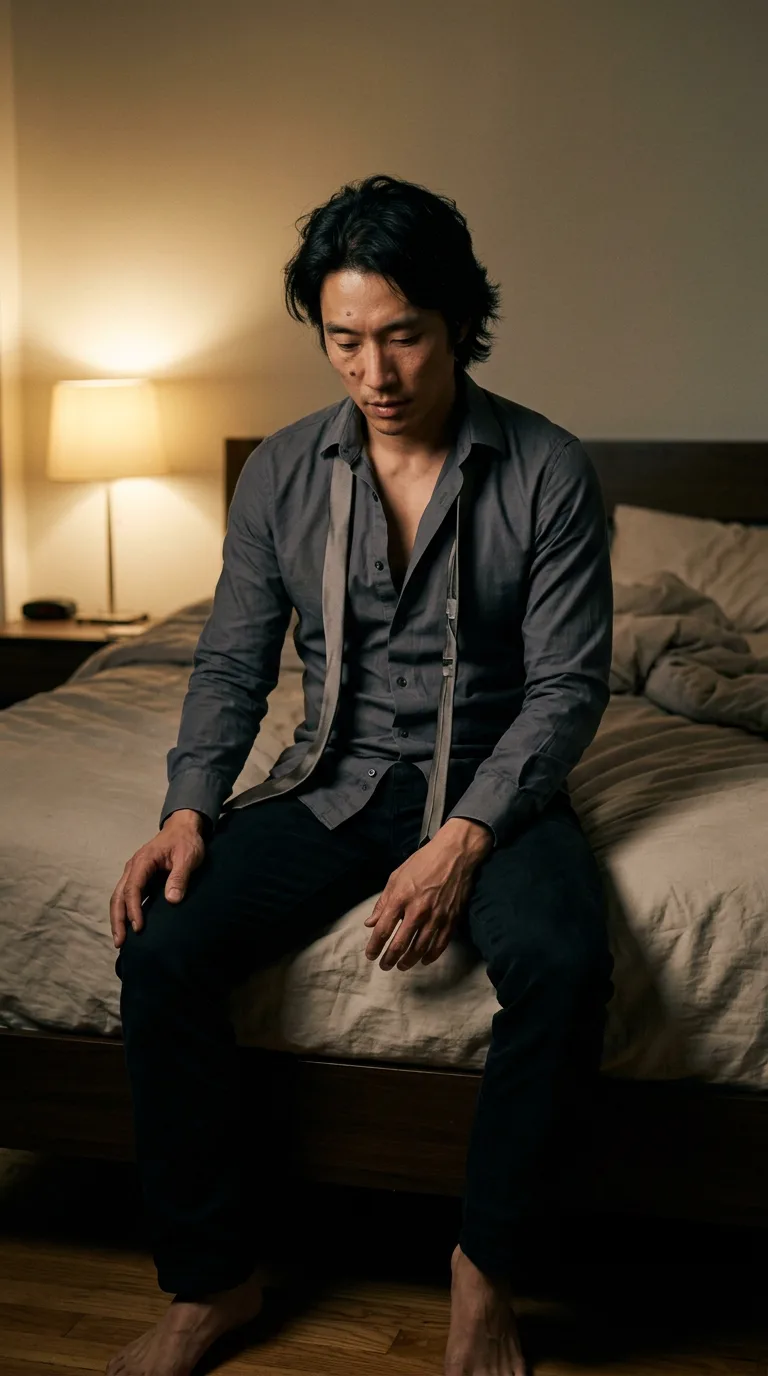
Rarest thing about him: Type 2 diabetes — epic, 1 in 68
Season 0seed 1679241914 · engine v10
Character card
lineage 2NZHHJ
His body-swap story
@colin.hasbrook, wearing Steve Wozniewski, rolled the wheel on and woke up as David Yoon, spent under a minute in him, then spun the wheel and woke up as Marcus Deveraux
---
The knee is what does it, in the end. Steve Wozniewski's knee, sixty years old, fluid on the joint like a bad hinge, and you have been him for less than a minute and already you hate it. You are sitting on the edge of somebody's unmade bed in a rowhouse in Philadelphia, on a Sunday afternoon with the light coming through venetian blinds in bars, and the body is complaining before you have even asked it to do anything. Gray chest hair. A dad gut that pushes against the waistband no matter how the pants are cut. Blue eyes that need reading glasses for the phone screen, which is exactly where the wheel's page is open, wheel still slowing, the word WOZNIEWSKI printed under a photo that is not this tired and not this soft in the belly. Somewhere down the hall a television is on too loud, a game he doesn't care about, and there is a smell of joint cream and coffee gone cold. Sixty is not old. It only feels like a lot of miles were driven in one day. You spun for this, once, and it was fine, it was a body that worked, hands that could still run wire through a wall — but "fine" is not why you keep dropping quarters in a machine that only pays out in men. You want the ache to be somebody else's problem for a while. You put your thumb — his thumb, thick-knuckled — on the wheel, and you spin.
You are reaching for a button.
That's the whole handoff: a button between two fingers, a shirt gapped open over a chest that is not a chest you have ever had, ribs closer to the surface, no give in the stomach at all. The room smells like it, not like joint cream — like clean laundry two days old and something faintly antiseptic, and the light is lamp-light, warm and low, not Sunday-bright, because somewhere outside this room the sun has already gone and left New York the kind of wet dark that makes sodium lamps look orange through a window. The tie is already hung around the neck, loose, unknotted, waiting. The shirt is buttoned wrong — you can feel it before you see it, the collar sitting crooked, one buttonhole out of step — and your hand, his hand, flattens on his own sternum for one second like it's checking that the ribs are still where they were left. Then the fingers just know. Undo. Redo. Each button finds its true hole like it's done this ten thousand times, which it has, and the tie goes up and around and through itself in a knot this closet has apparently never seen tied on him before, though the hands don't hesitate at all.
And then it starts coming in, through the shirt, through the collar against the back of the neck, through the mattress edge under bare feet on hardwood.
David Yoon. The name arrives with the tie, the way a name arrives when you've read it off a lanyard a thousand times without thinking about it — DAVID YOON, HISTORY, ROOM 214 — laminated, worn soft at the corner where his thumb keeps rubbing it. Thirty-three years old. A body that runs a little warm all the time, the diabetes humming underneath everything like a low tone you learn to stop hearing, the fingertip callus from the lancet that his right index finger has now, permanently, a small toughened coin of skin nobody else would ever notice. Brooklyn. A brownstone with a stoop he sweeps in fall because the leaves from next door's tree drift onto it like it's his job and not theirs. An empty classroom this afternoon in the memory that isn't now — no, wait, that's Sunday too, some Sunday, grading at the desk with the light gone flat gold through the window blinds, red pen going dry, the particular ache of a spine that sits in a chair built for someone else's back. That classroom is not this room. This room is a Sunday night getting dressed for a week that starts tomorrow, and something in him — in what's left of him, coming up through the cloth — hates Mondays a little and loves them a little too, the way you love a thing you're good at and tired of being good at.
The shirt sleeve unrolls a memory of a woman who isn't there anymore, or never quite was — a name that surfaces and doesn't stay, a dinner that went fine and then didn't, three years back, the specific quiet of a subway platform afterward and the relief under the disappointment, shameful and real, of being alone again. No one currently. No one who would notice if the tie was crooked. His mother's voice, not scolding, just constant, telling him to eat something besides toast, the blood sugar meter's small mean beep at six in the morning in an apartment that's otherwise silent. The mole on his cheek, high, that a girl in eighth grade once called a beauty mark and he decided, standing in a school bathroom, to believe her about that for the rest of his life. The smell of dry-erase marker that's gotten into his own skin the way sawdust gets into a carpenter's. He has never smoked. He has never needed to drink to get through a Sunday-night dread, though God, some Sundays.
The body underneath all of it is thirty-three and knows things the sixty-year-old shoulders didn't: how to stand still in front of twenty-eight teenagers and not flinch when they're cruel by accident; how to hold a marker at the register of a whiteboard so the letters don't drift downhill; how to test his own blood without looking, the lancet's small click as familiar as a doorknob. Strong through the forearms in a way that has nothing to do with a gym — chalk dust, hauling boxes of textbooks up three flights every August, no one else around to ask. Nothing hurts yet the way Wozniewski's knee hurt. Everything is quieter here, tauter, a held breath instead of a groan.
Your hand — his hand — finishes the knot and comes down and just sits there against the buttoned front of the shirt, flat, the way it started.
You look at it. At the black hair falling shapeless past a collar it's never quite been cut in time for. At the fingers, thinner than the ones you had a minute ago, the small hard callus on the one that isn't yours yet and already is.
"Okay," you say, to the empty room, to the lamp, to nobody, in a voice that surprises you by being his and not the old man's. "Okay. Monday."