David Ozawa
Fictional. Generated by AI — not a real person, and no likeness of one is intended.
60, lawyer in Dallas · rolled by @colin.hasbrook · card — no film
History
who has worn him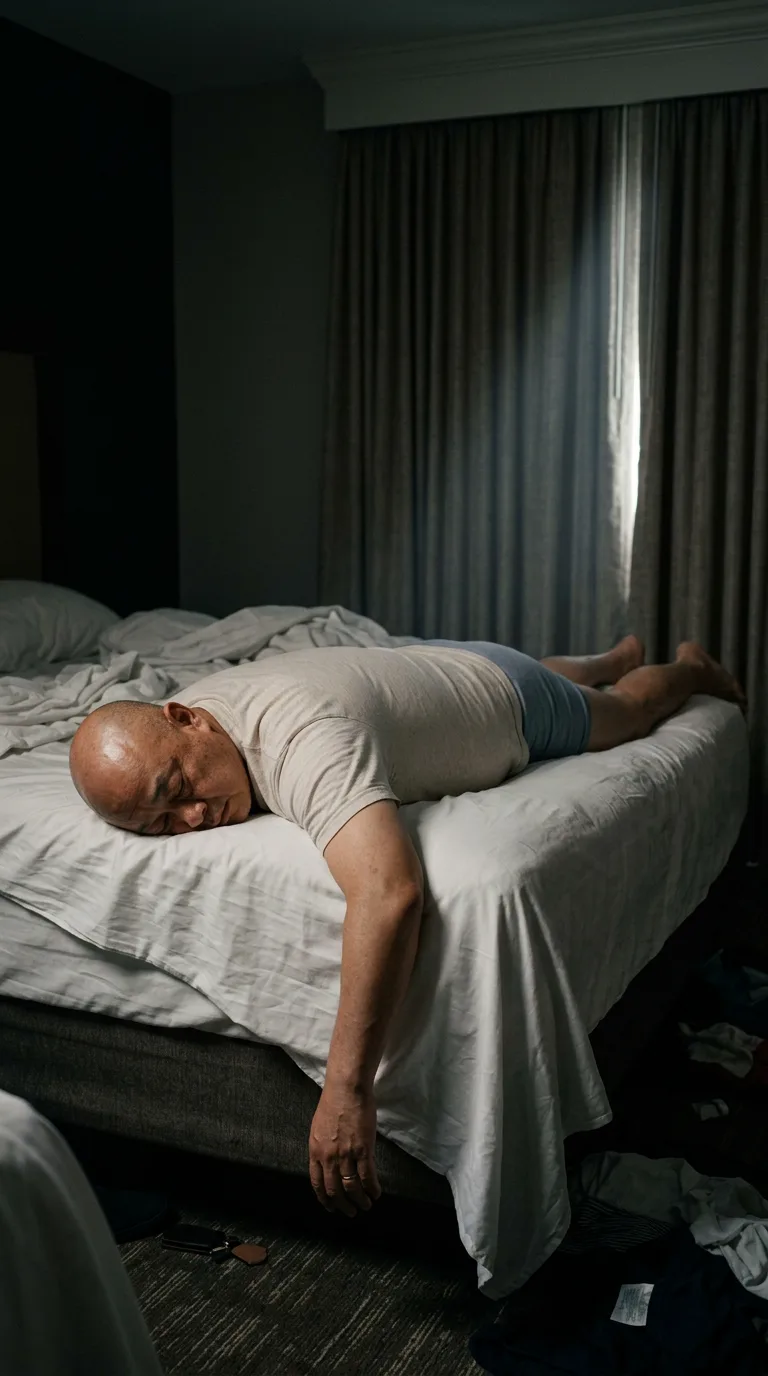
Rarest thing about him: East Asian — uncommon, 1 in 13
Season 0seed 691585748 · engine v10
Character card
lineage 2NZHHJ
His body-swap story
@colin.hasbrook, wearing Rick Alvarado, rolled the wheel on and woke up as David Ozawa, spent under a minute in him, then spun the wheel and woke up as Kevin Nishimoto
The oven timer in Rick Alvarado's kitchen has been beeping for four minutes and you have not gotten up to turn it off. That's new. Rick — the body you've been wearing for less than a minute of his life, though the muscle memory in these forearms goes back fifty-nine years — has a rack of sourdough going gray-black at the edges somewhere behind you, and you don't care, because the phone in his flour-dusted hand still has vessel.cards open on the screen from last night, the wheel sitting there mid-spin like an itch you never scratched all the way. You spun once already today. Got him. Felt his shoulders, his knees, that particular ache along the lower back that never leaves, and thought: comfortable, but small. A life measured out in loaves. You want to know what it feels like to be a man who wins arguments for a living, who has a courthouse under his shoes instead of a walk-in fridge. That's the whole shameful truth of it, and you don't say it out loud even to yourself. Rick's thumb — your thumb, for four more seconds — taps the wheel a second time before the smoke alarm goes off behind you both.
The room that answers is dark and wrong in a way that has nothing to do with smoke. Curtains held nearly shut, gray light in one seam of them, cold air moving on skin that is not covered in flour, that is not standing at all — it is lying down, face-first, one arm hung off the mattress like it fell there on its own. You feel the breath go from a rough, catching drag into something slow and even, and the arm you didn't ask to move draws itself up off the edge and folds, with the other, over a chest that rises broad and soft under a plain undershirt. Legs shift. A body settles onto its back like it has done this every night for sixty years, though something underneath tells you it hasn't, not this way, not once.
Then the shirt. It's still on him, day clothes on a body that fell into bed without changing, and the moment your palm brushes the cotton over his stomach it opens like a door: a hotel room, this one, early this morning, him sitting on the edge of the bed in his boxers working his left sock over toes that ache in the cold. The shirt going on next — striped, blue and white, a gift from his wife three Christmases ago because she said the stripes made him look less like a man who forgot he owned color. Buttoning it one-handed while the other hand holds his phone to his ear, his daughter's voice tinny and half-asleep on the other end, calling from Austin to ask if he's coming up for her birthday even though he told her twice he'd be in Dallas all week for the Kowalczyk deposition. You feel the tie go on after — not this tie, a different one, dark and narrow, his fingers doing the knot without looking because forty years of courtrooms taught them how. You feel the ring on the third finger of that hand catch briefly on the fabric, the way it always does, the way it has since a wedding thirty-one years gone in a church in Plano that his mother cried through because she'd wanted the ceremony in Japanese and gotten it in English with one line of it, just one, in the language she'd raised him half-hearing.
The mattress under this body's back gives you the rest of him in pieces, the way pressure always does. The knees first — both of them, a dull grinding complaint that has been there so long it barely registers as pain anymore, just weather. The lower back, worse, a hot wire along the left side that flares when he's been on his feet in front of a judge for three hours, which he was, this morning, arguing a motion he expected to lose and didn't. Relief in that, real and warm, still sitting in the muscle like a held breath let go. The freckles across his nose and cheeks — you feel them without seeing them, a texture only, the ghost of a mother's hand pointing them out when he was six and hating them, an ojisan at a barbecue forty years later calling him "the freckled one" with real affection, the word landing soft instead of like the taunt it used to be. A wife's mouth pressed to one of them once, on a night neither of you will get all the way back tonight, only the warmth of it, only that she'd laughed doing it.
His leg is already bouncing. It started the second the memories did, knee going against the sheet in a rhythm that isn't yours and isn't quite his either anymore, just the body doing what it does when a mind that isn't thinking about it sits inside long enough. Downstairs, faint, a television. A wife's voice under it, not calling for him yet. Afternoon light behind gapped curtains that has no business being afternoon if this were a normal Monday — and it comes to you sideways, through the ache in his knees and the specific gray fatigue behind his eyes, that this is not a normal Monday: red-eye back last night from a deposition in another city, a nap that turned into something longer than either of you meant, the deposition itself already a memory with somebody else's questions in it, waiting to be finished this evening whether he shows up rested or not.
You bring the left hand up in front of the face — this face, wide and soft-jawed, unfamiliar from the inside — and turn it over slowly, watching light from the curtain gap slide along the wedding band, along freckled knuckles that have signed a thousand documents you never wrote a word of. Downstairs the television murmurs on. Your knee is still going, tapping its private rhythm against sheets that smell like someone else's laundry soap.
"Okay," you say, to the empty room, to no one, in a voice pitched lower and rougher than the one you left in a kitchen that is probably filling with smoke about now. "Okay."
You don't know yet how long David Ozawa gets to keep being spoken through. Neither does he — he never will. Somewhere a wheel is only ever one spin away from spinning again, and you lie there a moment longer in his ache and his ring and his afternoon, in no hurry at all to find out when.