David Okonkwo-Reyes
Fictional. Generated by AI — not a real person, and no likeness of one is intended.
64, electrician in Pittsburgh · rolled by @colton.vasek · card — no film
History
who has worn him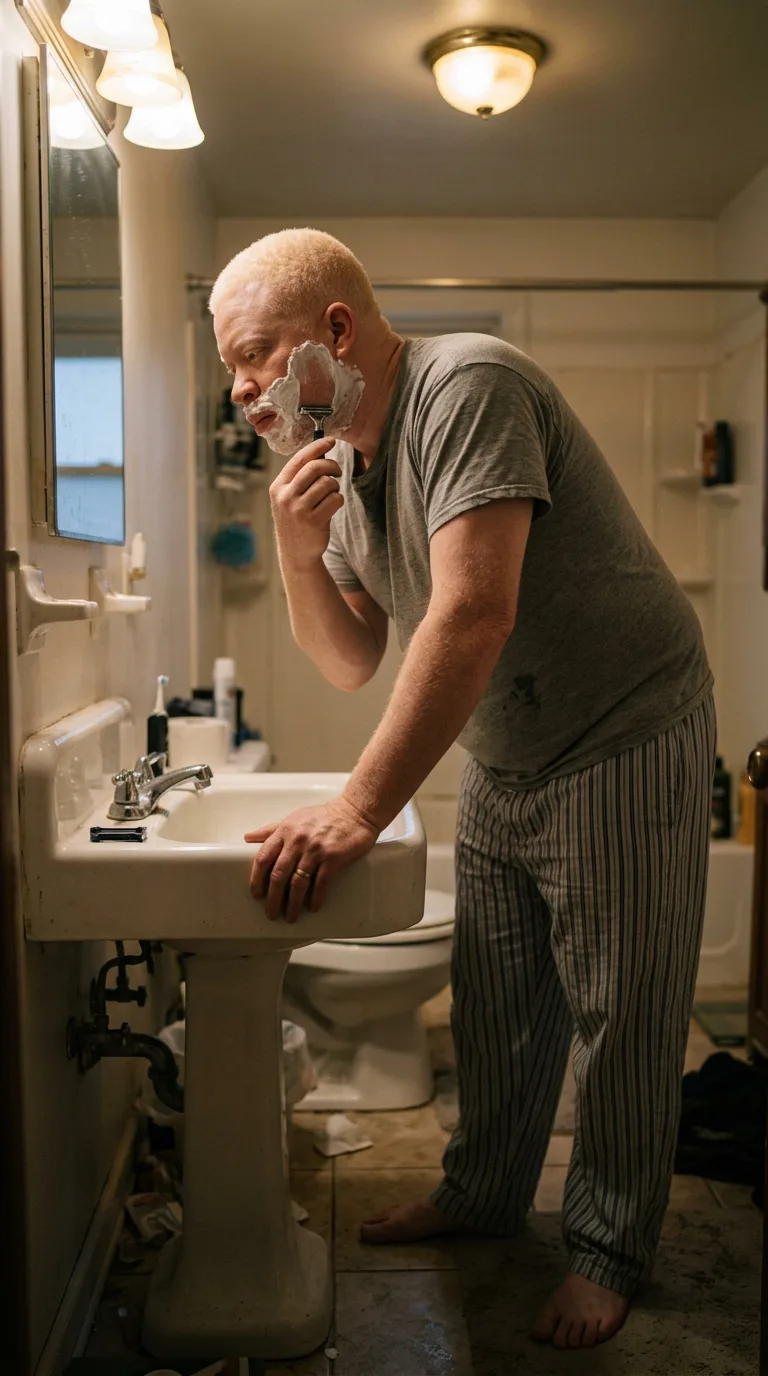
Rarest thing about him: Albinism — legendary, 1 in 661
Season 0seed 457369341 · engine v10
Character card
lineage Y1E4FB
His body-swap story
@colton.vasek rolled the wheel on and woke up as David Okonkwo-Reyes — their first, spent 5 minutes in him, then spun the wheel and woke up as Malik Ashford
The apartment is quiet the way it only gets after one in the morning, when even the refrigerator sounds like company. You have been at the screen for an hour, maybe two, in that particular late-night posture that isn't quite awake and isn't quite deciding anything. The tab has been open since a Tuesday. You keep closing it and opening it again, the way you'd worry a tooth.
vessel.cards. No exclamation points on it, no countdown timer, nothing that looks like it's selling you a mattress. Just a wheel, rendered plain, and a line of small text under it that says what it does in language too flat to be a lie: pay, spin, arrive. You have wanted this since before you knew to call it wanting — every story where someone wakes up wrong, every thread at two in the morning where strangers argue about whether they'd stay or come back, every film where the mirror shows somebody else's face doing somebody else's smile. You never thought it would be real enough to have a price. Now it does, and the price is small enough that the smallness itself feels like a joke at your expense, and you pay it anyway, and you put your thumb on the wheel, and you spin.
There isn't a countdown. There isn't a light. There is a jaw against a razor, mid-stroke, and the jaw is not one you have ever owned.
You are leaned over a sink, weight on your left forearm, and the water is running warm over your wrist in a way that says it has been running a while. Foam on half a face in the mirror — a face pale past paleness, colorless in a way that isn't sickness, blond hair cropped close under a bathroom light gone a little yellow with age. The razor is already moving. It goes up the jaw against the grain and does not stop at the corner of the mouth, which some other part of you — older than you, older than tonight — knows it should have. It always stops there. Not this time. This time the second half of the face gets done faster than the first, clean, unbothered, and the man in the mirror doesn't feel the wrongness of that at all, because there is no man in the mirror anymore who would.
The rinse water is hot on this hand and you did not choose the temperature.
You set the razor down on the edge of the sink — his hand does it, an inch to the left of where he always sets it, and the porcelain there is worn pale in a spot the exact width of a razor's handle, worn there for years — and the sink's chill comes up through your forearm and that is the first door. Behind it: a hardware store, decades gone, a first paycheck folded in a shirt pocket, an older man's voice saying *you got good hands, don't waste 'em on somebody else's houses forever* — and then it's not a memory of a store, it's a whole trade, twenty-some years of it, breaker boxes and crawlspaces and the particular ache that lives in a lower back after a day spent kneeling under a half-finished ceiling with conduit strung overhead like ribs waiting to be covered over. This body knows exactly how much weight a stepladder will take before it complains. It knows the difference between a live wire and a dead one by a hum you feel more than hear. It knows, without being told, how to breathe shallow and careful when the dust in an old attic gets into a chest that has never once in sixty-four years worked quite right — asthma, a fact arriving not as a word but as a remembered tightness, an inhaler's shape recalled by a jacket pocket you are not currently wearing.
The T-shirt against your back gives you the morning it went on: gray, soft from washing, pulled over a head still damp, in a bedroom where a woman's breathing stayed slow and even in the bed behind him because it was too early even for her. Three kids' worth of noise used to fill that house and doesn't anymore, mostly — grown now, scattered, a phone call on Sundays, a grandbaby's photo taped inside a toolbox lid. The pajama pants — striped, thin at the knee — carry a smaller memory, funnier: a wife laughing at these exact pants across fifteen years of Christmas mornings, threatening every single year to finally throw them out, never doing it.
The wedding band is cold first, then not. It comes with a whole marriage folded into one band of gold-colored metal — an argument about money that was really about fear, made up in a kitchen at midnight; her hand finding his in a hospital waiting room when the second kid came early; the specific, embarrassing sweetness of being the strange-looking man some woman decided, for her own unaccountable reasons, to keep. There is an ex in there too, further back, touched only glancingly — a girl from a different decade, a door that closed on its own terms, no malice left in it, just weather that passed through a long time ago and left the ground a little different shape.
Your left hand, resting on the sink's edge, is heavier than any hand you've imagined having. Not fat — soft in a settled way, a gut that gave up arguing with a desk job it never had, because this man's whole life has been standing. Dad bod, somebody at a job site called it once, not unkindly, and he'd laughed, because it was true and because he liked being laughed with. The knees ache a little, low, the good kind of ache that means yesterday was a real day's work. The right hand, still slightly wet, wants — with a wanting that isn't yours and that you feel arrive like weather — a cigarette, has wanted one since before the razor came out, will want one on the walk to whatever job is first this morning, whenever morning actually is in this house, because you understand now, dimly, that the light through that little window is not dawn but the tail end of a night shift, and this face has been up working while a wife and grown kids slept, and shaving now is just the last ordinary thing before bed. The right knee bounces once, unbidden, against the underside of the sink — a habit older than the pack-a-day, a leg that has never in sixty-four years learned how to sit still even when everything else has gone tired.
Somewhere in all of it, unhurried, sits the fact of what he's worth on paper — a number with commas in it that this body doesn't carry the way you'd expect, doesn't wear like a suit, just knows the way you know your own address: contracts won early, a business built slow out of a toolbelt and Saturdays, a modest house that isn't modest anymore on the inside. He goes to church on the strength of that and on the strength of something older than the money, a low steady faith worn like the wedding band, unremarked, always there.
You lift your face from the sink. Water drips once off the jaw you did not shave yourself.
You look at your hand — his hand, pale past pale, the ring catching the bathroom light, a hand that has run wire through a hundred houses and held three children as infants and set down a razor an inch off its own worn mark — and you turn it over slowly, watching it not be anyone you have ever been.
Then you find the eyes in the mirror and hold them.
"Whole life in these hands," you say, out loud, to no one, "and none of it's mine."