Danny Wysocki
Fictional. Generated by AI — not a real person, and no likeness of one is intended.
20, butcher in Chicago · rolled by @colin.hasbrook · card — no film
History
who has worn him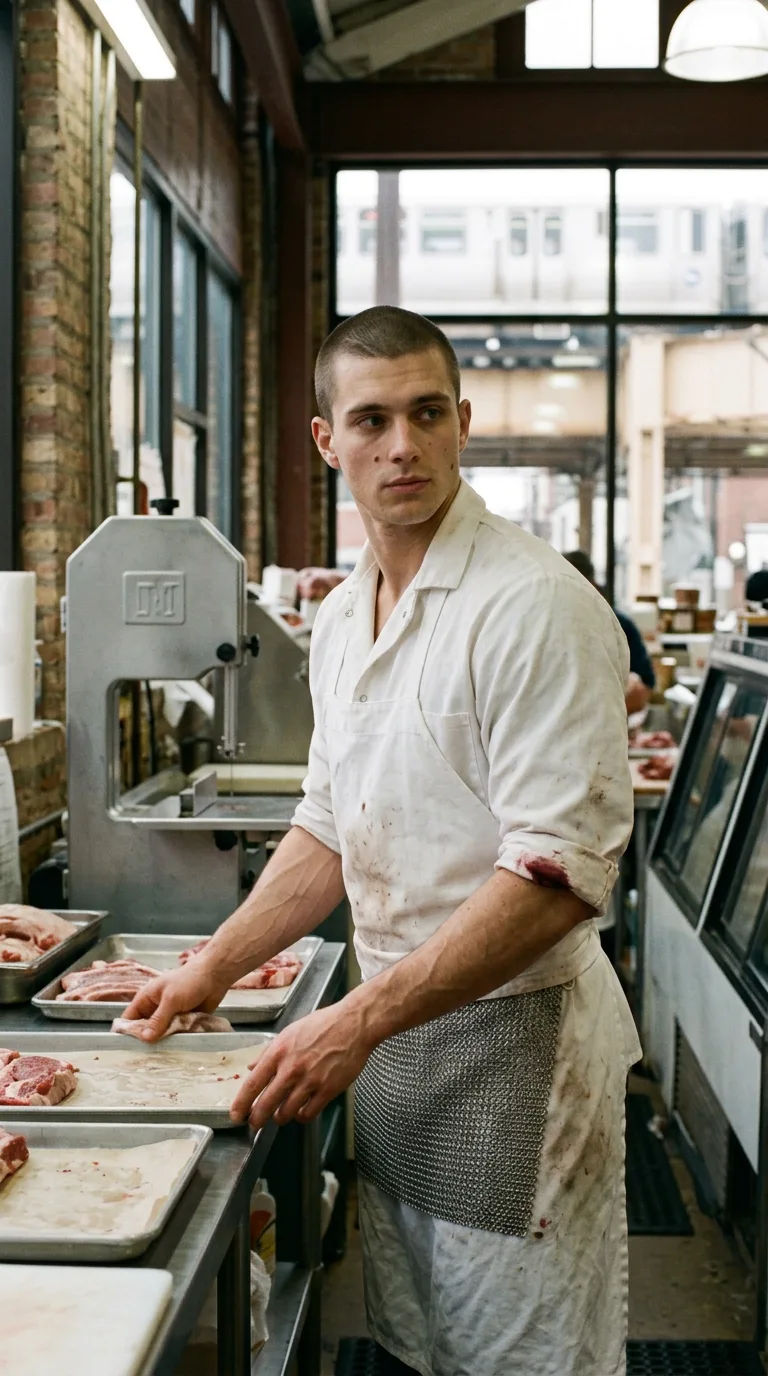
Rarest thing about him: HIV, undetectable on treatment — epic, 1 in 205
Season 0seed 1145670489 · engine v10
Character card
lineage 2NZHHJ
His body-swap story
@colin.hasbrook, wearing Marcus Freeney, rolled the wheel on and woke up as Danny Wysocki, spent 6 minutes in him, then spun the wheel and woke up as Colton Weatherall
You are standing in an exam room in Camden that smells like antiseptic and wet dog, and the dog on the table is fine, the dog was always fine, the owner just wanted to hear it from somebody with a license. You said the words. You watched her nod and cry a little from relief. It is a Sunday afternoon in Maine, gray light off the harbor through the blinds, and you are wearing a fifty-two-year-old man's tired feet and his freckled forearms and his patience, and none of it is boredom exactly, it's that you have done this appointment eleven times this body's life and three hundred and nine times in other lives before it, the healthy dog, the relieved owner, the small clean competent hour — and something in you that is not him wants friction again, wants to not know what happens next. You excuse yourself to the back office. You lock the door. You take out your phone and the wheel is already loaded, spinning colors, vessel.cards sitting patient in the tab like it always is. You do not think about it as a decision so much as a hand that has already reached.
The wheel stops.
You are bent over a steel table under a hard fluorescent light, and there is a knife in your hand, and the meat under it is cold and does not care that you have arrived. The cut you are three motions into goes wrong — the blade skids, catches nothing, a half-second of a stranger's hand not knowing its own weight — and then you correct, slow, deliberate, like a man double-checking work he's done ten thousand times and has never once had to check. The tray in front of you holds pork loin, cross-cut, pink and clean. Somewhere behind you a train goes over on the L, close enough that the glass in the window shivers.
The apron ties are the first thing — canvas gone soft and gray-white at the waist, chainmail panel heavy and cold against your hip below it, and touching the knot at your back you get him: a Wednesday, or every Wednesday, tying it one-handed in the walk-in doorway before the case lights come on, vape pen already in his coat pocket for the break he won't take till two. The sleeve, rolled twice, rust-colored at the cuff where it always is no matter how many times he bleaches it — and that gives you more, gives you his mother ironing shirts that didn't need ironing, gives you Mass at nine and the smell of his father's coat, gives you a whole childhood of being handed things that were already broken in.
The knife handle is the deepest one. Worn smooth in the exact shape of his grip, and it comes back not as a memory but as a fact of the hand: twenty years old, two years on this counter, the boss who taught him the shoulder cut trusting him now with the whole case unsupervised on Sundays. His shoulders ache in the good way, worked-honest, and there's a tightness low in his back from lifting that he has stopped noticing the way you stop noticing your own name. He is strong the way that comes from moving heavy dead weight since he was seventeen, not from a gym. His knuckles want cracking — both hands, one after another, an old habit that isn't nerves so much as punctuation — and you feel the want arrive before you decide to do anything about it.
Under his shirt, close to the skin, is a smaller thing that surfaces almost shyly: a pill taken every morning without ceremony, a doctor's visit every three months, the particular relief of a number that stays low and a life that goes on being ordinary because of it. Nobody at this counter knows. He has never told anyone here. It sits in him quiet and managed and his, the way this apron is his, the way the small dark mole riding high on his cheek is his — he has stopped seeing it in the mirror, though a woman named Steph used to touch it with her thumb like it was something she'd found.
Steph. That one comes rushing in off nothing at all, off the cold air of the case itself, off standing this exact way at this exact table — three months gone and he still reaches for his phone some mornings before he remembers there's no one to text. She used to meet him at the L stop after close, both of them cold, her hands going straight for his coat pockets. It ended over something neither of them says out loud even to themselves. He genuflects at it a little, still, the way you genuflect walking past a church you don't go into anymore.
You look down. The hand on the knife handle is not the hand you had an hour ago in an exam room three hundred miles east and one clock-hour behind — this one is broad, young, scarred nowhere, a plain working hand with meat blood drying pink in the creases. You set the knife down flat on the steel and turn the hand over once, palm up, like you're checking it for something that isn't there and never will be.
You look up, past the tray, toward the window, where the train is just clearing the platform.
"Order up," you say, to no one, because that's the last thing his mouth was already halfway to saying, and it comes out steady, checked, correct — the way everything about him has come out since the second you arrived.