Danny Restrepo
Fictional. Generated by AI — not a real person, and no likeness of one is intended.
34, barista in New York · rolled by @tyler.iverson · card — no film
History
who has worn him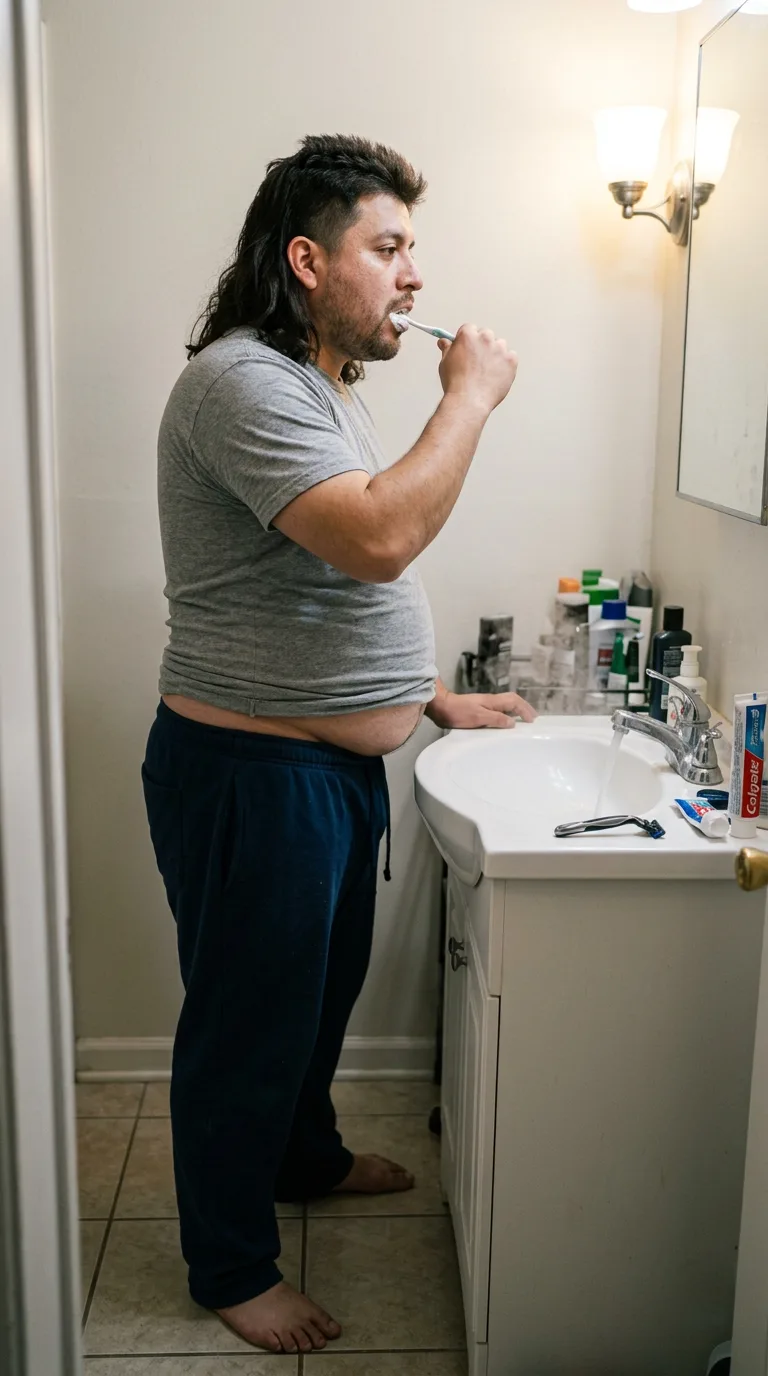
Rarest thing about him: A mullet — rare, 1 in 203
Season 0seed 448253480 · engine v10
Character card
lineage 9IC4OB
His body-swap story
@tyler.iverson, wearing Travis Ledoux, rolled the wheel on and woke up as Danny Restrepo, spent 3 minutes in him, then spun the wheel and woke up as Gary Pelletier
Travis Ledoux's scrubs are still on the chair where the last man left them, and you are sitting on the edge of a bed that isn't yours in an apartment that isn't yours, two minutes into a life you already know you don't want. The nurse's shift starts in four hours. His phone is full of texts from a woman named Priya who he has not answered, and you can feel, distantly, like a smell in another room, that he would rather sit here doing nothing than go be her boyfriend for one more night. You didn't take this body to be bored in it. You spun for Colton, three days and two hours ago, and you gave him back because you had to — every spin only lends you forward — and you have been thinking about him since, the itch of a house you know the floorboards of, a friend who isn't Colton but is Colton's, someone you've heard about from inside Colton's own skull without ever once being him. That's rarer than it sounds. You want to see the friend from the other side. You open the laptop, find the site, feel Travis's tired shoulders bend over the keyboard one more time, and spin.
The bathroom light is warm and yellow and it is not Travis's light. The mirror in front of you throws back a stranger's face — heavier through the jaw, dark stubble, hair long at the back — mid-motion, toothbrush working the last molars on the right, foam gone thin and grey at the corner of the mouth. You did not choose the angle your arm is at. You finish the stroke anyway because the arm was already going and some second passenger in the muscle just carries it through. You spit. You rinse. You rinse again, out of a habit that isn't yours yet, and you stand the brush up bristles-first in water that has clearly sat in that cup, ungodly, for years.
The T-shirt is what opens first — grey, soft at the collar from a hundred washes, and it comes with a flash of a Sunday morning, sun through kitchen blinds, a woman's laugh, small hands pulling at the hem of this exact shirt wanting to be picked up. Then more: this is Danny Restrepo, thirty-four, and the shirt has been through two kids' worth of spit-up and one dead father's funeral and he wore it home from the hospital the second time, when Mateo was born, because it was what was in the bag. His wife's name arrives with the smell of the fabric softener she buys — Marisol — and with her comes a whole marriage at once, not sorted, just there: her laugh at something stupid he said behind the counter once, a fight about money that lasted three days and ended with her hand flat on his chest in the dark saying I'm not going anywhere, don't act like I'm going anywhere. The apron isn't on him now but his shoulders remember its strap anyway, the particular ache low in his back from standing all day, the steam wand's hiss so constant in his ears that silence at home sometimes feels wrong. His hands know things without being told: the twist-tamp-twist of espresso, the angle you hold a pitcher of milk to get the microfoam right, and under that, older, his father's hands teaching him to fix a bike chain in a garage in Sunset Park that isn't there anymore.
The sweatpants at his hips carry the specific tiredness of a man who works mornings and gets up before anyone, who kissed Marisol's shoulder an hour ago without either of them really waking, whose daughter Camila had a nightmare last week and ended up wedged between them till four. The wedding band on the left hand is warm from his own skin and it brings, all at once and overwhelming, the day he put it on — nervous in a rented suit, her father not fully sold on him yet, Colton three states away texting stupid jokes to calm him down because Colton always knew when to be an idiot on purpose. You feel that friendship arrive sideways, the way it always does with someone else's memories: not the years, just a shape — a kid from two blocks over who taught him to skate badly, who left for New Orleans and still calls on his birthday, whose voice on the phone can still make him laugh so hard his stomach hurts, this stomach, soft now, that carries two kids' worth of birthday cake and a hundred family dinners he wasn't ashamed of. The half sleeve on his right arm prickles under the shirt sleeve with the memory of eleven hours in a chair getting his abuela's face put there in black and grey, her eyes exactly right, the artist saying hold still, mijo, almost done, and Danny not moving because it mattered too much to move.
None of it is dramatic. That's the whole shape of him: a man with nothing to his name worth counting, two kids asleep down the hall, a wife who loves him in the unglamorous way of someone who has seen him at his worst and stayed, a job that hurts his feet and doesn't pay much and that he is, in some quiet unspoken way, proud of anyway. He prays sometimes, not loud about it, mostly at night, mostly for the kids. He has one drink most evenings, never smoked, never needed to. His hands crack their knuckles now without you telling them to, an old tic firing off on its own down in the muscle where his memories still half-live.
You look down at those hands in the bathroom light — sink water still running, foam drying at the corner of a stranger's mouth that is now yours — and you turn the right one over slow, the ink of the woman's face shifting in the light, and something in your chest that is half you and half Danny Restrepo goes tight and glad at once.
"There you are," you say, low, to no one, and you shut off the tap.