Danny Iwasaki
Fictional. Generated by AI — not a real person, and no likeness of one is intended.
42, contractor in Western Kansas · rolled by @colin.hasbrook · card — no film
History
who has worn him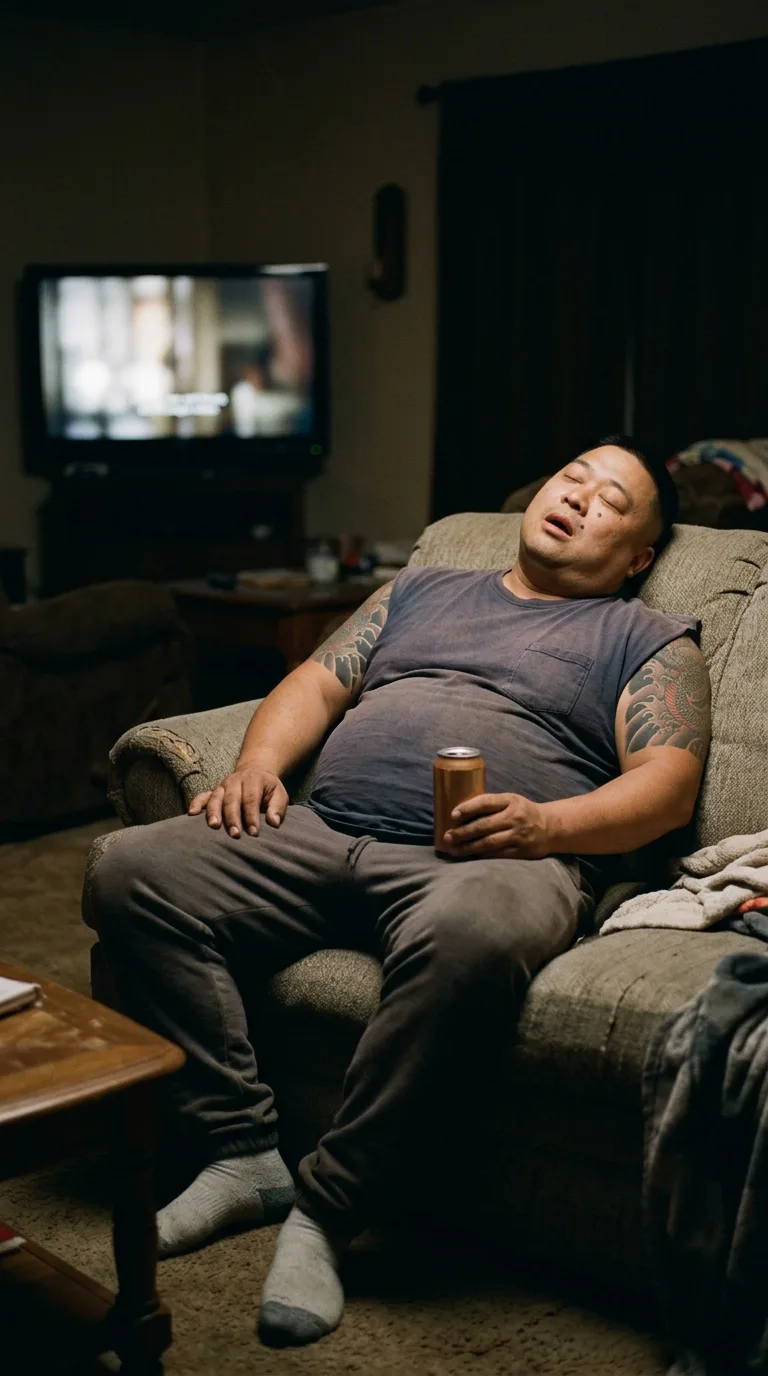
Rarest thing about him: Back piece — epic, 1 in 95
Season 0seed 890618156 · engine v10
Character card
lineage 2NZHHJ
His body-swap story
@colin.hasbrook, wearing Marcus Broadnax, rolled the wheel on and woke up as Danny Iwasaki, spent under a minute in him, then spun the wheel and woke up as Justin Carter
You are Ethan Kowalczyk for exactly seven minutes, standing in his kitchen with his knife still in his hand and his rent due Friday and his back already complaining about a shift that hasn't started, and it is the smallness of it that does you in — the drawer that won't close right, the smell of somebody else's dish soap, a life you can feel is fine and is not yours and is already, unbearably, boring. You set the knife down. You go back to the site because seven minutes was long enough to know you don't want the rest of the minutes. vessel.cards loads on a cracked phone screen that isn't yours either. You pay. You spin.
The wheel finds a couch in western Kansas.
You arrive heavy — heavier than Ethan, heavier than you've been in a while — sunk into cushions that have learned the shape of this exact body over years, mouth open, a can gone warm in a hand that is suddenly yours and loose around it. The TV throws blue light across a room you've never stood in. Onscreen a ball is already crossing a goal line for the second time, the replay looping past for an audience that missed it live. Your thumb — his thumb — finds the volume knob on some remote logic laid down before you got here, precise even though the rest of him is three beers past precise, and you sit forward into a body that outweighs anything you've worn tonight, joints announcing themselves like tenants with a grievance.
Then the shirt against your back speaks first.
It's a soft old henley, snug over the belly, the fabric gone thin at the elbows from work, and it gives you a Tuesday morning: standing in front of a dresser mirror in an undershirt, guessing correctly that today's job would run hot by noon, pulling this exact shirt over his head one arm at a time because the left shoulder has stopped forgiving fast movement — a torn something, years back, off a ladder, never actually looked at by a doctor because doctors mean time off and time off means no invoice. The shirt remembers being pulled down over a gut he stopped fighting around thirty-six. It remembers deodorant applied twice because once never feels like enough on a body that sweats through vests by nine a.m.
The tool belt on the floor by the coffee table — kicked off, not put away, because after nine hours framing a barn addition outside Colby you do not care where the belt lands — gives you longer. Twenty years of it: an apprenticeship under a uncle who spoke more Japanese than English on the jobsite and more profanity than either, the particular ache of learning to swing a hammer with a body that was never built lean, the day the business became his own name on the invoice instead of somebody else's. The back piece under the henley — koi and wave, bold outdated color going soft at the edges — comes back through nothing you're touching, just the itch of ink against sweat-damp skin, a memory of a tattoo parlor in Wichita at twenty-four, a friend who's dead now, a design picked because it looked strong and he wanted, for once, to feel like something built to last instead of something that gets tired by 3 p.m.
The can in his hand tells you about drinking alone, which is most of the drinking. Not desperate — just a man with nobody currently required to notice how many. Church on the Sundays he's not too hungover, a Unitarian building with a woman pastor he likes and doesn't examine why. The vape on the coffee table, closer to his other hand than the case, tells you three-in-the-morning trips to the bathroom, coughing, promising himself and nobody else he'll quit after this job, this year, this decade.
The couch itself — worn to him, no one else's weight ever seasoning it — tells you the shape of the whole solitary architecture: no wife's photo on the wall, no kid's height marked on a doorframe, a phone that doesn't light up much past six p.m. except with a jobsite group text. Comfortable money, no one significant to spend the comfort on. Chronic ache low in the back that the couch cushions are shaped exactly wrong for and exactly right for at the same time, the way old pain and old furniture make peace with each other.
You look at your hand. Wide, callused, a white scar across two knuckles from a table saw that nearly took more than it did, the can trembling slightly with a low-grade tremor that has nothing to do with fear. You turn it over. The mole is not on the hand, you know, it's on the cheek, but you feel it there anyway, a fixed point on a face that has been described to strangers a hundred times as "the guy with the mole," a life spent being findable in a crowd for one reason.
You lift your eyes to the dark window, to your own reflection ghosted over cut wheat stubble and a thunderhead somewhere out past the glass, and you say, thick-tongued, testing the new weight of a new mouth:
"Who turned it down."