Danny Escareño
Fictional. Generated by AI — not a real person, and no likeness of one is intended.
32, refrigeration technician in Chicago · rolled by @marco.villagrana · card — no film
History
who has worn him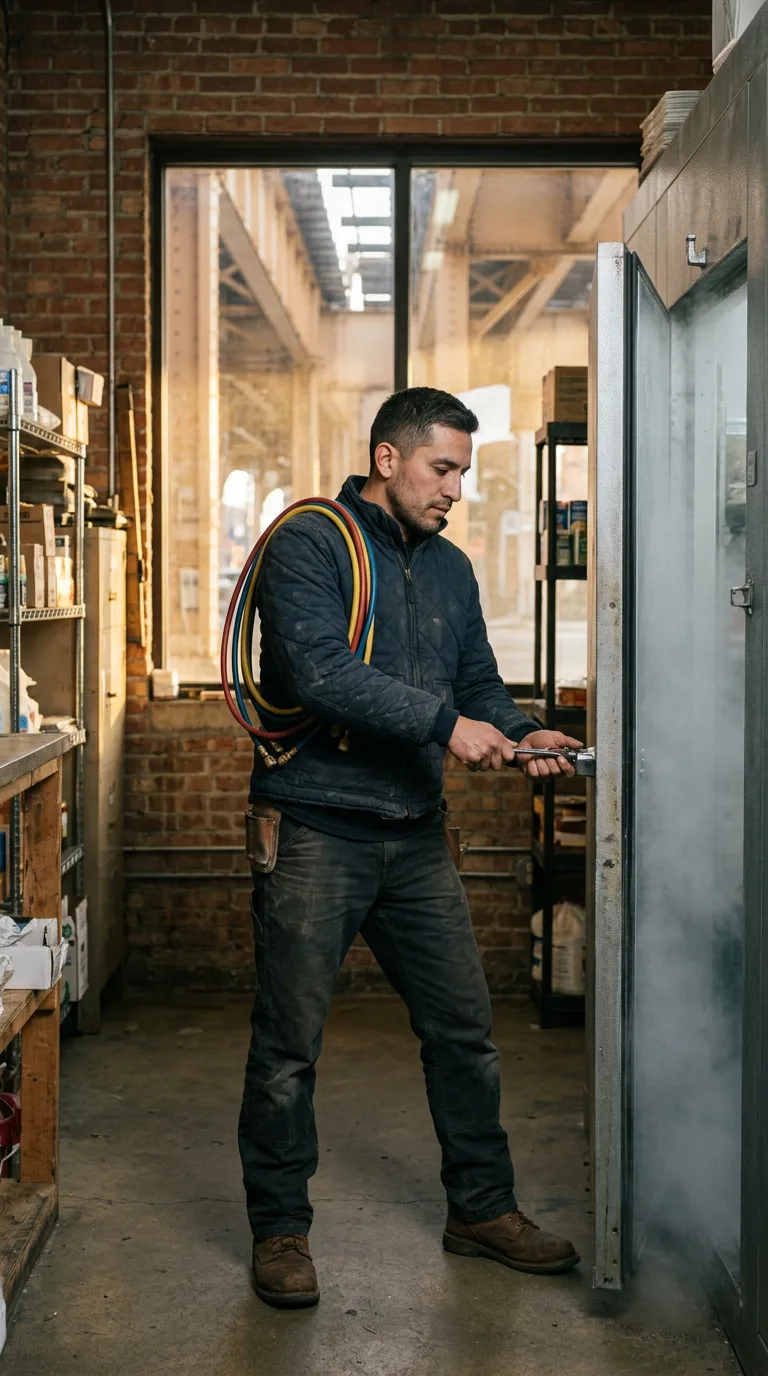
Rarest thing about him: Refrigeration technician — common, 1 in 172
Season 1seed 53037279 · engine v11
Character card
lineage LJL8SV
His body-swap story
@marco.villagrana, wearing Preston Iwata, rolled the wheel on and woke up as Danny Escareño
You are Preston Iwata for two minutes, and already it isn't enough.
You feel it the way you always do now, that fast dulling, like a good meal eaten too quickly to taste. Preston's office is exactly as advertised: floor-to-ceiling window, gray Maine light going lavender at the edges, a framed photo of a boat he never sails turned slightly toward the desk so clients see it before they see him. Forty-five years old, bald by choice and razor, soft in the middle in the way of a man who golfs to feel athletic. You sit in his chair, in his good charcoal suit, and you flex his hand and think: I have been rich before. I have been careful before. There is nothing here that surprises you, and surprise, you have learned across a hundred and thirty-five men, is the only thing you actually spend money for. You open the laptop. You do not open his email or his calendar or whatever waits in his second minute of a life you will never live. You open vessel.cards instead, because boredom, in you, has become a reflex faster than curiosity.
The wheel loads. You do not think about who is on the other side of it, the way you stopped doing around body eleven or twelve. You spin.
—
The walk-in door is half open and the cold is rolling out of it in a slow fog when the motion breaks. Your hand — his hand — is on the flare nut wrench, seated against a copper line, and the turn that should be automatic stops halfway, like a record catching. You redo it. Slow. Correct. Then the next ten turns come out of you checked, deliberate, a grown man relearning a motion he has done ten thousand times, because you are new in here and the hands are not answering to reflex anymore, they are answering to you.
Cold air. Actual cold, biting through a quilted jacket, not the dry recycled chill of an office building. Under your boots, sealed concrete. Behind you, brick, a wall of it, old and orange in a light that is going gold instead of gray — the sun lower here, further along in its evening than the one you just left. A train somewhosewhere close overhead, a long steel shudder passing through the building's bones. You are shorter now. Wider through the shoulders. Something aches low in the back, an old ordinary ache, the kind that comes from bending into machines for a living rather than sitting near them.
You are still holding the wrench when his life starts coming up through your fingers.
The tool first — the shape of the grip, worn smooth on the left side where his thumb always sits, and with it a flash: a man's voice, older, laughing, "aprieta pero no le rompas los huevos a la tubería," don't strangle the pipe, mijo, feel it, don't fight it — his father, teaching him this exact motion in a garage in Cicero when he was nineteen and thought HVAC was a placeholder before something better came along. Something better never came. He stayed. He got good. He is, if you let the wrench keep talking, quietly proud of being good at something most people only notice when it's broken.
The jacket next, cold quilted nylon against your — his — back, and it gives you this morning whole: the alarm at five-forty in a one-bedroom two blocks from the tracks, frost feathering the inside of the window, the particular grunt he makes getting out of bed that has nothing to do with age and everything to do with a mattress he's meant to replace for three years. Pulling the thermal on first, then the work shirt, then this jacket, zipping it to the throat against a Chicago morning that does not care what month the calendar says it is. His tool belt from the hook by the door, heavier on the right hip than the left, and he never fixed that, never bothered, because his body corrected for it years ago without asking him.
The belt at your hip: his daughter's drawing, folded small, tucked behind his phone in the truck, not touching you now but close enough to arrive anyway — she is six, she drew him as a stick figure holding a rectangle she labeled "COLD BOX," and it lives in the truck because Marisol, her mother, has him only every other weekend and he cannot stand for the drawing to be somewhere he isn't. Marisol he does not hate. He thought he would, once, in the year after, and instead what's left is something quieter and worse — a tenderness with nowhere left to go, the two of them better as exes than they ever were as anything else, and both of them knowing it, and neither saying it at the wedding they weren't invited to when she starts seeing someone new.
The steel of the walk-in door under your other hand, so cold it almost burns, and this gives you the shape of the job itself — the diner upstairs waiting on their cooler, the owner already texted twice, the low Friday-evening hum of a man near the end of a ten-hour shift who still checks his gauges twice because a restaurant losing four hundred pounds of product on a weekend is somebody's whole month. He believes, in the plain unfussed way of a man who was raised on it and never had reason to set it down, that this — the fixing, the showing up, the not cutting corners even when no one's watching — is a kind of worship that doesn't need a building. Sunday mornings, a church on Cermak with folding chairs and a pastor he likes. He has never had a drink in his life and has never wanted one; it was never a fight, just never a door he opened.
His body under all of it: thirty-two, compact, strong through the forearms in the specific way of a man who has spent a decade wrestling copper and steel into small spaces, a low ache in the lower back that flares on cold mornings, knuckles rough, nothing soft anywhere. The nose — you feel it before you understand it, a faint permanent wrongness in the air going in, a slight crook you didn't put there and can't take out, from a ladder and a bad landing at twenty-two, a story he tells exactly once per new coworker and never again.
The fog from the open cooler keeps rolling past your ankles.
You look down at your hands — his hands, scarred faint white across two knuckles, nails cut blunt and short, a smear of yellow lubricant on the pad of one thumb — and you turn them over slow, like you're checking they're real, because for one more second some very old, very tired part of you almost expects Preston's soft manicured fingers to still be there.
They're not.
You lift your eyes off them, up into the low gold light bouncing off the brick, and you say, quiet, mostly to no one:
"Okay. Show me what's wrong with you."