Danny Cabrera
Fictional. Generated by AI — not a real person, and no likeness of one is intended.
22, line cook in Small-town Ohio · rolled by @colin.hasbrook · card — no film
History
who has worn him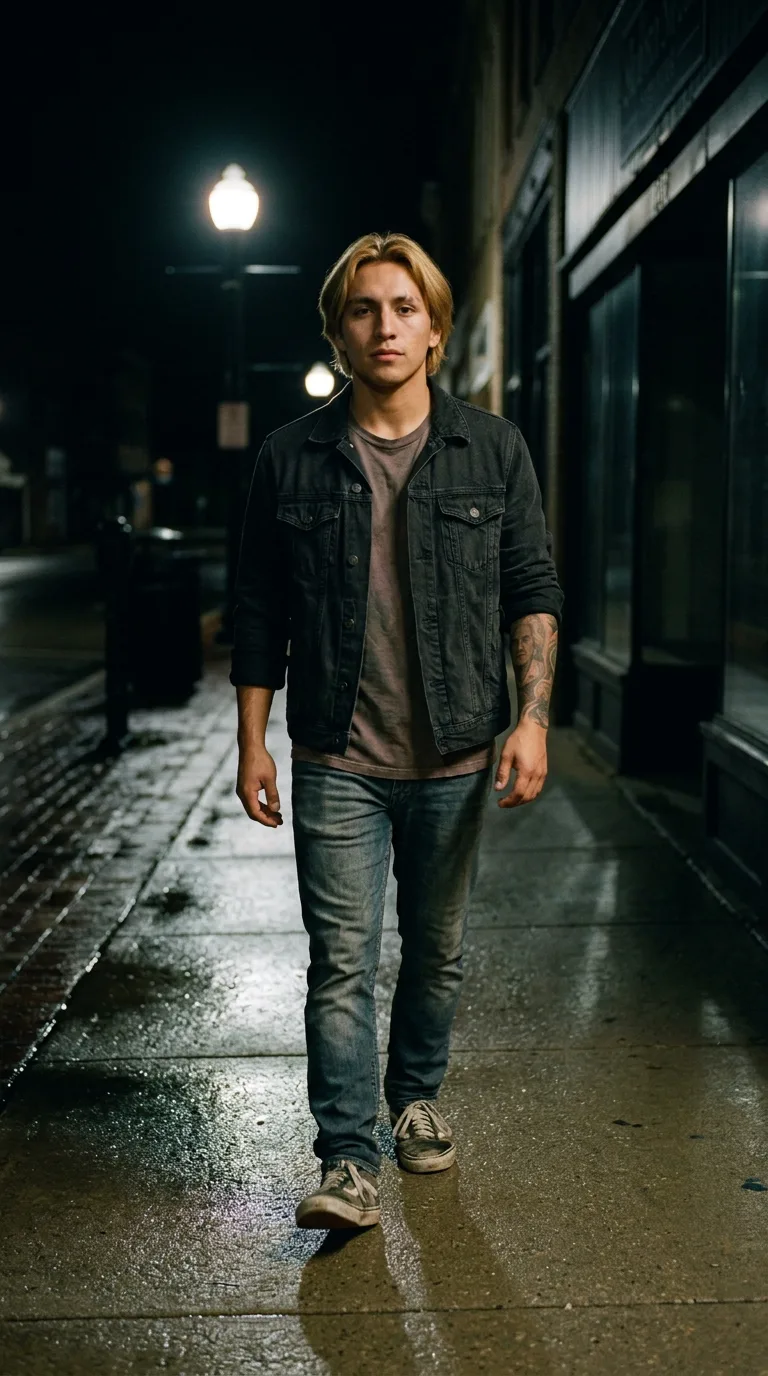
Rarest thing about him: Cigars only — epic, 1 in 56
Season 0seed 941997108 · engine v10
Character card
lineage 2NZHHJ
His body-swap story
@colin.hasbrook, wearing an unnamed body, rolled the wheel on and woke up as Danny Cabrera, spent 3 minutes in him, then spun the wheel and woke up as Rigo Cantú
The tape measure is still looped around your neck when the itch starts. Detroit, Monday, sun coming sideways through the shop window onto bolts of gray flannel, and you're pinning a cuff on a man's trousers who keeps talking about his daughter's wedding like you care, like this beauty mark and these blue eyes and this steady tailor's patience are yours and always were. Forty-nine years old. Good hands. A life that runs on time, on measurements, on being trusted. It fit fine for a while. That's the trouble with fine — it doesn't stay interesting once you know exactly what tomorrow's chalk marks will look like. You finish the cuff. You tell him to come back Thursday. Then you're washing your hands in the back room, and the water's warm, and you're already gone before it's cold, already thinking about the site, the wheel, the little animated spin that never once looks like what it does.
You don't decide so much as arrive at the decision already moving, the way you always do.
The street is wet and black and empty and it is very early, and then it is you — the whole weight of him lands at once, a shorter body than you've had, compact, coiled with a strength that isn't decorative, jacket hanging open over a shirt gone loose at the collar. One shoe has been scuffing the pavement every third step for blocks and it stops scuffing. Mid-stride, mid-stumble, your foot — his foot — catches the edge of a parked car's bumper for balance, and something that was drifting snaps straight. The next forty steps come down even. At the corner, instead of continuing toward whatever bed he was aimed at, you turn left.
The jacket is the first thing that talks. Denim, worn soft at the elbows, and it gives you a flash of a coat closet, a woman's laugh from another room, a night that ended with somebody's number saved under a joke name — Marcus, tall, work boots, a smile that didn't quite reach all the way, gone by spring for reasons that were nobody's fault and everybody's. The one who got away, and the jacket knows it, holds the shape of an arm that isn't there anymore against the inside seam.
The shirt underneath — you feel it dragging over skin that's still faintly damp with the night's walk, and it gives you this morning, hours and hours from now by the shop's clock but real to him, real to the body: pulling the tee over his head in a room above a hardware store, low ceiling, laundry on the floor, checking the clock because the lunch rush waits for nobody. Two years on that line. The particular ache low in the back that comes from bending over a flat-top for six hours, the reflexive way his wrist already knows how to flick a pan without spilling, muscle memory sitting in the forearm like a second nervous system. Small hands, quick hands, a body built low and dense and strong the way boxers are strong, not the way linemen are.
The ink on his arm gives the most. Realism, black and gray, a portrait worked in over four sittings that hurt more than he told anyone — his abuela's face, done from the photograph on the mantel that nobody else in the family wanted, because he was the one who used to sit with her on the porch after school while his parents worked doubles, the only one who stayed long enough to learn how she took her coffee. She's three years gone. The tattoo artist cried a little on the second session, said the eyes were coming out right, and Danny — the name comes with the memory, quiet, unforced — didn't cry, just watched his own arm turn into her, one careful line at a time.
The scar through the eyebrow arrives almost as a joke, a flash of a kitchen, a dropped sheet pan, a line cook's laugh from across the pass — stupid, avoidable, thirteen stitches and a story he tells wrong on purpose because the true version isn't funny.
The wet pavement under his sneakers gives you the walk itself, the one you're finishing for him: a Sunday night into Monday morning, closing shift, a few drinks after with people from the kitchen who all went home in the other direction, and him choosing the long way past the shut-up diner with its dead sign, because there's nobody waiting on him and no reason to hurry toward an empty apartment above a hardware store that still smells like paint thinner.
He carries nothing. No wallet weight worth mentioning, no phone buzzing, nothing he'd bring up if you asked him straight out what's wrong. That absence is its own small mercy — there's nothing left in these pockets to argue with you.
You stop at the corner, under the streetlight, and look down at your hands — smaller than you're used to, brown-knuckled, a thin white line of an old grease burn along one thumb. You turn the right one over, palm up, like you're checking it's real, and the tattoo shifts with the tendon, his abuela's face rippling faintly at the wrist.
"Not the way home," you say, out loud, to the empty street, and you don't know yet — nobody does — how long you intend to make that true.