Damon Whitfield
Fictional. Generated by AI — not a real person, and no likeness of one is intended.
29, chimney sweep in Atlanta · rolled by @colin.hasbrook · card — no film
History
who has worn him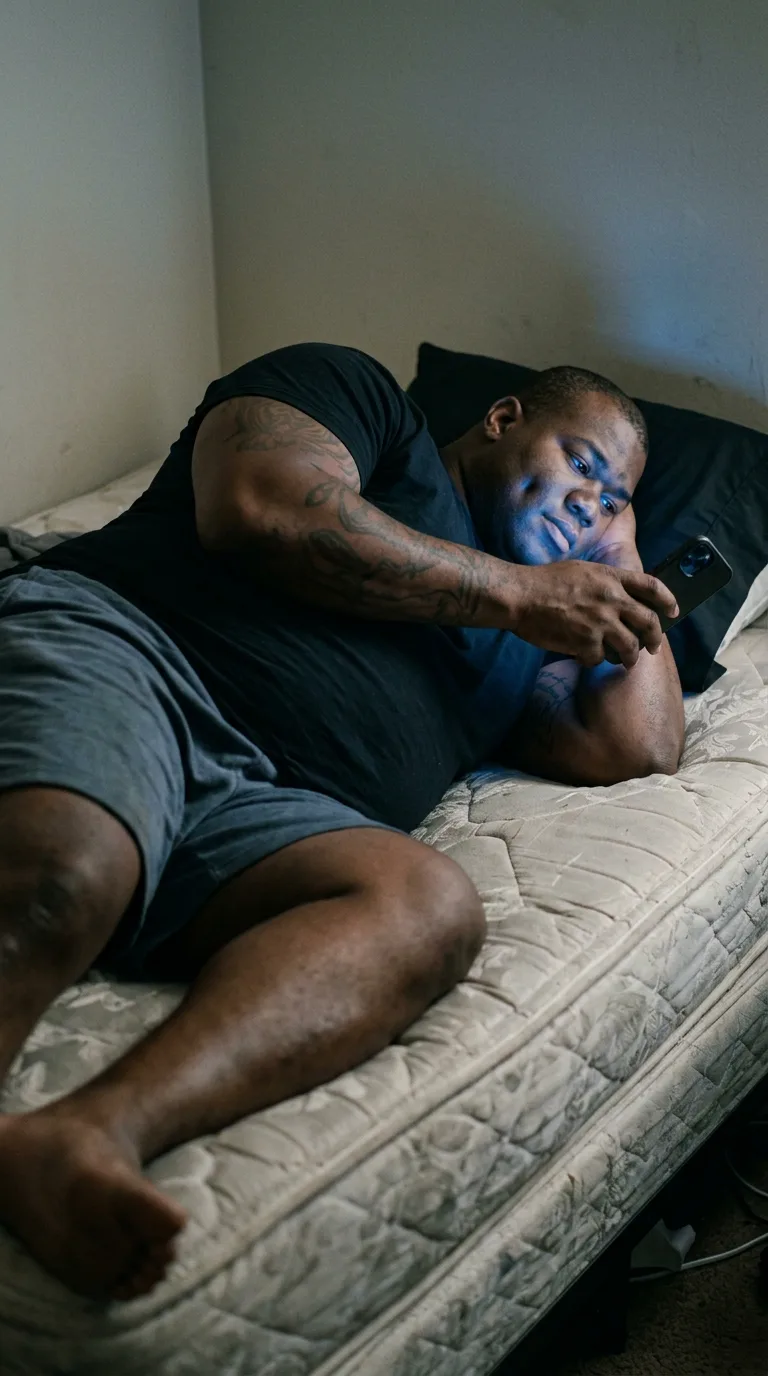
Rarest thing about him: Chimney sweep — uncommon, 1 in 176
Season 0seed 1174312174 · engine v10
Character card
lineage 2NZHHJ
His body-swap story
@colin.hasbrook, wearing Joey Alama, rolled the wheel on and woke up as Damon Whitfield, spent under a minute in him, then spun the wheel and woke up as Aman Rehani
The roofer's arms are still tingling from a nail gun he never fired. You are sitting on the edge of Joey Alama's mattress, in Joey Alama's rented room, three minutes into a life that felt, the second you took it, like a coat one size too small. You'd wanted the height. You'd wanted the scar through the eyebrow, some story you could invent around it later. Instead you got tired shoulders, a phone with nine unread texts from a foreman, a body that ached in a specific, boring way from an actual day's actual work — his work, not yours, and none of it earned. Three minutes was enough to know you didn't want the bill for it. So you open the site again on his cracked phone, thumb sure over the cracks, and you spin.
The scroll keeps going for a half-second after you land — his thumb, still finishing his sentence — and then it's yours, and it slows, then quickens again, flicking wrong past a photo he'd stopped on. You're on your side in the dark. Blue light on your cheek. The mattress under you is thin in a specific spot, worn soft where a hip has pressed it a thousand nights. Somewhere close, the air is heavy enough to taste — real Atlanta heat, held indoors, a window unit somewhere laboring and losing. You are enormous in a way Joey never was: broad through the chest, weight settled comfortable and solid across the middle, forearms thick from years of a rope and a brush. You don't know that yet. You just know the size of the change registers as gravity, as more of you touching the bed.
The phone is what gives you the first flash — not sight but feel, the specific worn slickness of the case, a corner chipped from a fall onto a hearth tile two winters back. Then: his name arriving sideways, the way names do when they're not spoken, just known. Damon. The screen he'd stopped on comes back to you sideways too — a girl's face, an old thread, three months cold, a message he typed and deleted four times that says something like *I hope you're doing good* and never sent because doing good without him was the whole point and he knew it.
The shirt is next. Thin, worn, twisted slightly where he's been lying on it, and it gives you a whole morning: him pulling it over his head in a bathroom with no fan, mirror fogged, humidity already thick before seven a.m., the smell of creosote that never fully washes out of anything he owns no matter how many times it goes through the machine. His undershirt goes on first, then this one, buttons at the collar left open because the heat doesn't care what's buttoned. He remembers — you remember, wearing him — the particular satisfaction of a clean shirt on a body that's going to be filthy again in forty minutes, how it doesn't matter, how you do it anyway because his mother raised him to leave the house decent.
The mattress under your palm gives you the cap — gray wool, sweated through at the band, sitting on a shelf by the door — and with it a whole year: the sweep business he half-inherited and half-built, an old man named Otis who taught him the trade three summers running and then retired to Griffin and calls sometimes just to ask if the Peachtree job ever called back. The brush rods come back through your fingers even though your fingers are empty right now, just the ghost-memory of them, jointed one into the next, up into a flue, the particular give when the last clump of soot lets go and rains down soft as a held breath.
Under all of it, steadier: a chest that works hard and sleeps light, a habit of running a hand over close-faded hair when a thought gets heavy, which is often, which is why there's a small orange bottle in the bathroom cabinet that he takes every morning without making anything of it. No drink in the house — there used to be, there isn't now, and the absence has its own texture, a door he shut on purpose and doesn't open even alone, even now. The dimples are there even now, even in the dark, even doing nothing — a face built to look like it's about to smile whether or not anything's funny, which used to make his ex laugh and tell him he couldn't be sad and look like that at the same time, and he'd tell her that was the whole trick of it.
Her name comes last, clearest, off nothing you're touching — off the fact of the phone itself, off the shape of the last three months of holding it at midnight. Nia. Not a fight so much as a slow closing door, both of them tired in ways that didn't match up anymore. He'd been scrolling past her sister's stories on purpose, the way you scroll past a house you used to live in.
You sit up. The mattress complains under real weight, more of it than you've carried in any of the two hundred and fifty-eight men before this. You bring a hand up — his hand, the one you have now — broad, callused hard along the palm and the base of each finger, one thumbnail gone slightly ridged from an old smash nobody bothered to get looked at. You turn it in the blue light like it's a tool you're checking for damage.
Then you look up into the dark room, into where a camera would be if there were one, and the dimples show even though nothing in you is smiling yet.
"Well," you say, out loud, to no one in the room but you, "let's see what you're worth."