Dale Kessner
Fictional. Generated by AI — not a real person, and no likeness of one is intended.
59, waiter in Rural Texas · rolled by @justin.moy · card — no film
History
who has worn him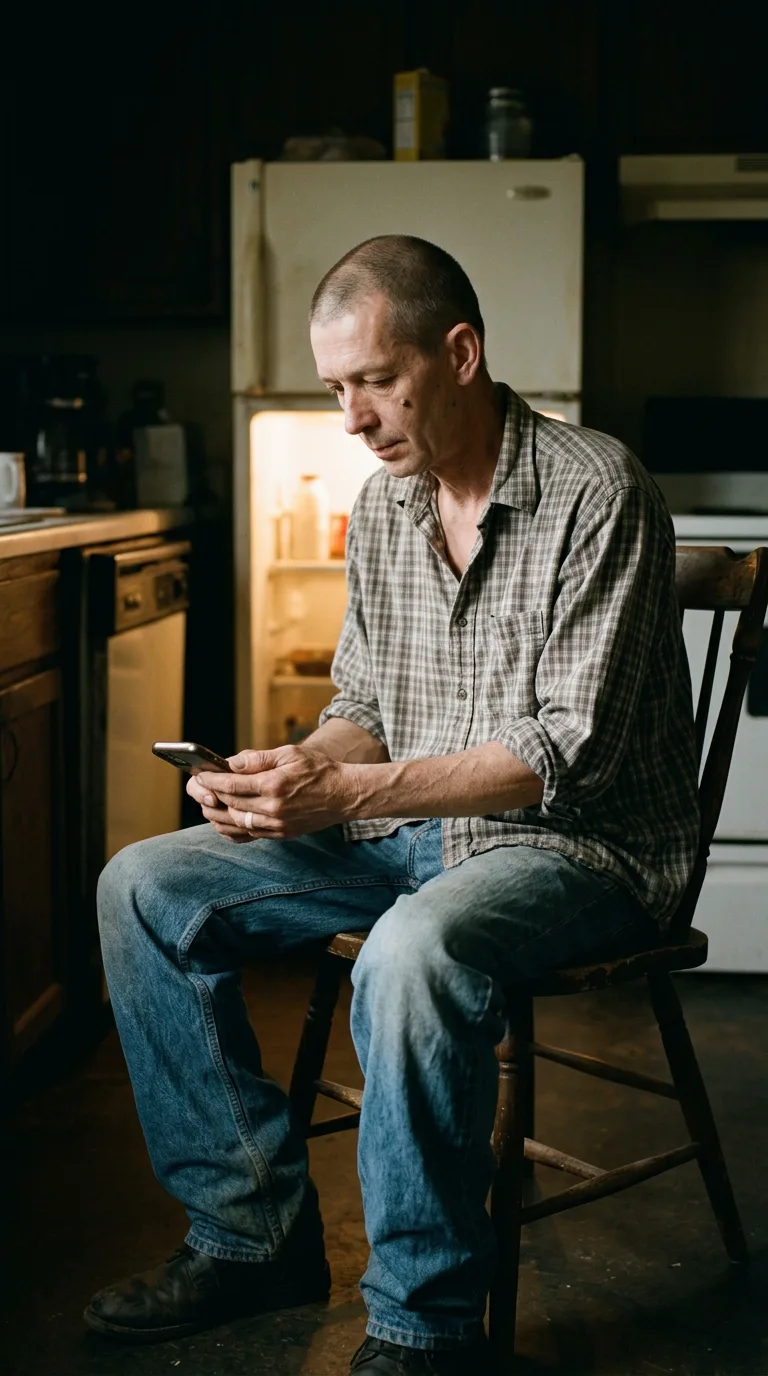
Rarest thing about him: Type 1 diabetes — epic, 1 in 313
Season 0seed 650255904 · engine v10
Character card
lineage EN1F2L
His body-swap story
@justin.moy, wearing Roy Tackett, rolled the wheel on and woke up as Dale Kessner, spent under a minute in him, then spun the wheel and woke up as Travis Odom
The route truck idles at the curb, and Roy Tackett's hands are on the wheel, gray hair under the ballcap, the smell of the bins still on him no matter how many times he washes. You've been him less than a minute and already you know the whole shape of it — the knees, the schedule, the ex-wife's number he still hasn't deleted, the ache low in the back that never quits. It's not that he's bad. It's that you've already lived him, standing there deciding, and there's nothing left to find. Boredom is its own kind of hunger. You pull out the phone, thumb shaking a little with his tremor, and open the page with the wheel on it. Monday afternoon in Eastern Kentucky. You pay. You spin.
The kitchen is dark and someone else's thumb is dragging a phone screen, and then it's yours — mid-drag, mid-want, the last watch on the feed priced at four months of somebody's rent. The thumb lifts. Stays lifted, hanging there in the air over the glass a second too long. Then the hand turns the phone face-down on the counter of its own accord, and does not pick it back up. You are standing in a kitchen that smells like old coffee and cold grease, and the body around you is thin, wire-thin, shorter than the one you just left, and the light through a window over the sink is the flat white light of noon.
The shirt is the first thing. Plaid, soft from washing, sleeves rolled to the forearm, and touching it brings you the morning — his morning, hours ago now by this clock, though the sun in this kitchen says noon: he pulled this shirt off a hanger in a trailer bedroom with a water stain shaped like Ohio on the ceiling, buttoned it one-handed while checking his sugar with the other, the meter's little cough of a beep, the readout fine, always fine lately, he's careful. He was careful for thirty years so his kids wouldn't have to watch him go proud and stupid the way his own father did. The rolled sleeves are habit — table work ruins a cuff otherwise — and his forearms already know how to carry four plates stacked wrong-handed, how to crumb a table without looking down, how to smile at people whose watches cost more than his truck. He works the early shift now. Middle of the day here means the tables are up, chairs stacked on top, floor mopped and drying, the whole dining room turned into a museum of itself before the doors open again for supper. He'd clocked out an hour ago. Come home to nothing. Sat down at his own kitchen table in his own work clothes because there was nowhere else that felt like sitting.
The jeans against your legs are older, softer at the knee, and they give you a Sunday — some Sunday, any Sunday, three kids in the back of a Buick that doesn't exist anymore, the ex-wife's laugh coming through the front seat, before the years wore it down to arguments about money and then to nothing at all. You feel the pale stripe of skin on the ring finger before you see it, a phantom weight that isn't there, ten years gone and the tan line still telling the truth his hands forgot. He does not drink. Drifted off it slow, the way a tide goes out, nobody announcing it. Never smoked either, though the fingers of his right hand keep asking for something to do, and when you glance down you understand why — a lighter, cheap, chrome worn to brass at the corners, sitting by the coffee maker, and just seeing it makes the hand twitch toward flipping it open-shut, open-shut, a tic with no cigarette behind it, just motion, just something to hold that isn't a phone with a watch on it he'll never own.
The mole is there under your own touch when you rub your cheek, a small dark thing high up, and it doesn't come with a memory, just the fact of it, the fact of a face that's been the same face for fifty-nine years while everything under it moved on without permission. Three kids, grown now, scattered, calling on holidays. A church he still goes to some Sundays out of something more like habit than belief, though the habit itself is a kind of prayer. A body that costs him a needle before every meal and asks nothing else of him, comfortable enough on paper — the house sold clean, the divorce fair as these things go — and still four months' rent sitting behind glass on a screen he can't stop dragging his thumb across.
You look at your hands. Thin, ropy, a road map of small burns across the knuckles from trays and pans, the tan line pale as a scar where a promise used to sit. You turn them over once, like they might explain themselves.
"Didn't need it anyway," you say, to the dark kitchen, to nobody, in his flat Texas drawl, and you don't know yet if you mean the watch.