Dale Benavidez
Fictional. Generated by AI — not a real person, and no likeness of one is intended.
61, construction laborer in Houston · rolled by @colin.hasbrook · card — no film
History
who has worn him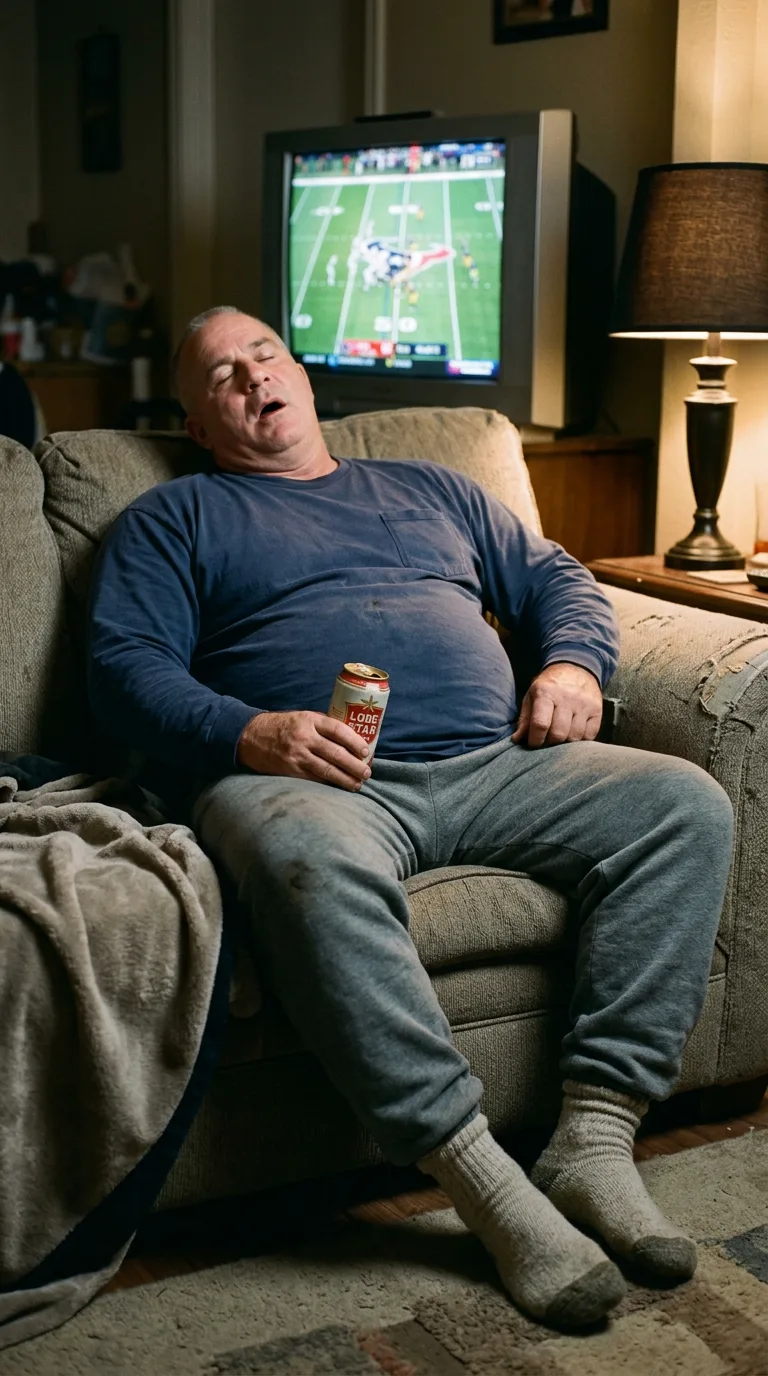
Rarest thing about him: Falling asleep in front of the game — common, 1 in 59
Season 1seed 22111546 · engine v11
Character card
lineage 2NZHHJ
His body-swap story
@colin.hasbrook, wearing Rigoberto Salcedo, rolled the wheel on and woke up as Dale Benavidez, spent under a minute in him, then spun the wheel and woke up as Ramiro Escalante
Rigoberto's apartment smells like the taquería three doors down, and that smell is the last thing you register as him before you stop being him at all. You have been him less than a minute — thirty-some seconds of standing at his own kitchen counter, keys still warm from his pocket, feeling how small his hands are, how quick his heart runs compared to the last one — and it is already not enough. That is the thing nobody tells you about the wheel: it is not the body that goes stale, it is the wanting. Thirty seconds in and you are already thinking about the site, the wheel, the next one, because Rigoberto is 875 men behind you now and he was never going to be the last stop, he was only ever a hallway. You set his phone down on his counter. You open the laptop that is already open. You do not finish being him. You spin.
The recliner takes your weight wrong — too much weight, more than Rigoberto ever carried, settling into a couch that has already learned this exact man's shape and accepts you into it like a mold closing. Your eyes are open partway; you were open partway a second ago too, his eyelids at half-mast on the second replay of a touchdown he never saw the first time. The can in your hand is warm and half-empty and your thumb is already, already, moving to the volume button before you've caught up to owning the thumb. Somewhere behind your face a football team in white is celebrating something. Your mouth is open. There's a thread of drool at the corner of it, cooling.
The first thing that comes in is not a memory, it's a smell — hops going flat, the particular mildew of a couch that has absorbed a decade of men falling asleep in it — and behind the smell, a hand. Your hand. Heavy across the knuckles, a burn scar-shine on the back of it that isn't a scar the facts allow so it isn't there, just weathered, sun-cooked brown going up to a farmer's tan line at the sleeve. The can in it: Lone Star, going warm, and that alone opens a door — thirty years of these, iced down in a cooler at lunch, warm by the end of a shift, doesn't matter, he stopped tasting them for taste a long time ago.
Then the shirt. Cotton, soft from washing, snagged slightly at the pocket where a pen lives when he's dressed for it — and dressing comes back whole, this morning, a morning that is already a day behind you and yet is the only morning you have of him: him standing in a bedroom with blinds throwing bars of gray across a dresser, pulling the shirt over his head one arm at a time because the shoulder doesn't love reaching overhead first thing, jeans up over legs that ache low in both knees before coffee touches them, boots last, the left one always fighting the sock. Your body remembers this in his hands, not yours — the practiced economy of a man who has dressed himself for a trench five thousand mornings and doesn't think about any single one of them until now, until you.
The hand that isn't holding the can wants a pen. It's not holding one — there's nothing to click — and still the fingers make the motion anyway, thumb and first two fingers, an old tic with nowhere to land, and that absence is its own small memory: a shirt pocket, a stub of a pencil at the yard, a habit that outlasted three different job sites and one wife.
Ex-wife. That comes in through the ring finger, which is bare and has been bare long enough that the groove is only a suggestion now, not a dent. Denise. You get her name the way you get everything here — sideways, through what his hand is doing, not through anything he'd hand you on purpose. Denise leaving isn't a scene, it's a temperature: a kitchen that got cold before she said anything out loud, three kids already teenagers by then and taking her side without being asked to, and him standing in a driveway that isn't this driveway watching a car that isn't backing out anymore in any present tense, just backing out forever in whatever part of him still keeps score. He has never once, not to himself, called her anything but the one who got away, even though she is the one who left. That's his to carry and now it's yours for exactly as long as you're wearing the carrying of it.
Under all of that — under the couch cushion giving at your back, under the blanket bunched at your hip that he pulled over his knees at some point and forgot — is the body itself, and it is generous with what it tells you. Sixty-one years in it: shoulders that still move like a younger man's when there's a shovel involved and betray him everywhere else, a lower back that has an opinion about this couch specifically, hands that are the strongest thing left on him, calloused at the base of every finger in a way that has nothing to do with age and everything to do with forty years of handles — shovel, jackhammer, the joystick of a mini excavator that today, hours ago in his own clock, walked him along a trench with the spoil piled up beside it same as every day this month. Muscle sits on him the way it sits on men who work with their bodies and stop caring what else they look like doing it. He is not soft and he is not hard, he is simply built, the way a thing gets built that has to last.
Catholic, not devout so much as habitual — a rosary he doesn't carry but could recite if you put a gun to this head, a guilt that runs under everything like a low current, present even now, even asleep, even three beers past caring. Three kids, maybe more, none of them close by tonight — that comes through as an ache with no photograph attached, just names that arrive and recede too fast to hold, the private grief of a man whose family got smaller by his own hand and knows it.
The TV keeps playing. The room is dim except for the lamp and the screen's light doing its cheap flicker across a wall you have not turned your head to see yet. Your — his — eyelids are still at half-mast. Somewhere in Denver a body you left mid-sentence is standing at a counter with a laptop open, nobody driving it now, nobody home. You don't think about that. You never do, not really, not past the leaving of it.
Your thumb finishes the motion it started before you arrived — the volume ticks up one more notch, precise, the beer nowhere near this precise on its own — and your eyes come the rest of the way open. You sit forward. The can tips a little in your grip and you catch it without deciding to, the hand already knowing weight and warm aluminum better than you do.
You look down at it. At the hand around it — thick-fingered, sun-marked, a stranger's hand doing a stranger's oldest trick, wanting a pen that isn't there.
"There you are," you say, to no one, to the room, to a couch that already knows the shape of this man better than you ever will, and you don't say for how long.