Corey Malinowski
Fictional. Generated by AI — not a real person, and no likeness of one is intended.
31, stagehand in Boston · rolled by @colin.hasbrook · card — no film
History
who has worn him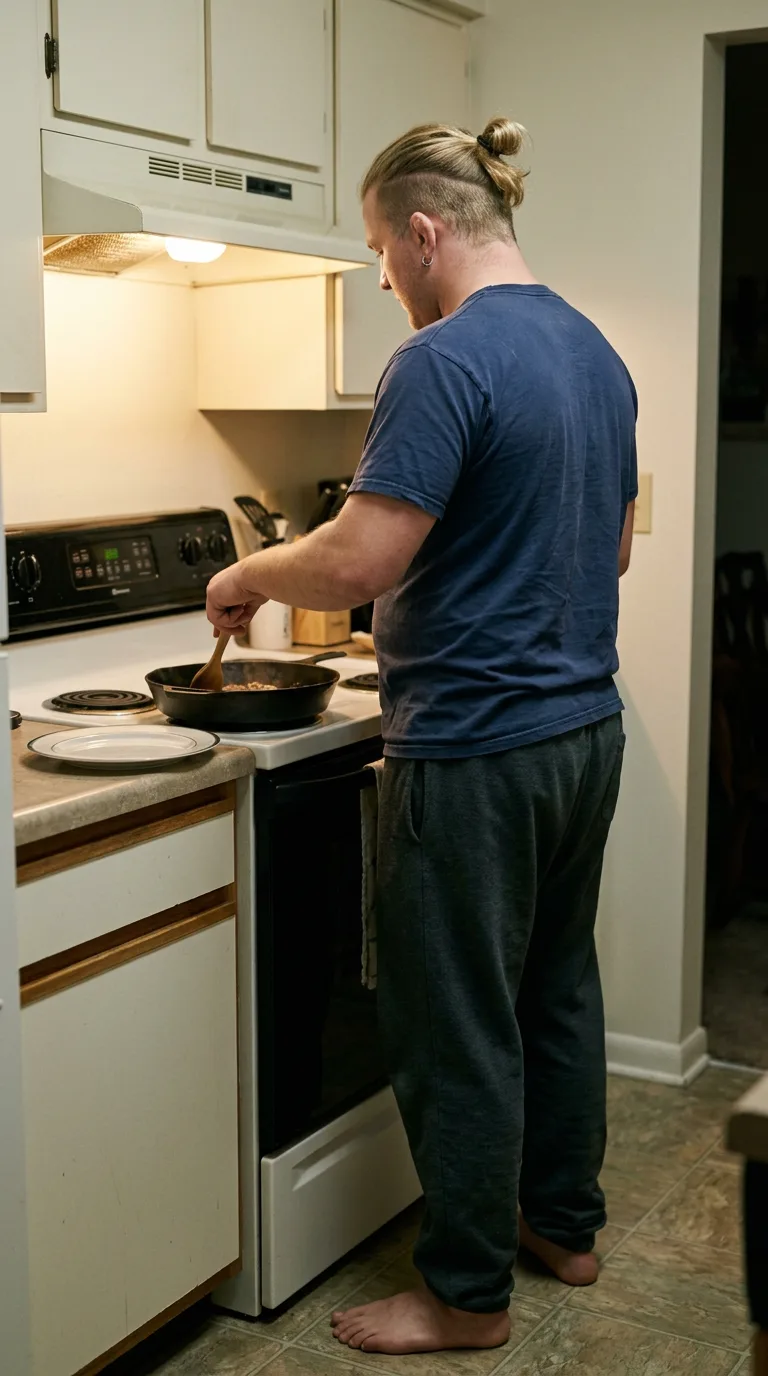
Rarest thing about him: Cauliflower ear — epic, 1 in 159
Season 0seed 1470598334 · engine v10
Character card
lineage 2NZHHJ
His body-swap story
@colin.hasbrook, wearing Arthur Delacroix, rolled the wheel on and woke up as Corey Malinowski, spent under a minute in him, then spun the wheel and woke up as Marvin Detrick
The wrench is heavy against Arthur Delacroix's chest, cold through the shirt, and you have been him for forty seconds and already you know this is not the one. His knuckles ache in a way that has nothing to do with you. The garage bay behind him smells like a life you did not choose — cut grass through the open door, a radio talking about corn futures, a lunch cooler with somebody else's sandwich in it. Sixty-three years old and his knees complain when he shifts his weight, and the freckled hand you are wearing already wants to reach up and rub his own scalp before you stop it. You didn't even get the tour. One body and then straight to the site again, because that is not why you spin — you spin because a life half-lived in someone doesn't count as having it, and this one still has the customer's Buick up on the lift and forty years of oil under the nails and nothing in you wants to finish the job. So you find the phone, you find the site, you pay, and Arthur Delacroix's thick finger — not yours, never yours — taps the wheel.
It stops.
The pan is already moving under your hand before you understand there is a hand. Onions and ground beef, brown and glistening, going one direction and then, without your telling them to, the other — the wrist finishing a decision that started before you arrived. You are shorter now, and wider through the middle in a softer way, weight sitting low and easy, and there's a hitch at the back of your throat that isn't a cough, just a tightness, old and familiar to somebody, filed away as nothing. Salt comes off your fingertips into the pan. You don't taste it. Somewhere behind you a kitchen holds still, waiting, and your free hand is already opening the cabinet for a second plate, setting it down next to the first like that was always the plan.
The wooden spoon is the first thing that talks to you. It's worn smooth on one side where a thumb has pressed it a thousand times, and when your palm finds that groove you get a flash — a woman's laugh, not unkind, saying *you always cook like you're feeding four* — and then more of her, all at once, sitting cross-legged on a counter that isn't this one, in an apartment two moves ago, her feet cold against your bare shin under a blanket on a couch. Rosa. Two years, give or take, and the ending wasn't a fight, it was just a slow leak, both of you agreeing without saying so that it had already stopped. You still cook for two sometimes without meaning to. Tonight you meant to, actually — you'd told yourself before the pan even got hot, tonight I'll just make one plate, and your hands didn't listen.
The t-shirt against your back gives you the morning it went on: pulled it from the same drawer as always, sniffed the collar first out of habit though it was clean, laundry day was Thursday and today was not Thursday, some other reason it smelled like home already. Sweatpants next, the elastic gone soft from years, and you remember — his memory, arriving sideways — standing at the closet at six a.m. with the fly rail waiting, choosing the black shirt with the paint on the hem for tonight's crew call instead, hanging back up what you're wearing now for after. Except after came early. A matinee got cancelled. You came home at four instead of eleven and the day folded up wrong, and that's the crack in the light letting you understand, distantly, that the clock over this kitchen does not match the one you left in Ohio, and that a man home this early on a Monday has a schedule most people don't keep — nights, load-ins, the blue running light at the fly rail, waiting up in the wings for a cue that comes at ten p.m. and calls it a shift.
Your ear throbs faintly where it always throbs, thickened, no longer shaped right, and a whole wrestling season comes up out of nowhere attached to it — a coach's whistle, a mat that smelled like bleach, a takedown he ate at seventeen that reshaped the cartilage for good and that his mother cried about more than he ever did. The little hoop in your left lobe is newer, a dare from a stagehand named Priya during a slow week of tech rehearsal, and it stayed because it stayed, no other reason. Your chest pulls tight again, familiar, and a hand that already knows the motion pats a pocket that isn't there — the inhaler's on the counter by the microwave, it's fine, it's always fine, you've had this since you were nine and you stopped being afraid of it around eleven.
You feel how strong the forearms are from hauling rope and batten, how the low center of gravity that would look soft standing still is the same thing that makes him hard to move when he sets his feet backstage. You feel how tired he is in a good way, the kind that comes after a long focus session under gel light, and how much he likes, when nobody's watching, running his palm slow over his scalp like checking that his own head is still there. Second plate down on the counter. Nobody is coming to eat off it. He knows that, somewhere under the wanting, and still the hand set it there anyway, the way grief and habit sometimes look exactly alike from the outside.
You look down. The hand on the spoon is not Arthur's — no liver spots, no old scar from a timing belt that got away from him once in 1994. This one's younger, a rope of muscle under a soft layer, a hoop of silver catching the stove light when you turn your head enough to see it in the black glass of the oven door. You set the spoon down. You turn the burner off without being asked to by anyone.
"Guess I'm not eating alone tonight," you say, to no one, in a voice that isn't yours and is, now, for as long as this lasts.