Colin Yarnall
Fictional. Generated by AI — not a real person, and no likeness of one is intended.
20, call center agent in Anchorage · rolled by @connor.waskiewicz · card — no film
History
who has worn him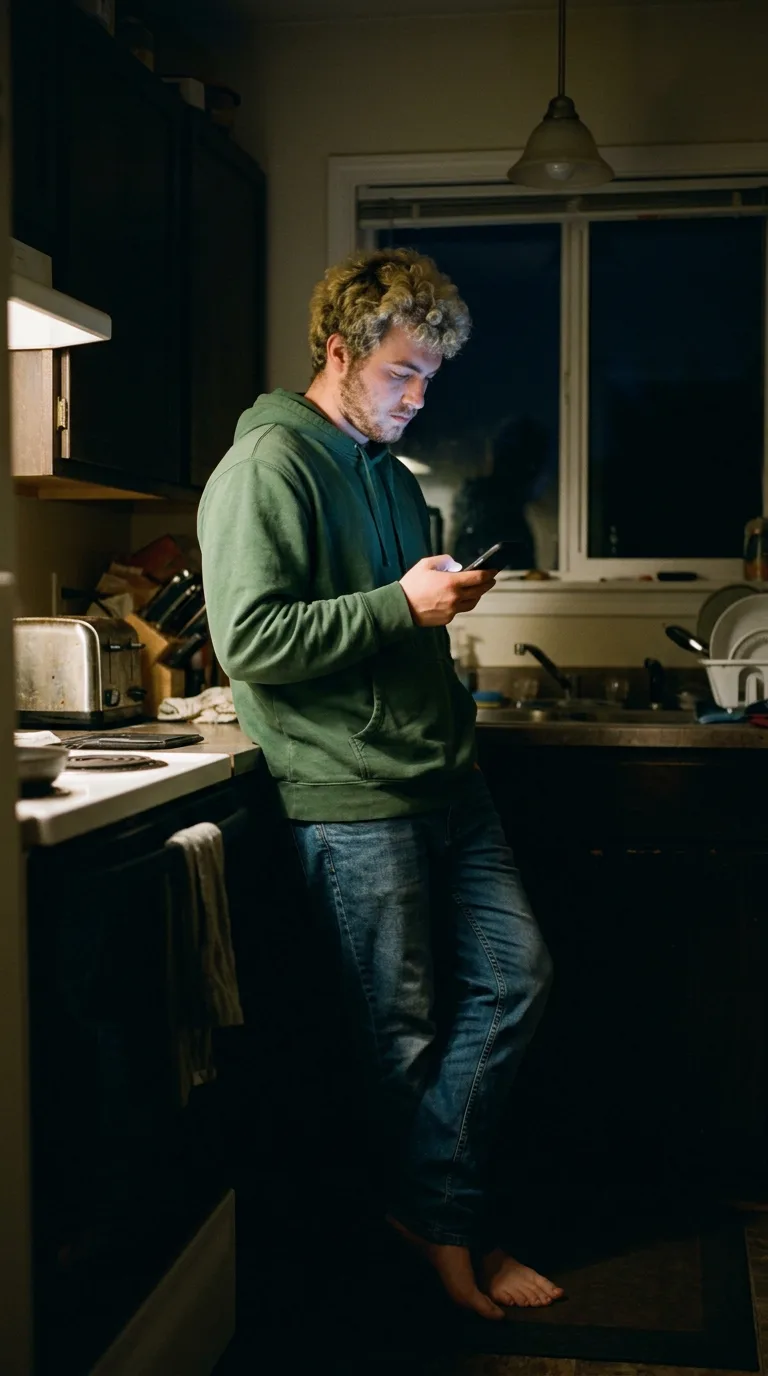
Rarest thing about him: Bleached blond — common, 1 in 54
Season 1seed 756824277 · engine v11
Character card
lineage 2NZHHJ
His body-swap story
@connor.waskiewicz, wearing Arturo Palencia, rolled the wheel on and woke up as Colin Yarnall, spent 6 minutes in him, then spun the wheel and woke up as Casey Miller
Arturo Palencia's hands smell like chlorine and stale coffee, and they are 58 years old, and they ache in the knuckles the way they have for eleven years now, and none of that is yours by choice — it is just what was left when the last spin settled. You stand in his kitchen in the dark, in Eastern Kentucky, in a house that is not yours, and everyone in it is asleep, and that is the problem exactly: there is nothing left to do in him tonight. You have already done the things his body is good for. You spun for him nine spins ago because you wanted to know what it was to be strong again after two hundred soft, easy bodies, and he gave you that, gave you forty minutes of a man who could still lift a compressor housing off a rack without thinking about it, and it was good, and now it is 3 a.m. and he is just a tired man standing in his own kitchen listening to his own house breathe, and the wanting is already back, the itch under it that has never once waited for a good reason. You take the phone from the counter — his phone, not yours, nothing here was ever yours — and you open the site the way you have opened it 926 times before, and the wheel is already spinning before you have decided anything at all.
The kitchen is gone. There is a different dark around you now, warmer somehow, a hanging light throwing yellow onto a window with no stars behind it, only black. Your thumb is on glass. A price sits under it — four digits, a watch you will never own — and your thumb has already lifted off, already stopped believing in the thing it was reaching for a half-second ago. The phone in your hand turns itself face-down on a stretch of chipped counter laminate, and the hand that does it is smaller than the one you just left, softer at the knuckle, twenty years younger, and it does not go back for the phone. It just rests there against the counter edge, and you feel, for the first time, the whole unfamiliar architecture of him: shorter, lighter, a looseness in the shoulders that Arturo never had, stubble that itches instead of feels grown-in.
The hoodie is the first thing that gives itself up — heavy cotton, worn soft at the cuffs, and through it comes a flash of a Tuesday morning, pulling it over his head still smelling faintly of the dryer sheet his roommate buys in bulk, the lanyard already looped and waiting on the hook by the door because he learned the hard way what it costs to forget it and have to run back down three flights. The lanyard against your collarbone brings the call floor with it whole: the beige partition walls, the identical headset weight settling behind his ear, a supervisor named Denise who says *have a great one* like it costs her something. You feel his voice — a voice you have not used yet — go flat and pleasant forty times a shift, *thank you for calling, how can I help you today*, hour after hour, while some other channel of him counts down the minutes to a fifteen-minute break spent standing outside in twenty-two-degree air because the walls inside make his chest feel like a fist.
The jeans know the walk from the bus stop, four blocks, the cold that gets into denim faster than people think it will. The countertop under your palm is the same laminate he has leaned against a thousand times, and it gives you the apartment whole — plywood tacked up behind where drywall should be, a snowmobile shrouded in blue tarp out back that he has taken out exactly twice this winter because gas is not free and neither is anything else. He is twenty. He rents a room from a guy he went to high school with. He has $340 in checking two days before payday and a phone screen he was staring at that was showing him a watch that costs more than that whole month, and he does that to himself on purpose sometimes, some nights, the way other people pick at a scab. His own fingers — your fingers now — go without asking to the edge of his thumbnail, working at a hangnail there, an old habit that has nothing to do with the watch or the money or any of it, just a thing his hands do when the rest of him has stopped paying attention to them.
There is a girl he liked for four months last year who is not worth much memory now, and a stepfather back in Wasilla he does not call, and a nicotine pouch still faintly stinging under his lower lip from twenty minutes ago, and none of it adds up to anything you would call a life in trouble — only an ordinary one, worn thin in the ordinary places, a twenty-year-old standing in a dark kitchen doing the small nightly math of not having enough.
You lift the hand off the counter and turn it over under the cheap hanging light, and it is unmarked, unringed, the nails bitten short, and it is nothing like Arturo's hand and nothing like the four hundred hands before that, and for a second that is the whole of the feeling — new, cold air still coming off the window glass, someone else's twenty years sitting in you like a room you just walked into.
"Okay," you say, to the dark kitchen, to no one, in his voice, trying it once.
Somewhere down the line the wheel is already still, waiting on nothing, and neither of you knows yet how long you intend to stay.