Colin Tavernier
Fictional. Generated by AI — not a real person, and no likeness of one is intended.
27, teacher in New York · rolled by @colin.hasbrook · card — no film
History
who has worn him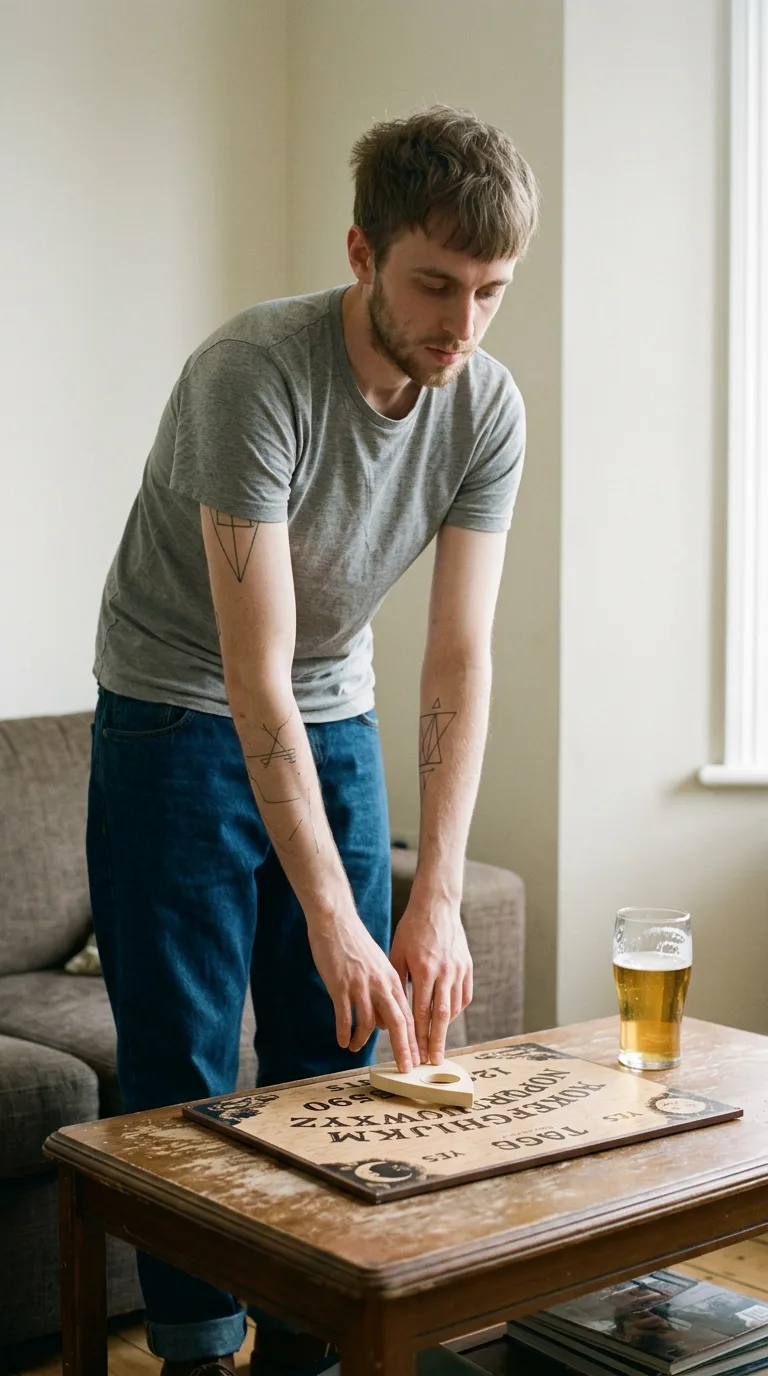
Rarest thing about him: Reading something he was not meant to — uncommon, 1 in 148
Season 1seed 974289863 · engine v11
Character card
lineage 2NZHHJ
His body-swap story
@colin.hasbrook, wearing Wendell Purcell, rolled the wheel on and woke up as Colin Tavernier, spent 2 minutes in him, then spun the wheel and woke up as Dustin Pelfrey
---
The bathroom mirror in the Houston duplex gives you back Wendell Purcell's face, and you have hated it since roughly the eleventh second of owning it. Sixty-three years packed onto a frame that gave up trying decades ago. The missing tooth makes his own smile look like a joke he's telling on himself. You have been him less than a minute — you haven't even found the light switch by feel yet — and already you know you are not spending a today, let alone a retirement, in a body that creaks getting into a squad car. There's a badge on the dresser catching the streetlight. You don't want it. You want to be someone whose knees don't have opinions. You go to the wheel already deciding, which is its own kind of ordinary sin — the buyer's remorse of a man who owns four hundred and some coats and wears none of them long. You spin before Wendell's coffee finishes dripping.
—
The coffee doesn't finish. You're not there anymore.
You're bent at the waist over a coffee table, fingertips light on a wooden planchette, and your whole arm is already moving — pushing the little heart-shaped thing across painted letters, driving it toward a word at the bottom edge of the board. GOODBYE. Somebody's joke, winding down. But the hand doesn't stop at the word. It keeps going, past the edge of the board entirely, onto bare wood, and it slows, and it presses down, and it starts to spell something with a patience that isn't yours and isn't his either — three letters, unhurried, like a signature. Then it stops. The room exhales. A beer sweats a ring onto varnish an inch from your knuckles.
You are standing in a body that weighs nothing like the one you left. Narrower through the shoulders, soft through the middle in that particular way of a man who bikes to work and eats like he doesn't. There's a lanyard weight against your sternum you didn't feel a second ago and now can't stop feeling.
—
The shirt gives it up first — chambray, a little stiff at the collar, and putting it on this morning comes back to you in his hands: standing in front of a closet that's really half a closet, the other half colonized by her cardigans, and pulling this one off the hanger because it was the one that didn't need ironing and he was already going to be the last one out the door. Rolling the sleeves to the elbow out of habit, not fashion, the fine-line geometric tattoos on his forearms disappearing and reappearing as the fabric folds — he got them one at a time, one a year almost, each one small enough to not have to explain to his mother, a triangle, a cluster of thin lines like a compass with no direction on it. He liked that they meant nothing. Everyone assumed they meant something and he liked correcting them, mildly, the way he liked being the guy who knew a fact nobody asked for.
The lanyard: his ID card face-out because a kid in third period held it up once and said you look constipated in this, sir, and everyone laughed including him. The keys under the card jingle and that's the classroom, that's the supply closet, that's the front door of the apartment, and touching them brings the smell of dry-erase marker and the particular hush of a room after the last bell — chairs at angles, someone's forgotten hoodie on a desk, him standing at the whiteboard erasing tomorrow's homework because he'd written it on the wrong day. He is, if he is honest with himself in the two seconds a day he allows for it, not a natural teacher. He is a patient one. There's a difference and the kids can tell, and mostly they don't mind.
The jeans are hers, technically — no, that's wrong, they're his, but she picked them out, a birthday two years back, and the memory of her holding them up in the store, this or the dark ones, comes with an ache that isn't about jeans. Whitney. Not the girlfriend — the girlfriend is asleep right now four feet from where you're standing, curled toward the wall, and he loves her in the unspectacular daily way that doesn't need announcing. Whitney is the one from before, the one who left for Portland and didn't ask him to come, and he thinks about her still, not often, but at specific hours — usually early, usually like this, before the day has decided what it's going to be, when the apartment is quiet enough that old rooms get loud. He hasn't told his girlfriend that this hour does that to him. There's no reason to.
Under your palm the board itself gives one more thing — his mother's rosary somewhere in a drawer two rooms away, the Sunday mass he stopped going to but still crosses himself at funerals, the joke he made twenty minutes ago about talking to spirits like it was nothing, a beer for courage he didn't need, laughing with — someone, a friend, off camera of this memory, egging him on. Do the goodbye, man, freak him out. He was already smiling when his hand went past the word.
The body itself: twenty-seven, and it knows things without being told — how to stand at a whiteboard for six hours without noticing his lower back until he sits, the specific tiredness that comes from talking all day to people who don't have to listen, the small ache behind his sternum that is either acid reflux or nothing, the vape in his pocket he'll want inside of ten minutes. Skinny in a way that photographs thin and feels, from inside, soft and unfinished. Nothing about him remarkable. That was always the quiet fact of him, even to himself — a man nobody would pick out of a room, who made peace with that around twenty-four and has mostly kept it.
—
You straighten up off the coffee table and look down at the hand still resting on bare wood past the board's edge. It's thinner than the one you had thirty seconds and sixty-three years ago, the knuckles less swollen, a thin scatter of ink disappearing under the rolled cuff. You turn it over once, like you're checking it's actually yours to turn.
"Huh," you say, to no one, in his voice, and it comes out lighter than you expected, younger than you've sounded in longer than you can remember.
You lift your eyes off the hand and into whatever's watching.