Colin Farraday
Fictional. Generated by AI — not a real person, and no likeness of one is intended.
43, biologist in San Francisco · rolled by @colby.marchetti · card — no film
History
who has worn him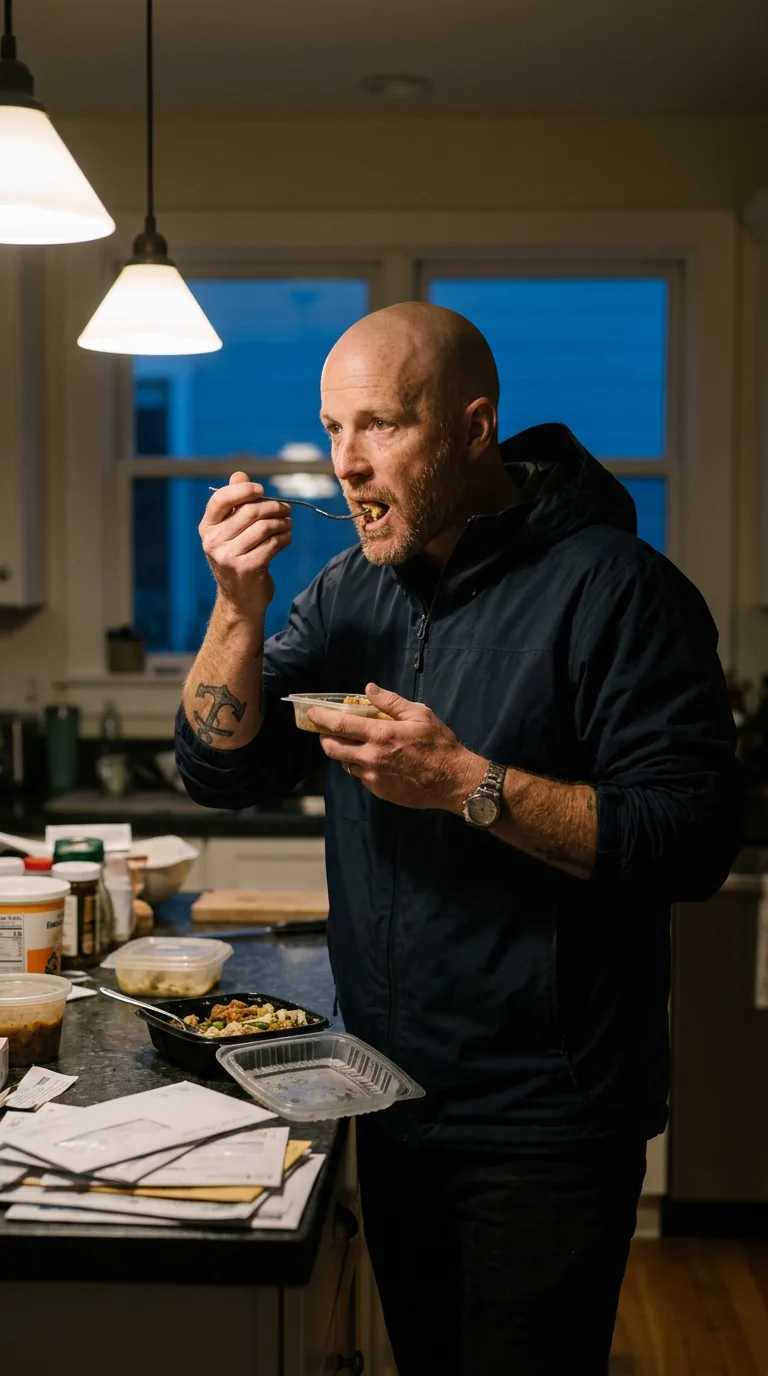
Rarest thing about him: Biologist — uncommon, 1 in 858
Season 1seed 396238588 · engine v11
Character card
lineage OZ80W3
His body-swap story
@colby.marchetti, wearing Melvin Draughn, rolled the wheel on and woke up as Colin Farraday, spent 2 minutes in him, then spun the wheel and woke up as Preston Vandegrift
Melvin Draughn's kitchen smells like microwave popcorn and the particular staleness of a man who eats standing at the counter every night of his life, and you have been him for less than a minute and you already know you don't want the rest of the night in this skin. It's not the body — 61 is fine, the knees ache but everything works. It's the sales calls stacked up on the fridge in magnets, the divorce decree he keeps meaning to shred, the whole small-town Ohio quiet pressing on the windows like it wants in. You spun this one on a bad night and you have been sitting inside his regret ever since it landed. Eleven months of somebody else's dead marriage is enough. You go to the laptop still open on his kitchen table, the site already bookmarked, the wheel already loaded from last time, and you don't think about it any longer than it takes to click.
The fork is already moving when you arrive — halfway up, a piece of chicken and rice speared on the tines, and you feel the whole weight of him arrive around you at once: taller, leaner through the shoulders, the smooth cold dome of a bald head under a slack coat hood. You bring the fork back down instead of up, set it on the lip of the container without deciding to, the way a hand does when the person driving it has just changed. The coat comes off your shoulders — his shoulders — sleeve by sleeve, and underneath the window is going dark blue over rooftops that aren't Ohio rooftops, and the light overhead is a hard white kitchen light, and none of this is a place you have ever stood in your life.
The shirt is what opens him first — chambray, soft with washing, and the memory comes in on the collar like static resolving into a picture: a Tuesday morning, this exact shirt off a hook by the door, pulling it on one arm at a time while the coffee maker clicked and hissed behind him, thinking about pH levels and nothing else, a whole quiet competent morning of a man who likes his work. Then the fleece, zipped to the throat against a cold that lives permanently on this coast, and under it comes a bigger flash — waders, boots sucking mud, a creek cold enough to ache through neoprene, a net scooping and the particular satisfaction of a good sample, a label written in Sharpie with steady hands. Forty-three years old and the body still does that without complaint: crouches, wades, hauls gear up a bank, comes home smelling of creek water and cold, showers it off, eats standing because sitting down feels like admitting the day is over.
The counter under your palm gives you paperwork — insurance forms, something with a lab logo, unopened mail leaning against a coffee tin — and a feeling that isn't dread exactly, more the low hum of a man who is doing fine and knows it and still eats alone most nights. Doing fine: the number is good, better than good, and none of it is the point standing here. A ring that isn't on his finger anymore gives you, through the watch strap where his wrist remembers its old weight, a woman's laugh in another kitchen, years back, a version of this life with someone else's coffee cup on the counter too. She is not here. She has not been here in a while. He still turns his phone over sometimes hoping and doesn't tell anyone that.
His hand comes up — not yours, his, muscle memory older than you — and touches his own jaw, the short beard there, a habit that isn't thinking so much as checking he's still himself, still present, a tell so old it isn't even nervous anymore. Under your fingers the beard is neat, kept close, a Sunday-morning trim in a mirror with the radio on low, a rosary he doesn't use much anymore but hasn't thrown out either, a church three blocks from here he goes to on Christmas and tells himself that's enough for now. No drink in the house — he quit that, mostly, except the cigarette he'll have if someone hands him a beer at a barbecue, half a ritual, half an apology to himself. The tattoo on the forearm, faded blue-green, gives you a locker room, a team, a younger man who believed harder in something with a crest on it than he believes in most things now.
You finish the container in even mouthfuls because that's what the body was already doing and there's a kind of mercy in letting it. The window shows you nothing but your own dim shape and the blue going to black behind it.
You look down at the hand holding the empty fork — freckled, older than the last one you wore, a thin white scar you didn't put there across one knuckle, someone else's forty-three years — and you turn it over once like you're checking the weight of it.
"There you are," you say, to no one in the dark glass, and you don't know yet if that's tonight's whole sentence or the start of a much longer one.