Colin Braswell
Fictional. Generated by AI — not a real person, and no likeness of one is intended.
21, longshoreman in Houston · rolled by @marco.villagrana · card — no film
History
who has worn him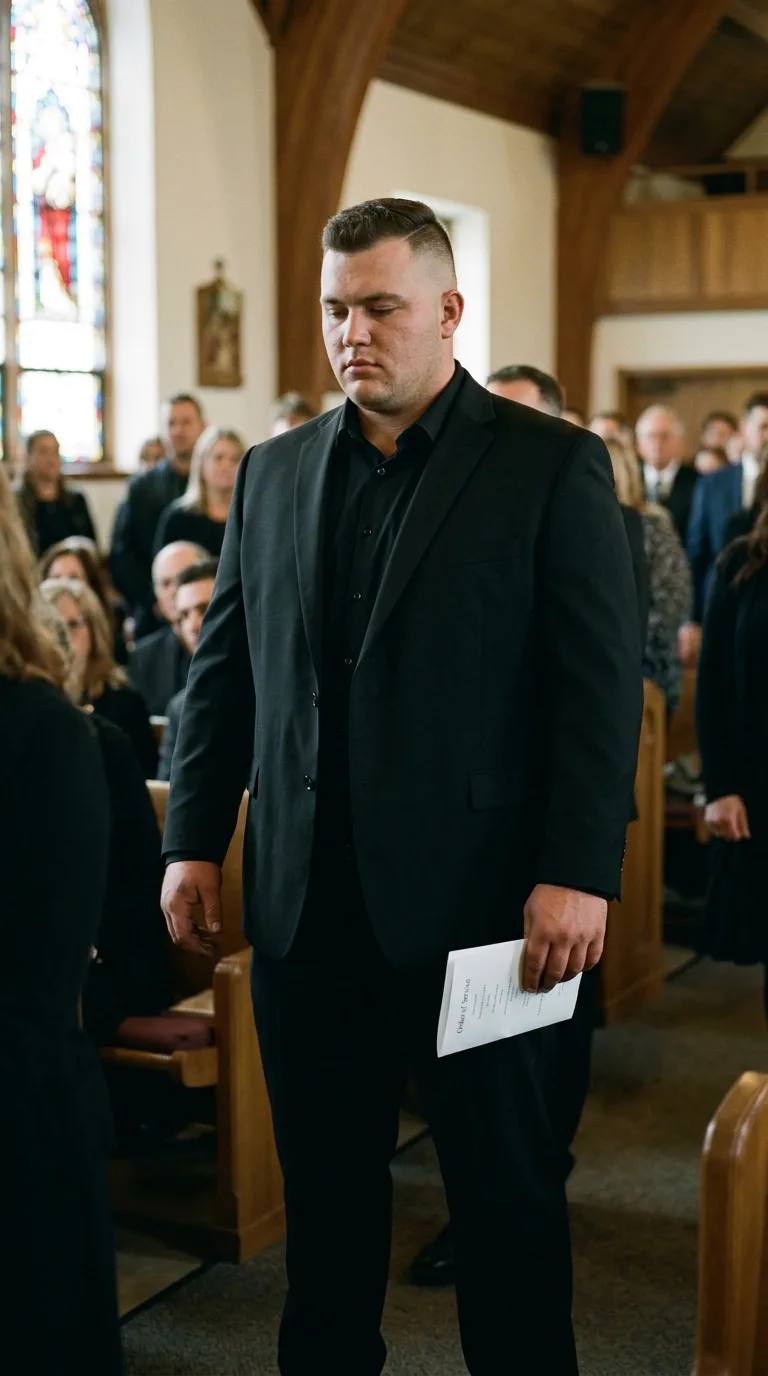
Rarest thing about him: At a funeral, at the back — rare, 1 in 105
Season 0seed 180507149 · engine v10
Character card
lineage LJL8SV
His body-swap story
@marco.villagrana, wearing Owen Kaczmarek, rolled the wheel on and woke up as Colin Braswell, spent 4 minutes in him, then spun the wheel and woke up as Gary Peschke
The griddle in front of you still ticks with heat off the last order, and your borrowed forearms — Owen's forearms, thick and shining with fryer grease — ache in that specific way that means the Sunday brunch rush is over and there is nothing left to do but stand here being him. Fifty-three minutes now. Fifty-three minutes of a walk-in that smells like bleach and old lettuce, of a manager who calls everyone "chief" like he forgot their names on purpose, of feet that hurt in a way your old feet — whichever ones those were, you've lost count — never did. You liked the size of Owen for about ten minutes. You do not like the smell, or the ringing in his left ear, or the fact that his ex texted twice this morning and he flinched both times like a man expecting a bill. There's a particular flatness that sets in around minute forty, when the new body stops being a novelty and starts being a Tuesday. You feel it now on a Sunday. Your thumb finds the phone in your borrowed apron pocket, and the site is already loaded, the wheel already sitting there mid-spin from muscle memory alone. You don't decide so much as notice your hand has already done it.
The organ cuts off mid-chord and eleven hundred miles of distance and several hours of clock fold down into nothing, and you are upright in a pew aisle in a black coat that is not Owen's, is not any coat you've wetted with your own sweat before, and the room is standing around you in a soft wave, and there is a folded paper in your right hand creased soft at the fold from being carried, not read. Your knees — his knees — know how to rise before you tell them to. You come up a half-beat behind the room, the way you always do, the borrowed half-second where the wheel finishes handing you over. Stained glass throws red and blue across the wood in front of you. Nobody turns. Nobody ever turns.
The coat is the first thing that speaks. It is borrowed — you feel that before you feel anything else, a looseness through the shoulders that doesn't match the rest of him, a rental smell of dry-cleaning chemical laid over a body that runs hot — and under that unfamiliar cut you get him: a man broader through the gut and chest than the jacket wants him to be, big hands gone soft-calloused, a low simmer of a headache sitting behind the eyes that has nothing to do with grief and everything to do with the blood pressure medication he keeps meaning to refill and doesn't. Colin Braswell. The name arrives with the coat's second button, the one he did up wrong twice this morning in a bathroom mirror with condensation still on it, because his hands were shaking a little and he didn't want anyone to see that they were.
The order of service is thin card stock going soft at the crease where his thumb has worried it since the second hymn. Touching it gives you her — his aunt Patrice, the one who used to slip him twenty dollars folded into a birthday card even after he turned old enough that it was faintly embarrassing, the one who came to exactly one of his high school games in the Houston heat and sat under a golf umbrella the whole time and yelled his name wrong on purpose because she thought it was funny. He is not, you understand from the program alone, close enough to this family to be sitting up front, and that is exactly why he is standing at the back — a nephew twice removed by marriages that didn't last, here because it mattered to somebody once and he couldn't make himself skip it.
The dress shirt against your back, buttoned all the way up because he doesn't own a tie that isn't his father's and didn't want to ask, gives you the getting-dressed of it: alone in an apartment with a mattress on a frame and no headboard, a recent stretch of carpet worn pale where a second person's side of the closet used to be. He'd stood in front of that closet a long time this morning for a man who owns four button-downs. He'd thought about her — not his aunt, the other one, the one whose toothbrush left a ring on the sink for two weeks after she took the rest of her things — and thought, unhelpfully, that she would have known which shirt, would have picked it off the hanger and put it into his arms without him having to stand there working it out at seven in the morning like long division. He put on the black one himself. His hands, buttoning it, already know this motion the way they know a wrench, a strap, a winch controller — economical, unhesitant, a body that works with its hands for a living and doesn't waste movement on softer things.
His shoulders under the coat are heavy with four years of dock work, sloped forward slightly the way big men get from years of looking down at what they're lifting. There's a low ache riding both knees from standing on concrete under a gantry crane since before the sun was fully up most mornings, and a tightness across the temples that is just the pressure, always the pressure, a doctor's voice he half-listens to twice a year. His green eyes are dry. He has been controlling his face since the second reading, and something in the set of his jaw — which you can feel now, the specific clench of it — says this control is costing him more than the woman under discussion would ever have asked for.
The organ finishes its long final note and the room exhales into shuffling and quiet talk, and you look down, and the hand holding the order of service is not a hand you have ever owned. Blunt fingers, a burn scar-shine along one knuckle you didn't put there and don't ask about, nails cut short and practical. You turn it over once in the low church light, watching it not obey any memory you have of your own.
You look up into the stained-glass hush of it, into no one in particular, and you say, quiet enough that it passes for a man clearing grief from his throat, "Didn't think I'd make it either."