Brendan Sculley
Fictional. Generated by AI — not a real person, and no likeness of one is intended.
40, stagehand in Seattle · rolled by @colin.hasbrook · card — no film
History
who has worn him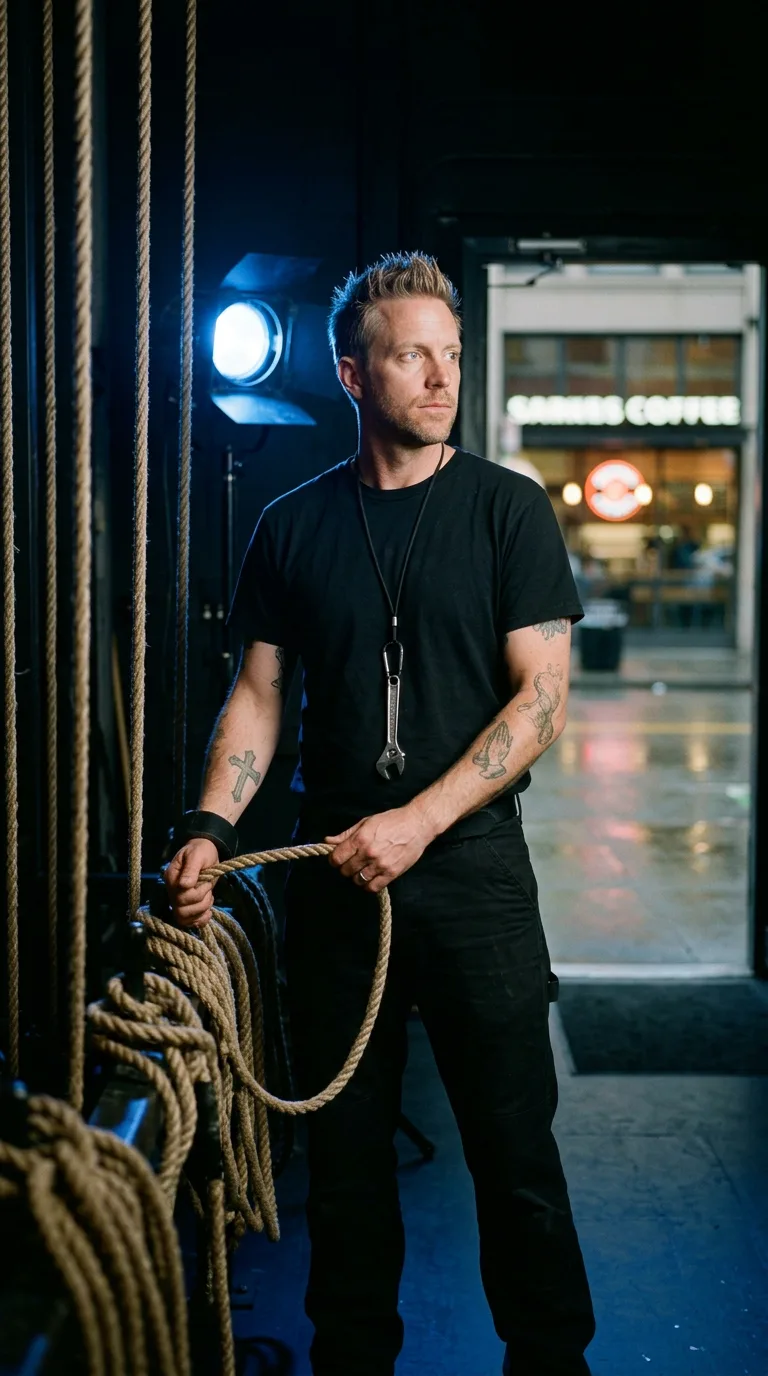
Rarest thing about him: Deep in the hole — $25k to $100k under — rare, 1 in 34
Season 0seed 251768183 · engine v10
Character card
lineage 2NZHHJ
His body-swap story
@colin.hasbrook, wearing Todd Ostrander, rolled the wheel on and woke up as Brendan Sculley, spent under a minute in him, then spun the wheel and woke up as Marcus Whittier
You are standing in Todd Ostrander's garage, and it is not going well.
The invoice is on the workbench under a socket wrench that has not moved in three days, and it says what it has said all week: the transmission job on the Silverado is going to lose him money, because the parts guy quoted wrong and Todd already promised the customer a number. This is the fourth job this month that has gone like this. Todd's hands — thick, scarred across one knuckle where a jack slipped two years back — are not your hands, but you have had them a minute now, less than a minute, and already you can feel the specific tiredness in them, a tiredness that isn't about the wrench. It's Monday afternoon and Ohio is bright and flat outside the open garage door and you are so bored of owing people money that isn't even yours to owe. You didn't come here to fix Todd's numbers. You came here to stop being him for a while. That's reason enough. It's always been reason enough.
You don't decide much beyond that. You wipe the hand on a rag, walk to the little laptop propped on the shelf between a parts catalog and a coffee can full of loose screws, and you open the page you have opened a hundred and thirty-one times before. The wheel loads slow on Todd's connection. You pay. You spin.
—
The rope is heavier than you expect, though you don't have time to expect anything really, because the expecting and the arriving happen in the same instant: your hand — his hand — is three-quarters through a coil, the big loop of it hanging off two fingers the way it has ten thousand times before, and then it isn't right. The loop kinks. You feed it back out and do it again, slow, correct, feeling for something that isn't there yet, a rhythm you don't have the memory for. Blue light comes down from a can lamp somewhere above you and paints one side of the rope and one side of your forearm. Down a short hallway of dark, a door stands open on gray daylight and a coffee sign glowing red and white, and rain is falling past it in threads. Behind you, ropes hang in a long column into a dark you can't see the top of. Your body is standing at an odd hour for what it's doing, and the wrongness of that — a full-day brightness for a shift that should be a night one — sits at the edge of things without explaining itself yet.
You do the coil again. And again. Ten more, each one checked, on hands that used to not need checking.
The rope is rough and dry against fingers that are not thick like Todd's, longer, a callus riding the base of each one in a place Todd's callus wasn't. A cross is inked into the skin above the wrist you're using, black lines gone slightly soft with age, and touching the rope to that arm gives you the first flash: a tattoo parlor in Ballard, nineteen years old, his mother two years dead and him getting the cross because he wanted something on him that would outlast the drinking he was about to start doing. It doesn't summarize. It arrives whole — the smell of the shop, the buzz through his arm, the guy asking was he sure, and him saying yes before he'd let himself think about it.
The wrench on the lanyard around your neck swings and taps your chest, and that's the second door: Todd — no, not Todd, that's wrong here, this is someone else's memory riding someone else's tattoo — this is a smaller wrench, a spanner really, given to him by the head carpenter his first week on this job, fifteen years ago, half joke and half induction, *you're one of us now, don't lose it.* He never has. He wears it every shift like a medal nobody else knows is one.
The rope again, under both hands now, and it gives you the fly rail itself: years of two a.m. calls, load-ins that ran until the sun came up over the Sound, the particular satisfaction of a batten landing dead level on the marks with no one watching because no one needs to watch him, he's good, he's been good at this since before some of the actors upstairs were born. The shift he's on now is one of those — a Monday overnight turnaround, get the set out before the truck comes for the next show, which is why it's the middle of a bright rain-soft day outside that door and he is this deep into a graveyard shift, tired in the specific way of a body that trained itself long ago to be awake when the rest of the city wasn't.
The shirt against your back — his back, black cotton, a little damp under the arms — gives you this morning. Or last night, whichever it was for him: pulling it on in the dark of the bedroom so as not to wake Marisol, one arm through the sleeve and then a pause, standing there in his own kitchen light with his son's night-light glow leaking under the hallway door, thinking, the way he thinks most days, a small silent thing that isn't quite a prayer and isn't quite not one, thank you for this, keep them, keep me able to keep them. He does that every morning. Nobody's ever seen him do it. The praying hands tattooed into his other forearm are older than the cross — got them the year his daughter was born, when the anxiety that had lived quiet in him since he was a teenager came up loud enough that he finally let a doctor put a name to it and give him something for it, and the tattoo was his own private marker of the week he decided to be okay on purpose.
The wedding band is warm, worn thin at the underside from fifteen years of exactly this motion, hands on rope, hands on rope. Marisol on their wedding day, laughing at something his best man said before either of them noticed the priest was ready. Marisol four years ago, doing the number in their heads that never came out right — two kids, one income steady and one that dries up between shows, a roof that needed doing, a used minivan that shouldn't have needed the transmission it needed. He doesn't tell her the whole shape of the number. He goes to Mass and doesn't tell God the whole shape of it either, just carries it, the way he carries the rope, hand over hand, because it's the only motion he actually knows how to trust.
His boots on this floor, worn at the outside heel, are older than the current show. They know this floor better than he consciously does — where the deck dips half an inch by the third wing, where the blue running light throws a shadow you can misstep in if you're new. He has never misstepped in it. Not once in fifteen years. Not until whatever just happened to his hands a few seconds ago, which he will never know happened at all.
You feel all of it land in a body that is taller than the one you left, leaner through the same average build, forty years worn easily except for a low ache behind the eyes that you recognize now as his, chronic, managed, a Tuesday-morning appointment and a small orange bottle in a bathroom cabinet six hundred miles from where you're standing. His hands know sixty different knots without being asked. They do not know what you're about to do with them.
You look down at them. Turn the left one over, thumb catching on the band, and for a second it isn't a stranger's hand at all — it's just a hand, doing what hands do, in a job that goes on whether or not the man attached to it is the one who's been doing it fifteen years or someone spinning through him from four states and one Monday afternoon away.
You look up, past the ropes, out the open door where the coffee sign burns red through the rain, and you say, quiet, to no one in the wings who's listening:
"Okay. Okay — one more year."
Whether you mean the job, or him, or how long before the wheel calls you back, you don't say. Neither does he. He isn't there to hear it.