Aurelio Bautista
Fictional. Generated by AI — not a real person, and no likeness of one is intended.
58, veterinarian in Eastern Kentucky · rolled by @colin.hasbrook · card — no film
History
who has worn him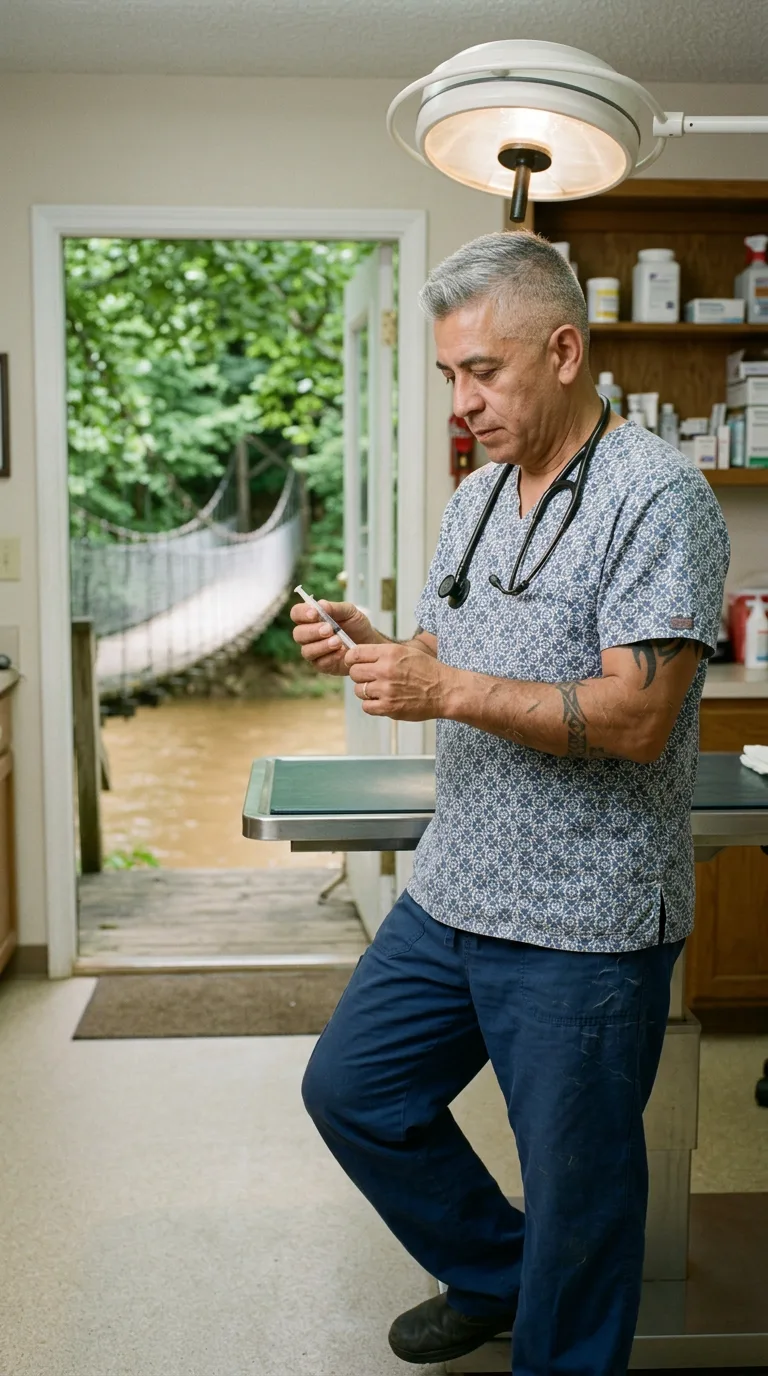
Rarest thing about him: Can't stand still — rare, 1 in 52
Season 0seed 1256591890 · engine v10
Character card
lineage 2NZHHJ
His body-swap story
@colin.hasbrook, wearing Rogelio Casillas, rolled the wheel on and woke up as Aurelio Bautista, spent under a minute in him, then spun the wheel and woke up as James Petrakis
The heat is the first thing you notice about being Rogelio Casillas, the way it always is — Miami afternoon pressing down through a shirt already soaked at the collar, the smell of turned soil and diesel from the tractor parked crooked by the fence. His hands are thick, farmer's hands, knuckles swollen from thirty years of rope and wire, and you have had them less than a minute and already you know what they are for and it bores you. You spun for muscle last time, for sun, for something that felt like plainness after a run of men who complicated themselves. It worked for about forty seconds. Now you are standing in his field with his phone in his pocket buzzing about a delivery he does not care about, and the boredom sits in your chest like something swallowed wrong. Ninety-eight men behind you and this one already feels like a rerun. You take the phone out, thumb the screen, find the site the way Rogelio's hands already seem to know the motion — muscle memory that isn't his, memory that's yours now, riding shotgun in a stranger's fingers. The wheel loads. You do not think about it as a decision. You spin.
You are bent over a stainless table with a syringe between two fingers, and the motion goes wrong — the plunger stutters half a millimeter off true, a thing this hand has not gotten wrong in eleven years — then rights itself, slow, deliberate, checked. You do it again. Again. Ten more times, each one watched like it might fail, on a job that stopped needing watching before some of the animals in this building were born. Outside the open door a footbridge hangs over water gone the color of steeped tea, and green light comes down through leaves onto the cable and the boards, and somewhere behind you a dog is breathing hard in a crate, waiting.
The shirt is what opens him first — the blue print of it against your back, damp at the shoulder blades though the room isn't hot, and with it comes the five-fifteen dark of this morning, his hand pulling this exact shirt off the hanger by feel because the light switch in the closet has been broken since March and he keeps saying he'll fix it. Overnight shift bleeding into a double because Dana called in and there's nobody else within forty minutes who'll come out for a horse with a bowed tendon at 2 a.m. He's fifty-eight and running on four hours and the coffee wore off around ten, and that's the doorway you're standing in now, that specific tiredness, bone-deep and familiar to him the way a scar is familiar.
The syringe in your fingers gives you more — hundreds of afternoons, thousands, a whole education in this one gesture, four years of vet school in Auburn he almost didn't finish, the semester his father was dying back in Perry County and he drove the six hours every weekend without telling anyone how close he came to quitting. He didn't quit. He came home instead, after, and set up here because somebody had to and because Elaine liked the mountains, liked the creek, liked the quiet before she didn't anymore. The tan line on your ring finger throbs faintly with that — eleven years married, four trying for something that never came, the two of them going quiet in different rooms of the same house until quiet became the whole marriage. She's in Lexington now. Better, probably. He sends a card at Christmas and she sends one back and neither of them knows why they bother except that it would feel worse to stop.
The tattoos on your forearms come up warm and half-embarrassed — twenty-three years old, a buddy's kitchen table, tribal ink because it was what the guy knew how to do and Aurelio liked how it looked against his skin after, liked it enough to go back twice more. Small vanity, the only one he'd admit to. His hands, when nothing is asked of them, will not sit still — tapping the table edge, turning a pen, and right now, mid-injection, they are perfectly still because he made them be, because this is the one time in the day he doesn't let them wander. That stillness is its own kind of prayer for a man who still goes to Mass some Sundays and skips others and doesn't examine why either way.
Behind you through the open door the creek runs the color it always runs after rain upstream, and the footbridge sways a little on its cables though nobody's on it, and that sound — cable ticking, water moving, a dog's ragged breath in the crate — is the whole of his life reduced to a room he built himself, a life he did not run from, small and steady and entirely his, and you are standing in the exact center of it holding a needle he trusted his own hand to fill without looking.
You look down at the syringe, then at your fingers wrapped around it — a stranger's hand wearing a stranger's calluses, gray hair falling forward as you tip your head to study skin that isn't yours yet and already is. Ninety-nine now. The dog in the crate shifts, whines low, and you set the syringe down on the tray with a care that isn't quite his and isn't quite yours either.
"Okay," you say, to the empty room, to the water outside, to no one. "Okay, let's see."